NTA JEE Main 8th April 2019 Shift 2
For the following questions answer them individually
NTA JEE Main 8th April 2019 Shift 2 - Question 21
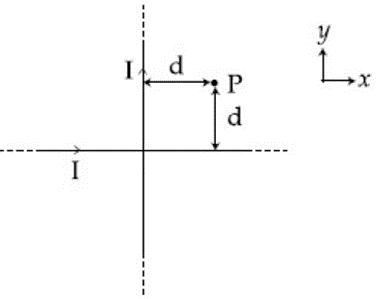
Two very long, straight, and insulated wires are kept at 90° angle from each other in xy-plane as shown in figure. These wires carry currents of equal magnitude I, whose direction are shown in the figure. The net magnetic field at point P will be:
NTA JEE Main 8th April 2019 Shift 2 - Question 22
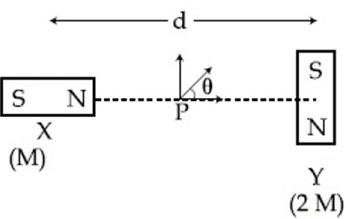
Two magnetic dipoles X and Y are placed at a separation d, with their axes perpendicular to each other. The dipole moment of Y is twice that of X. A particle of charge q is passing through their mid-point P, at angle $$\theta = 45°$$ with the horizontal line, as shown in figure. What would be the magnitude of force on the particle at that instant? (d is much larger than the dimension of the dipole)
NTA JEE Main 8th April 2019 Shift 2 - Question 23
A circuit connected to an ac source of emf $$e = e_0 \sin(100t)$$ with t in seconds, gives a phase difference of $$\frac{\pi}{4}$$ between the emf $$e$$ and current $$i$$. Which of the following circuits will exhibit this?

NTA JEE Main 8th April 2019 Shift 2 - Question 24
The magnetic field of an electromagnetic wave is given by:
$$\vec{B} = 1.6 \times 10^{-6} \cos(2 \times 10^{7}z + 6 \times 10^{15}t)(2\hat{i} + \hat{j}) \frac{Wb}{m^2}$$
The associated electric field will be:
NTA JEE Main 8th April 2019 Shift 2 - Question 25
Calculate the limit of resolution of a telescope objective having a diameter of 200 cm, if it has to detect light of wavelength 500 nm coming from a star.
NTA JEE Main 8th April 2019 Shift 2 - Question 26
A convex lens (of focal length 20 cm) and a concave mirror, having their principal axes along the same lines, are kept 80 cm apart from each other. The concave mirror is to the right of the convex lens. When an object is kept at a distance of 30 cm to the left of the convex lens, its image remains at the same position even if the concave mirror is removed. The maximum distance of the object for which this concave mirror, by itself would produce a virtual image would be:
NTA JEE Main 8th April 2019 Shift 2 - Question 27
A nucleus A, with a finite de-broglie wavelength $$\lambda_A$$, undergoes spontaneous fission into two nuclei B and C of equal mass. B flies in the same direction as that of A, while C flies in the opposite direction with a velocity equal to half of that of B. The de-Broglie wavelengths $$\lambda_B$$ and $$\lambda_C$$ of B and C are respectively:
NTA JEE Main 8th April 2019 Shift 2 - Question 28
The ratio of mass densities of nuclei of $$^{40}$$Ca and $$^{16}$$O is close to:
NTA JEE Main 8th April 2019 Shift 2 - Question 29
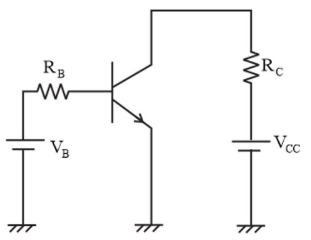
A common emitter amplifier circuit, built using an NPN transistor, is shown in the figure. Its dc current gain is 250, $$R_C = 1$$ k$$\Omega$$ and $$V_{CC} = 10$$ V. The minimum base current for $$V_{CE}$$ to reach saturation is:
NTA JEE Main 8th April 2019 Shift 2 - Question 30
In a line of sight radio communication, a distance of about 50 km is kept between the transmitting and receiving antennas. If the height of the receiving antenna is 70 m, then the minimum height of the transmitting antenna should be: (Radius of the Earth = $$6.4 \times 10^{6}$$ m)