
Join Our JEE Preparation Group
Prep with like-minded aspirants; Get access to free daily tests and study material.
Sign in
Please select an account to continue using cracku.in
↓ →
Join Our JEE Preparation Group
Prep with like-minded aspirants; Get access to free daily tests and study material.
In a simple pendulum experiment for determination of acceleration due to gravity (g), time taken for 20 oscillations is measured by using a watch of 1 second least count. The mean value of time taken comes out to be 30 s. The length of the pendulum is measured by using a meter scale of least count 1 mm and the value obtained is 55.0 cm. The percentage error in the determination of g is close to:
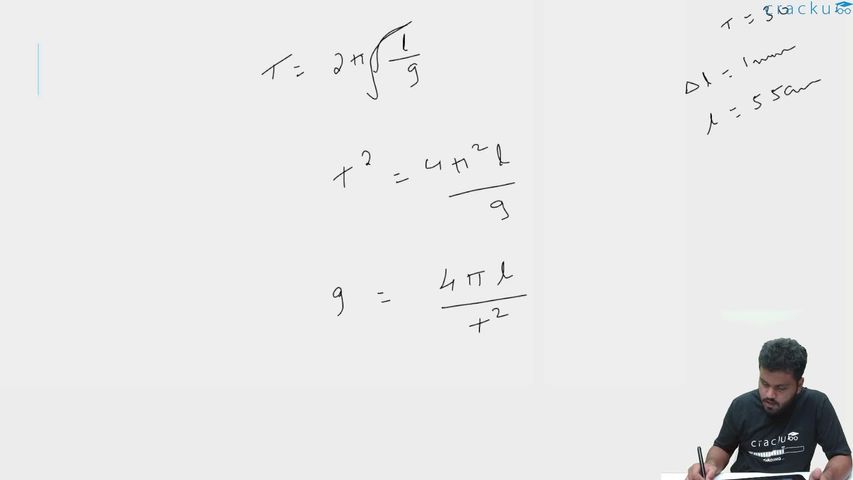
The period of a simple pendulum is connected with the acceleration due to gravity by the well-known formula $$T = 2\pi\sqrt{\dfrac{l}{g}}.$$
This relation is usually rewritten to obtain $$g = \dfrac{4\pi^{2}l}{T^{2}}.$$
Whenever a quantity such as $$g$$ is calculated from measured quantities, its percentage (or fractional) error is obtained by adding the fractional errors of the individual measurements, each multiplied by the power with which that measurement appears. In symbols, if $$g = k\,l^{\,1}T^{-2},$$ then
$$\dfrac{\Delta g}{g} \;=\; \dfrac{\Delta l}{l} \;+\; 2\,\dfrac{\Delta T}{T},$$
where $$\Delta$$ denotes the absolute error in the corresponding quantity.
Step 1: Error in length. The length is measured with a metre scale whose least count is $$1\ \text{mm}=0.1\ \text{cm}.$$ We therefore take
$$\Delta l = 0.1\ \text{cm},\qquad l = 55.0\ \text{cm}.$$
So the fractional (percentage) error in length is
$$\dfrac{\Delta l}{l} = \dfrac{0.1}{55.0} = 1.818\times10^{-3} \;=\; 0.182\%.$$
Step 2: Error in time period. The total time for 20 oscillations is measured with a watch whose least count is $$1\ \text{s}.$$ Thus
$$\Delta t = 1\ \text{s},\qquad t = 30\ \text{s}\;(\text{for }20\text{ oscillations}).$$
The time period is the time for one oscillation:
$$T = \dfrac{t}{20} = \dfrac{30}{20} = 1.5\ \text{s}.$$
Because the division by the exact number 20 introduces no further error, the fractional error in the single-period measurement equals that in the 20-period measurement:
$$\dfrac{\Delta T}{T} = \dfrac{\Delta t}{t} = \dfrac{1}{30} = 3.333\%.$$
Step 3: Combining the errors for $$g$$. Substituting the two fractional errors into
$$\dfrac{\Delta g}{g} = \dfrac{\Delta l}{l} + 2\,\dfrac{\Delta T}{T},$$
we get
$$\dfrac{\Delta g}{g} = 0.182\% + 2 \times 3.333\%.$$
Now,
$$2 \times 3.333\% = 6.666\%.$$
Adding the length contribution:
$$\dfrac{\Delta g}{g} = 6.666\% + 0.182\% = 6.848\%.$$
Rounded to two significant figures, the percentage error is $$\boxed{6.8\%}.$$
Hence, the correct answer is Option B.
Was this solution helpful?
Click on the Email ☝️ to Watch the Video Solution
Create a FREE account and get:
_1.webp)

Educational materials for JEE preparation

Ask our AI anything

AI can make mistakes. Please verify important information.
AI can make mistakes. Please verify important information.


