
Join Our JEE Preparation Group
Prep with like-minded aspirants; Get access to free daily tests and study material.
Sign in
Please select an account to continue using cracku.in
↓ →
Join Our JEE Preparation Group
Prep with like-minded aspirants; Get access to free daily tests and study material.
Let $$\vec{A_1} = 3$$, $$\vec{A_2} = 5$$ and $$\vec{A_1} + \vec{A_2} = 5$$. The value of $$\left(2\vec{A_1} + 3\vec{A_2}\right) \cdot \left(3\vec{A_1} - 2\vec{A_2}\right)$$ is:
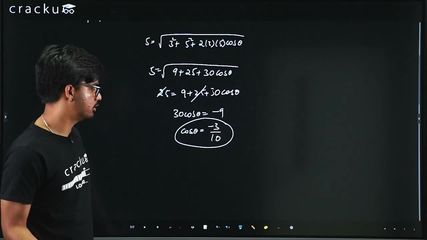
We are told that the magnitudes of the two vectors are $$|\vec A_1| = 3$$ and $$|\vec A_2| = 5$$, while the magnitude of their sum is $$|\vec A_1 + \vec A_2| = 5$$.
First, we need the dot product $$\vec A_1 \cdot \vec A_2$$. We use the standard magnitude formula for the sum of two vectors:
$$|\vec A_1 + \vec A_2|^2 \;=\; |\vec A_1|^2 + |\vec A_2|^2 + 2\,\vec A_1 \cdot \vec A_2.$$
Substituting the given magnitudes, we have
$$5^2 \;=\; 3^2 + 5^2 + 2\,\vec A_1 \cdot \vec A_2.$$
Writing the squares explicitly,
$$25 \;=\; 9 + 25 + 2\,\vec A_1 \cdot \vec A_2.$$
Bringing the numerical terms on the right to the left side,
$$25 - 34 \;=\; 2\,\vec A_1 \cdot \vec A_2.$$
So
$$-9 \;=\; 2\,\vec A_1 \cdot \vec A_2,$$
and therefore
$$\vec A_1 \cdot \vec A_2 \;=\; -\frac{9}{2} = -4.5.$$
We also note the squared magnitudes that will be needed shortly:
$$|\vec A_1|^2 = 3^2 = 9, \qquad |\vec A_2|^2 = 5^2 = 25.$$
Now we must evaluate the required scalar product
$$\bigl(2\vec A_1 + 3\vec A_2\bigr)\,\cdot\,\bigl(3\vec A_1 - 2\vec A_2\bigr).$$
We expand this dot product term by term, using linearity and the commutativity of the dot product ($$\vec A_2 \cdot \vec A_1 = \vec A_1 \cdot \vec A_2$$):
$$\begin{aligned} (2\vec A_1 + 3\vec A_2)\cdot(3\vec A_1 - 2\vec A_2) &= (2\vec A_1)\cdot(3\vec A_1) \;+\; (2\vec A_1)\cdot(-2\vec A_2) \\ &\quad +\; (3\vec A_2)\cdot(3\vec A_1) \;+\; (3\vec A_2)\cdot(-2\vec A_2). \end{aligned}$$
Evaluating each term separately:
$$\begin{aligned} (2\vec A_1)\cdot(3\vec A_1) &= 6\,(\vec A_1\cdot\vec A_1) = 6\,|\vec A_1|^2, \\ (2\vec A_1)\cdot(-2\vec A_2) &= -4\,(\vec A_1\cdot\vec A_2), \\ (3\vec A_2)\cdot(3\vec A_1) &= 9\,(\vec A_2\cdot\vec A_1) = 9\,(\vec A_1\cdot\vec A_2), \\ (3\vec A_2)\cdot(-2\vec A_2) &= -6\,(\vec A_2\cdot\vec A_2) = -6\,|\vec A_2|^2. \end{aligned}$$
Combining these, we obtain
$$\begin{aligned} (2\vec A_1 + 3\vec A_2)\cdot(3\vec A_1 - 2\vec A_2) &= 6|\vec A_1|^2 \;+\; \bigl(-4 + 9\bigr)\,(\vec A_1\cdot\vec A_2) \;-\; 6|\vec A_2|^2 \\ &= 6|\vec A_1|^2 \;+\; 5\,(\vec A_1\cdot\vec A_2) \;-\; 6|\vec A_2|^2. \end{aligned}$$
Now we substitute the numerical values we have found:
$$\begin{aligned} 6|\vec A_1|^2 &= 6 \times 9 = 54, \\ 5\,(\vec A_1\cdot\vec A_2) &= 5 \times (-4.5) = -22.5, \\ -6|\vec A_2|^2 &= -6 \times 25 = -150. \end{aligned}$$
Adding these three results together:
$$ 54 \;+\; (-22.5) \;+\; (-150) \;=\; 54 - 22.5 - 150 = 31.5 - 150 = -118.5. $$
Thus the required scalar product is $$-118.5$$.
Hence, the correct answer is Option B.
Was this solution helpful?
Click on the Email ☝️ to Watch the Video Solution
Create a FREE account and get:
_1.webp)

Educational materials for JEE preparation

Ask our AI anything

AI can make mistakes. Please verify important information.
AI can make mistakes. Please verify important information.


