
Join Our JEE Preparation Group
Prep with like-minded aspirants; Get access to free daily tests and study material.
Sign in
Please select an account to continue using cracku.in
↓ →
Join Our JEE Preparation Group
Prep with like-minded aspirants; Get access to free daily tests and study material.
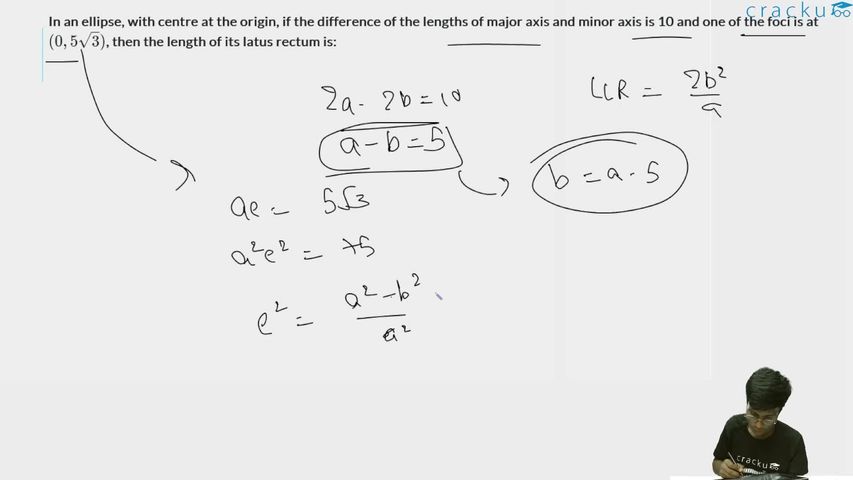
In an ellipse, with centre at the origin, if the difference of the lengths of major axis and minor axis is 10 and one of the foci is at $$(0, 5\sqrt{3})$$, then the length of its latus rectum is:
We are told that the ellipse is centred at the origin, and that one focus is at the point $$(0,\,5\sqrt{3})$$. Because this focus lies on the $$y$$-axis, the major axis must also be along the $$y$$-axis. Hence we may write the standard form of the ellipse as
$$\frac{x^{2}}{b^{2}}+\frac{y^{2}}{a^{2}}=1,$$
where $$a$$ is the semi-major axis, $$b$$ is the semi-minor axis and, by definition of “major”, we always have $$a \gt b$$.
For an ellipse in this orientation, the foci are located at $$(0,\pm c)$$, where the focal distance $$c$$ satisfies the well-known relation
$$c^{2}=a^{2}-b^{2}.$$
From the question, one of the foci is $$(0,5\sqrt{3})$$, so we immediately read off
$$c = 5\sqrt{3}.$$
Therefore, from the focal relation we have
$$a^{2}-b^{2}=c^{2}= \bigl(5\sqrt{3}\bigr)^{2}=25\cdot3=75.$$
Next, the question states that the difference of the lengths of the major and minor axes is $$10$$. The length of the major axis is $$2a$$ and that of the minor axis is $$2b$$, so
$$2a-2b=10 \quad\Longrightarrow\quad a-b=5.$$
We now possess the two equations
$$\begin{cases} a-b = 5,\\[4pt] a^{2}-b^{2} = 75. \end{cases}$$
Notice that $$a^{2}-b^{2}$$ factors conveniently:
$$a^{2}-b^{2}=(a-b)(a+b).$$
Substituting $$a-b=5$$ into this factorisation gives
$$5\,(a+b)=75 \quad\Longrightarrow\quad a+b = \frac{75}{5}=15.$$
We now have the simple linear system
$$\begin{cases} a-b = 5,\\ a+b = 15. \end{cases}$$
Adding the two equations:
$$2a = 20 \quad\Longrightarrow\quad a = 10.$$
Substituting $$a=10$$ into $$a-b=5$$ yields
$$10-b=5 \quad\Longrightarrow\quad b = 5.$$
With $$a=10$$ and $$b=5$$ found, we now compute the required length of the latus rectum. For an ellipse, the standard formula for the length $$L$$ of the latus rectum is
$$L = \frac{2b^{2}}{a}.$$
Substituting the values just obtained:
$$L = \frac{2\,(5)^{2}}{10}= \frac{2\cdot25}{10}= \frac{50}{10}=5.$$
Hence, the correct answer is Option D.
Was this solution helpful?
Click on the Email ☝️ to Watch the Video Solution
Create a FREE account and get:
_1.webp)

Educational materials for JEE preparation

Ask our AI anything

AI can make mistakes. Please verify important information.
AI can make mistakes. Please verify important information.


