
Join Our JEE Preparation Group
Prep with like-minded aspirants; Get access to free daily tests and study material.
Sign in
Please select an account to continue using cracku.in
↓ →
Join Our JEE Preparation Group
Prep with like-minded aspirants; Get access to free daily tests and study material.
The tangent to the parabola $$y^{2} = 4x$$ at the point where it intersects the circle $$x^{2} + y^{2} = 5$$ in the first quadrant, passes through the point:
We begin with the two curves that have been given.
The parabola is $$y^{2}=4x$$ and the circle is $$x^{2}+y^{2}=5.$$
We want the common point of these two curves that lies in the first quadrant, that is, with $$x>0$$ and $$y>0.$$
For a parabola of the form $$y^{2}=4ax,$$ a convenient parametric representation is
$$x = at^{2},\qquad y = 2at.$$
Here the parameter is $$t$$ and the constant $$a=1$$ (because the right side is $$4x = 4\cdot1\cdot x$$). Hence for our parabola we set
$$x = t^{2},\qquad y = 2t.$$
Now we substitute these expressions for $$x$$ and $$y$$ in the equation of the circle $$x^{2}+y^{2}=5.$$ So we have
$$\left(t^{2}\right)^{2} + \left(2t\right)^{2} = 5.$$
Simplifying each term gives
$$t^{4} + 4t^{2} = 5.$$
To solve this quartic, let us set $$u = t^{2}.$$ Because $$t^{2} \ge 0,$$ we will look only for non-negative solutions of $$u.$$ Rewriting, we get
$$u^{2} + 4u - 5 = 0.$$
This is a quadratic in $$u.$$ Using the quadratic formula $$u=\dfrac{-b\pm\sqrt{b^{2}-4ac}}{2a},$$ with $$a=1,\; b=4,\; c=-5,$$ we find
$$u = \dfrac{-4 \pm \sqrt{16 + 20}}{2} = \dfrac{-4 \pm \sqrt{36}}{2} = \dfrac{-4 \pm 6}{2}.$$
That yields two numerical values:
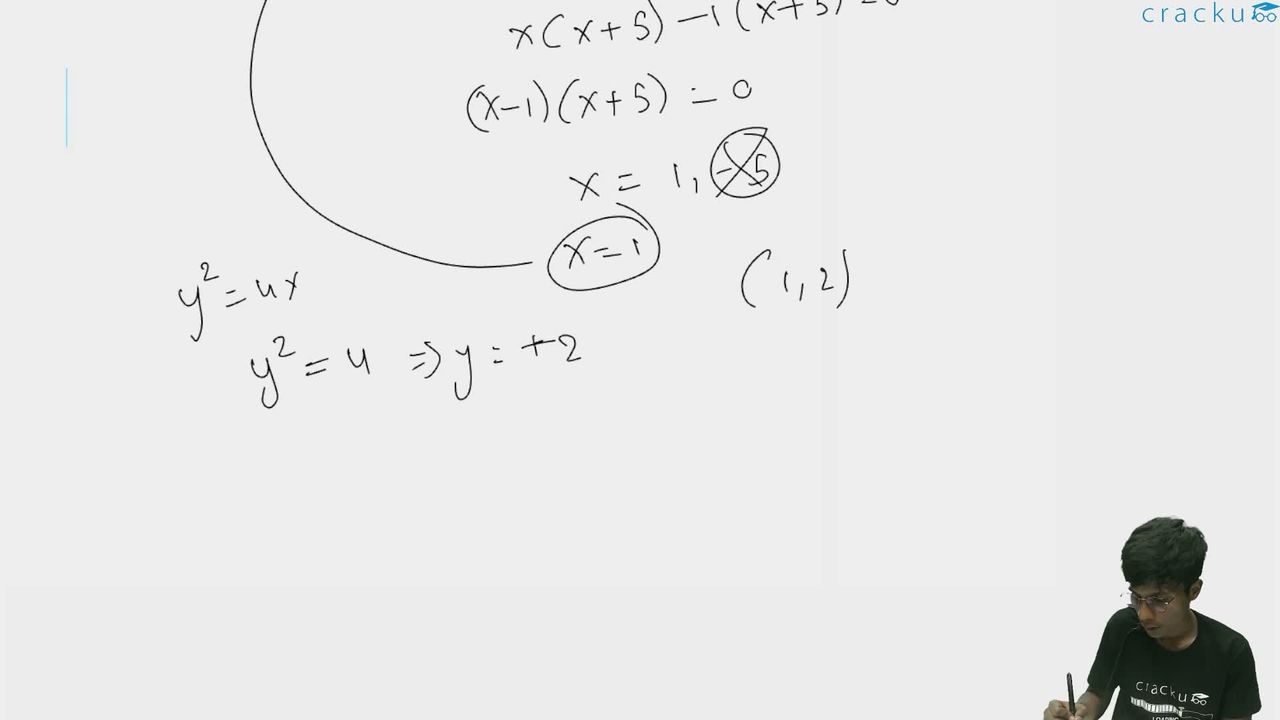
$$u = \dfrac{-4 + 6}{2} = 1, \qquad u = \dfrac{-4 - 6}{2} = -5.$$
Because $$u = t^{2} \ge 0,$$ we discard the negative value $$u=-5$$ and keep $$u=1.$$
Thus $$t^{2}=1 \implies t=\pm1.$$ We need the point in the first quadrant where $$y=2t$$ is positive, so we choose $$t=+1.$$
With $$t=1$$ we obtain the coordinates of the point of intersection: $$x = t^{2} = 1,\qquad y = 2t = 2.$$ Therefore the required point on both the parabola and the circle in the first quadrant is $$P(1,2).$$
Next, we find the equation of the tangent to the parabola at the point $$P.$$
First, we recall that for any curve given implicitly as $$F(x,y)=0,$$ the slope of the tangent is obtained via implicit differentiation: $$\frac{dy}{dx} = -\frac{F_{x}}{F_{y}}.$$
For the parabola $$y^{2}=4x,$$ let us differentiate both sides with respect to $$x.$$ We have
$$\frac{d}{dx}\bigl(y^{2}\bigr) = \frac{d}{dx}\bigl(4x\bigr).$$
Using the power rule and the chain rule,
$$2y\frac{dy}{dx} = 4.$$
Hence
$$\frac{dy}{dx} = \frac{4}{2y} = \frac{2}{y}.$$
At the point $$P(1,2),$$ we substitute $$y=2$$ to get the slope of the tangent:
$$m = \frac{dy}{dx}\Big|_{(1,2)} = \frac{2}{2} = 1.$$
Now we use the point-slope form of a straight line:
$$y - y_{1} = m(x - x_{1}).$$
With $$m = 1,\; (x_{1},y_{1}) = (1,2),$$ this becomes
$$y - 2 = 1\,(x - 1).$$
Simplifying gives
$$y - 2 = x - 1 \;\;\Longrightarrow\;\; y = x + 1.$$
This is the equation of the tangent line to the parabola at the required point.
Finally, we check which of the four option points lies on the line $$y = x + 1.$$ For a point $$\bigl(x_{0},y_{0}\bigr)$$ to be on this line we must have $$y_{0}=x_{0}+1.$$
Let us test each option:
Option A $$\left(\frac14,\frac34\right):$$ $$\frac34 \neq \frac14 + 1 = \frac54,$$ so it is not on the line.
Option B $$\left(-\frac13,\frac43\right):$$ $$\frac43 \neq -\frac13 + 1 = \frac23,$$ so it fails as well.
Option C $$\left(-\frac14,\frac12\right):$$ $$\frac12 \neq -\frac14 + 1 = \frac34,$$ so it is not on the line.
Option D $$\left(\frac34,\frac74\right):$$ Here $$\frac74 = \frac34 + 1,$$ which is exactly satisfied.
Therefore the tangent line $$y = x + 1$$ passes through the point $$\left(\frac34,\frac74\right),$$ which corresponds to Option 4.
Hence, the correct answer is Option 4.
Was this solution helpful?
Click on the Email ☝️ to Watch the Video Solution
Create a FREE account and get:
_1.webp)

Educational materials for JEE preparation

Ask our AI anything

AI can make mistakes. Please verify important information.
AI can make mistakes. Please verify important information.


