
Join Our JEE Preparation Group
Prep with like-minded aspirants; Get access to free daily tests and study material.
Sign in
Please select an account to continue using cracku.in
↓ →
Join Our JEE Preparation Group
Prep with like-minded aspirants; Get access to free daily tests and study material.
The tangent and the normal lines at the point $$(\sqrt{3}, 1)$$ to the circle $$x^{2} + y^{2} = 4$$ and the x-axis form a triangle. The area of this triangle (in square units) is:
We have the circle $$x^{2}+y^{2}=4$$ whose centre is the origin $$(0,0)$$ and whose radius is $$2$$ because $$\sqrt{4}=2$$.
The given point on the circle is $$P(\sqrt{3},\,1)$$. Clearly $$\left(\sqrt{3}\right)^{2}+1^{2}=3+1=4$$, so the point lies on the circle.
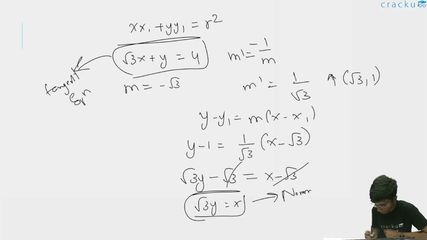
First we write the equation of the tangent to the circle at this point. For a circle $$x^{2}+y^{2}=r^{2}$$, the tangent at $$\bigl(x_{1},y_{1}\bigr)$$ is given by the standard formula
$$x\,x_{1}+y\,y_{1}=r^{2}.$$
Here $$x_{1}=\sqrt{3},\;y_{1}=1,\;r^{2}=4$$, so we substitute:
$$x\bigl(\sqrt{3}\bigr)+y(1)=4.$$
This simplifies to
$$\sqrt{3}\,x+y=4,$$
or, solving for $$y$$ so that the slope is clear,
$$y=4-\sqrt{3}\,x.$$
Next we find the equation of the normal at the same point. The normal is the line through the centre and the point of contact, so it is simply the radius $$OP$$. The slope of $$OP$$ is
$$m_{OP}=\frac{1-0}{\sqrt{3}-0}=\frac{1}{\sqrt{3}}.$$
Using the point-slope form $$y-y_{1}=m(x-x_{1})$$ with point $$P(\sqrt{3},1)$$ and the above slope, we write
$$y-1=\frac{1}{\sqrt{3}}\bigl(x-\sqrt{3}\bigr).$$
Expanding,
$$y-1=\frac{x}{\sqrt{3}}-\frac{\sqrt{3}}{\sqrt{3}}=\frac{x}{\sqrt{3}}-1.$$
Adding $$1$$ to both sides gives
$$y=\frac{x}{\sqrt{3}}.$$
Thus the normal line is
$$y=\frac{1}{\sqrt{3}}\,x.$$
Now we locate the intercepts of the tangent and the normal with the x-axis \;(set $$y=0$$).
For the tangent $$y=4-\sqrt{3}\,x$$ we put $$y=0$$:
$$0=4-\sqrt{3}\,x\quad\Longrightarrow\quad\sqrt{3}\,x=4\quad\Longrightarrow\quad x=\frac{4}{\sqrt{3}}.$$
Hence the tangent meets the x-axis at $$T\!\left(\dfrac{4}{\sqrt{3}},\,0\right).$$
For the normal $$y=\dfrac{x}{\sqrt{3}}$$ we again set $$y=0$$:
$$0=\frac{x}{\sqrt{3}}\quad\Longrightarrow\quad x=0.$$
So the normal meets the x-axis at the origin $$O(0,0).$$
Therefore the triangle in question has vertices $$O(0,0),\;T\!\left(\dfrac{4}{\sqrt{3}},\,0\right),\;P\!\left(\sqrt{3},\,1\right).$$
The base $$OT$$ lies on the x-axis. Its length is the absolute difference of the x-coordinates:
$$OT=\frac{4}{\sqrt{3}}-0=\frac{4}{\sqrt{3}}.$$
The height of the triangle is the perpendicular distance from the vertex $$P$$ to the x-axis. Because the x-axis is the line $$y=0$$, that distance is simply the y-coordinate of $$P$$, namely $$1$$.
Using the formula “area = $$\dfrac12\times\text{base}\times\text{height}$$”, we substitute:
$$\text{Area}=\frac12\left(\frac{4}{\sqrt{3}}\right)(1)=\frac{2}{\sqrt{3}}.$$
Hence, the correct answer is Option B.
Was this solution helpful?
Click on the Email ☝️ to Watch the Video Solution
Create a FREE account and get:
_1.webp)

Educational materials for JEE preparation

Ask our AI anything

AI can make mistakes. Please verify important information.
AI can make mistakes. Please verify important information.


