
Join Our JEE Preparation Group
Prep with like-minded aspirants; Get access to free daily tests and study material.
Sign in
Please select an account to continue using cracku.in
↓ →
Join Our JEE Preparation Group
Prep with like-minded aspirants; Get access to free daily tests and study material.
Suppose that the points $$(h, k)$$, $$(1, 2)$$ and $$(-3, 4)$$ lie on the line $$L_1$$. If a line $$L_2$$ passing through the points $$h, k$$ and $$(4, 3)$$ is perpendicular to $$L_1$$, then $$\frac{k}{h}$$ equals:
We are told that the three points $$(h,k),\,(1,2)$$ and $$(-3,4)$$ all lie on the same straight line, which we shall call $$L_1$$. We first recall the formula for the slope of a line joining two points. If the points are $$\bigl(x_1,y_1\bigr)$$ and $$\bigl(x_2,y_2\bigr)$$, then the slope is
$$m \;=\;\dfrac{y_2-y_1}{x_2-x_1}.$$
Using the two fixed points $$(1,2)$$ and $$(-3,4)$$ on $$L_1$$, we obtain
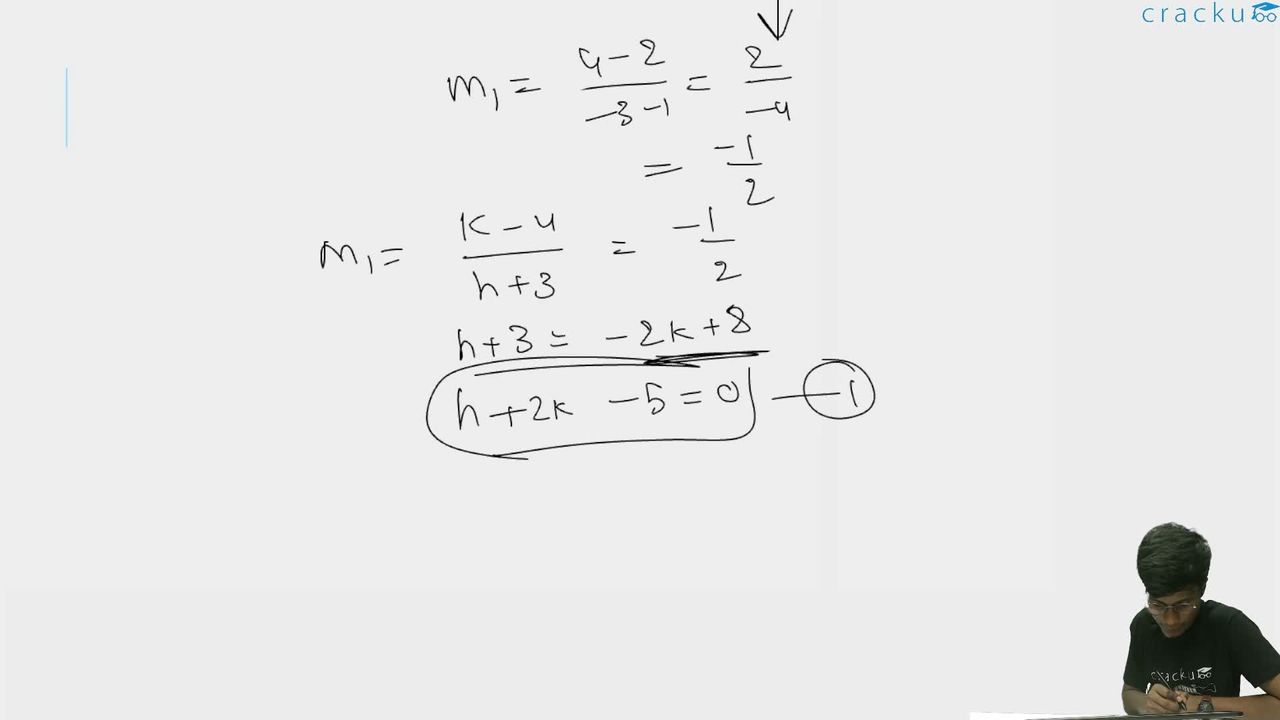
$$m_1 \;=\;\dfrac{\,4-2\,}{\,(-3)-1\,} \;=\;\dfrac{2}{-4} \;=\;-\dfrac12.$$ Hence the slope of $$L_1$$ is $$m_1=-\dfrac12.$$
Because the unknown point $$(h,k)$$ also lies on $$L_1$$, the slope of the segment joining $$(1,2)$$ and $$(h,k)$$ must equal $$-\dfrac12$$ as well. Applying the slope formula once more, we have
$$\dfrac{k-2}{h-1}= -\dfrac12.$$
Cross-multiplying gives
$$2(k-2)=-(h-1).$$
Expanding both sides,
$$2k-4 = -h+1.$$
Bringing every term to one side, we rewrite this as
$$h + 2k = 5.\qquad(1)$$
Now consider the second line $$L_2$$, which passes through $$(h,k)$$ and $$(4,3)$$ and is stated to be perpendicular to $$L_1$$. The slope of $$L_2$$, using the two points that define it, is
$$m_2 \;=\;\dfrac{3-k}{4-h}.$$
For two lines to be perpendicular, the product of their slopes equals $$-1$$. That is, if $$m_1$$ is the slope of the first line and $$m_2$$ is the slope of the second, then
$$m_1\,m_2=-1.$$
Substituting $$m_1=-\dfrac12$$ into this condition, we obtain
$$\Bigl(-\dfrac12\Bigr)\,m_2 = -1.$$
Dividing by $$-\dfrac12$$ (that is, multiplying by $$-2$$) yields
$$m_2 = 2.$$
But we already have $$m_2=\dfrac{3-k}{4-h}$$, so we must have
$$\dfrac{3-k}{4-h}=2.$$
Cross-multiplying once more,
$$3-k = 2(4-h).$$
Expanding the right-hand side,
$$3-k = 8-2h.$$
Collecting terms by moving every variable to the left and constants to the right, we get
$$2h - k = 5.\qquad(2)$$
We now have two linear equations in $$h$$ and $$k$$: $$\begin{aligned} (1)&\;\; h + 2k &= 5,\\ (2)&\;\; 2h - k &= 5. \end{aligned}$$
We solve this system step by step. From equation (1) we isolate $$h$$:
$$h = 5 - 2k.$$
Substituting this expression for $$h$$ into equation (2), we obtain
$$2(5 - 2k) - k = 5.$$
Multiplying out the bracket,
$$10 - 4k - k = 5.$$
Combining the $$k$$ terms,
$$10 - 5k = 5.$$
Subtracting $$10$$ from both sides,
$$-5k = -5.$$
Dividing by $$-5$$ gives
$$k = 1.$$
Returning to $$h = 5 - 2k$$ and substituting $$k=1$$, we find
$$h = 5 - 2(1) = 3.$$
Therefore,
$$\dfrac{k}{h} = \dfrac{1}{3}.$$
Hence, the correct answer is Option D.
Was this solution helpful?
Click on the Email ☝️ to Watch the Video Solution
Create a FREE account and get:
_1.webp)

Educational materials for JEE preparation

Ask our AI anything

AI can make mistakes. Please verify important information.
AI can make mistakes. Please verify important information.


