
Join Our JEE Preparation Group
Prep with like-minded aspirants; Get access to free daily tests and study material.
Sign in
Please select an account to continue using cracku.in
↓ →
Join Our JEE Preparation Group
Prep with like-minded aspirants; Get access to free daily tests and study material.
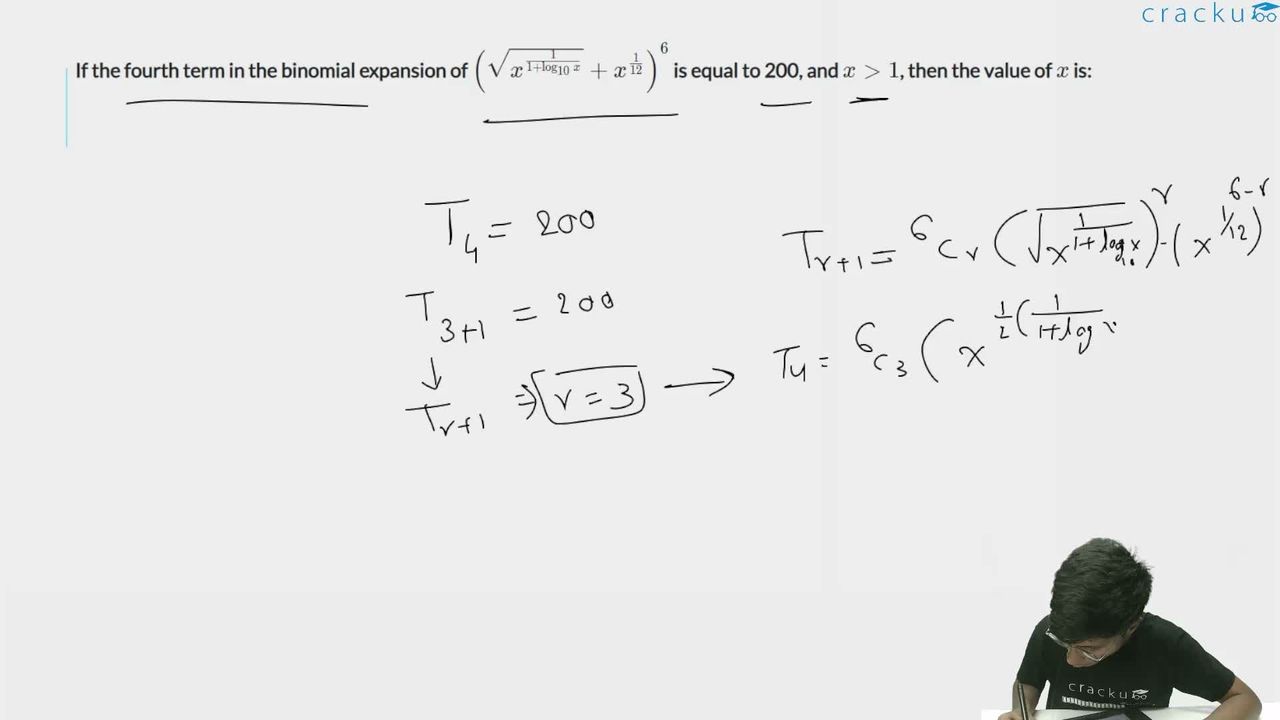
If the fourth term in the binomial expansion of $$\left(\sqrt{x^{\frac{1}{1+\log_{10}x}}} + x^{\frac{1}{12}}\right)^{6}$$ is equal to 200, and $$x > 1$$, then the value of $$x$$ is:
We begin with the given binomial expression
$$\left(\sqrt{x^{\frac{1}{1+\log_{10}x}}}+x^{\frac{1}{12}}\right)^{6}.$$
Write the two terms inside the bracket in a simpler exponential form.
The first term is a square root. Using the law $$\sqrt{A}=A^{1/2},$$ we have
$$\sqrt{x^{\frac{1}{1+\log_{10}x}}}= \left(x^{\frac{1}{1+\log_{10}x}}\right)^{\frac12}=x^{\frac{1}{2(1+\log_{10}x)}}.$$
The second term is already a single power:
$$x^{\frac{1}{12}}.$$
So let us set
$$a = x^{\frac{1}{2(1+\log_{10}x)}}, \qquad b = x^{\frac{1}{12}}.$$
We have the overall power $$\;6,$$ so the binomial theorem gives the general term
$$T_{r+1}= \binom{6}{r}\,a^{\,6-r}\,b^{\,r}\qquad(r=0,1,2,\dots ,6).$$
The fourth term corresponds to $$r=3,$$ because the counting starts from $$r=0.$$ Therefore
$$T_4 = \binom{6}{3}\,a^{\,6-3}\,b^{\,3}=\binom{6}{3}\,a^{3}\,b^{3}.$$
Since $$\binom{6}{3}=20,$$ this becomes
$$T_4 = 20\,a^{3}\,b^{3}.$$
According to the statement of the problem, this fourth term equals 200, i.e.
$$20\,a^{3}\,b^{3}=200.$$
Dividing by 20 gives
$$a^{3}\,b^{3}=10.$$
Taking the cube root on both sides,
$$(ab)=10^{1/3}.$$
Now substitute the explicit expressions for $$a$$ and $$b$$:
$$ab = x^{\frac{1}{2(1+\log_{10}x)}}\;x^{\frac{1}{12}} = x^{\;\frac{1}{2(1+\log_{10}x)}+\frac{1}{12}} = 10^{1/3}.$$
To eliminate the logarithm, set $$x=10^{k}$$ with $$k>0$$ (because $$x>1$$). Then $$\log_{10}x=k.$$
Compute the combined exponent of $$x$$ (or equivalently of $$10^{k}$$). First note
$$\frac{1}{2(1+\log_{10}x)}=\frac{1}{2(1+k)}.$$
Hence the total exponent in the product $$ab$$ is
$$\frac{1}{2(1+k)}+\frac{1}{12}.$$
Put these over a common denominator:
$$\frac{1}{2(1+k)}+\frac{1}{12}= \frac{6}{12(1+k)}+\frac{1+k}{12(1+k)} =\frac{6+1+k}{12(1+k)} =\frac{k+7}{12(1+k)}.$$
Therefore
$$ab = x^{\frac{k+7}{12(1+k)}}=(10^{k})^{\frac{k+7}{12(1+k)}} =10^{\,k\,\frac{k+7}{12(1+k)}}.$$
The equality $$ab=10^{1/3}$$ now reads
$$10^{\,k\,\frac{k+7}{12(1+k)}}=10^{1/3}.$$
Because the bases are equal (both are 10), we set the exponents equal:
$$k\,\frac{k+7}{12(1+k)}=\frac13.$$
Multiply both sides by $$12(1+k)$$ to clear the denominator:
$$k(k+7)=4(1+k).$$
Expand both sides:
$$k^{2}+7k=4k+4.$$
Bring all terms to one side:
$$k^{2}+7k-4k-4=0 \;\;\Longrightarrow\;\; k^{2}+3k-4=0.$$
This is a quadratic equation. Using the quadratic formula $$k=\frac{-b\pm\sqrt{b^{2}-4ac}}{2a}$$ with $$a=1,\;b=3,\;c=-4,$$ we get
$$k=\frac{-3\pm\sqrt{3^{2}-4(1)(-4)}}{2} =\frac{-3\pm\sqrt{9+16}}{2} =\frac{-3\pm5}{2}.$$
The two roots are
$$k=\frac{2}{2}=1,\qquad k=\frac{-8}{2}=-4.$$
Since $$k>0$$ (because $$x>1$$), we take $$k=1.$$ Thus
$$x=10^{k}=10^{1}=10.$$
Hence, the correct answer is Option D.
Was this solution helpful?
Click on the Email ☝️ to Watch the Video Solution
Create a FREE account and get:
_1.webp)

Educational materials for JEE preparation

Ask our AI anything

AI can make mistakes. Please verify important information.
AI can make mistakes. Please verify important information.


