
Join Our JEE Preparation Group
Prep with like-minded aspirants; Get access to free daily tests and study material.
Sign in
Please select an account to continue using cracku.in
↓ →
Join Our JEE Preparation Group
Prep with like-minded aspirants; Get access to free daily tests and study material.
This is a standard Arithmetico-Geometric Progression (AGP) problem.
Let the given sum be $$S$$. Write out the expanded series:
$$S = \frac{1}{2} + \frac{2}{2^2} + \frac{3}{2^3} + \dots + \frac{20}{2^{20}}$$
To solve an AGP, multiply the entire equation by the common ratio of the geometric part (which is $$r = \frac{1}{2}$$) and shift the terms one position to the right:
$$\frac{1}{2}S = \phantom{\frac{1}{2} + } \frac{1}{2^2} + \frac{2}{2^3} + \dots + \frac{19}{2^{20}} + \frac{20}{2^{21}}$$
Now, subtract the second equation from the first:
$$S - \frac{1}{2}S = \frac{1}{2} + \left(\frac{2}{2^2} - \frac{1}{2^2}\right) + \left(\frac{3}{2^3} - \frac{2}{2^3}\right) + \dots + \left(\frac{20}{2^{20}} - \frac{19}{2^{20}}\right) - \frac{20}{2^{21}}$$
$$\frac{1}{2}S = \left[ \frac{1}{2} + \frac{1}{2^2} + \frac{1}{2^3} + \dots + \frac{1}{2^{20}} \right] - \frac{20}{2^{21}}$$
The terms inside the square brackets form a standard Geometric Progression (GP) with first term $$a = \frac{1}{2}$$, common ratio $$r = \frac{1}{2}$$, and $$n = 20$$ terms.
Apply the standard GP sum formula $$S_n = a\left(\frac{1 - r^n}{1 - r}\right)$$ to the bracketed part:
$$\text{GP Sum} = \frac{1}{2} \left[ \frac{1 - (\frac{1}{2})^{20}}{1 - \frac{1}{2}} \right] = \frac{1}{2} \left[ \frac{1 - \frac{1}{2^{20}}}{\frac{1}{2}} \right] = 1 - \frac{1}{2^{20}}$$
Substitute this back into our equation for $$\frac{1}{2}S$$:
$$\frac{1}{2}S = 1 - \frac{1}{2^{20}} - \frac{20}{2^{21}}$$
Simplify the last term by dividing the numerator and denominator by 2:
$$\frac{20}{2^{21}} = \frac{10}{2^{20}}$$
Now combine the fractions:
$$\frac{1}{2}S = 1 - \frac{1}{2^{20}} - \frac{10}{2^{20}}$$
$$\frac{1}{2}S = 1 - \frac{11}{2^{20}}$$
Finally, multiply the entire equation by 2 to isolate $$S$$:
$$S = 2 - \frac{22}{2^{20}}$$
$$S = 2 - \frac{11}{2^{19}}$$
Was this solution helpful?
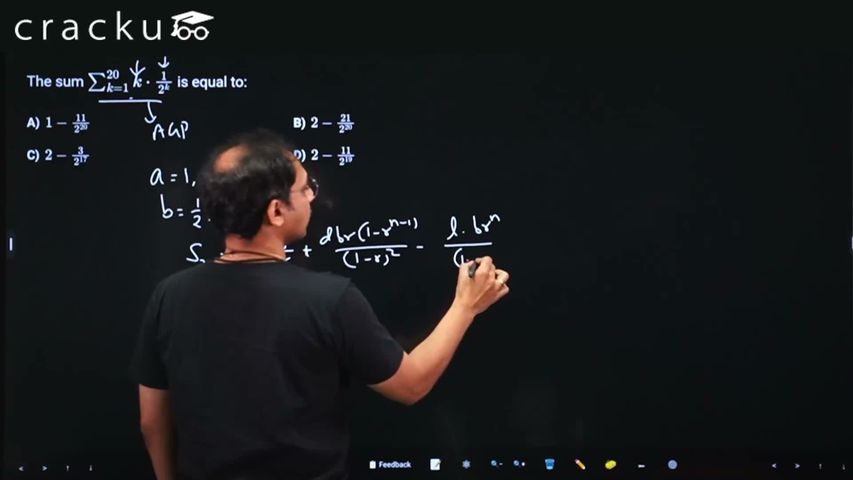
Click on the Email ☝️ to Watch the Video Solution
Create a FREE account and get:
_1.webp)

Educational materials for JEE preparation

Ask our AI anything

AI can make mistakes. Please verify important information.
AI can make mistakes. Please verify important information.


