
Join Our JEE Preparation Group
Prep with like-minded aspirants; Get access to free daily tests and study material.
Sign in
Please select an account to continue using cracku.in
↓ →
Join Our JEE Preparation Group
Prep with like-minded aspirants; Get access to free daily tests and study material.
The number of four-digit numbers strictly greater than 4321 that can be formed using the digits 0, 1, 2, 3, 4, 5 (repetition of digits is allowed) is:
We have six allowed digits: $$0,\;1,\;2,\;3,\;4,\;5.$$ Repetition is allowed, so every position in the four-digit number may repeat a digit that has already appeared.
A four-digit number is of the form $$abcd,$$ where $$a$$ is the thousand-place digit, $$b$$ the hundred-place digit, $$c$$ the ten-place digit and $$d$$ the unit-place digit. Because the number must be a genuine four-digit number, $$a\neq 0.$$
By the fundamental principle of counting, the total number of four-digit numbers that can be written with these digits (without yet imposing the condition “>4321”) is
$$\text{(choices for }a)\times\text{(choices for }b)\times\text{(choices for }c)\times\text{(choices for }d).$$
There are $$5$$ possible non-zero choices for $$a\;(1,2,3,4,5)$$ and $$6$$ choices for each of $$b,c,d.$$ Hence the total possible four-digit numbers that can be formed is
$$5\times6\times6\times6 \;=\;5\times216 \;=\;1080.$$
Now we must select only those numbers that are strictly greater than $$4321.$$ We split the count according to the thousand-place digit $$a.$$
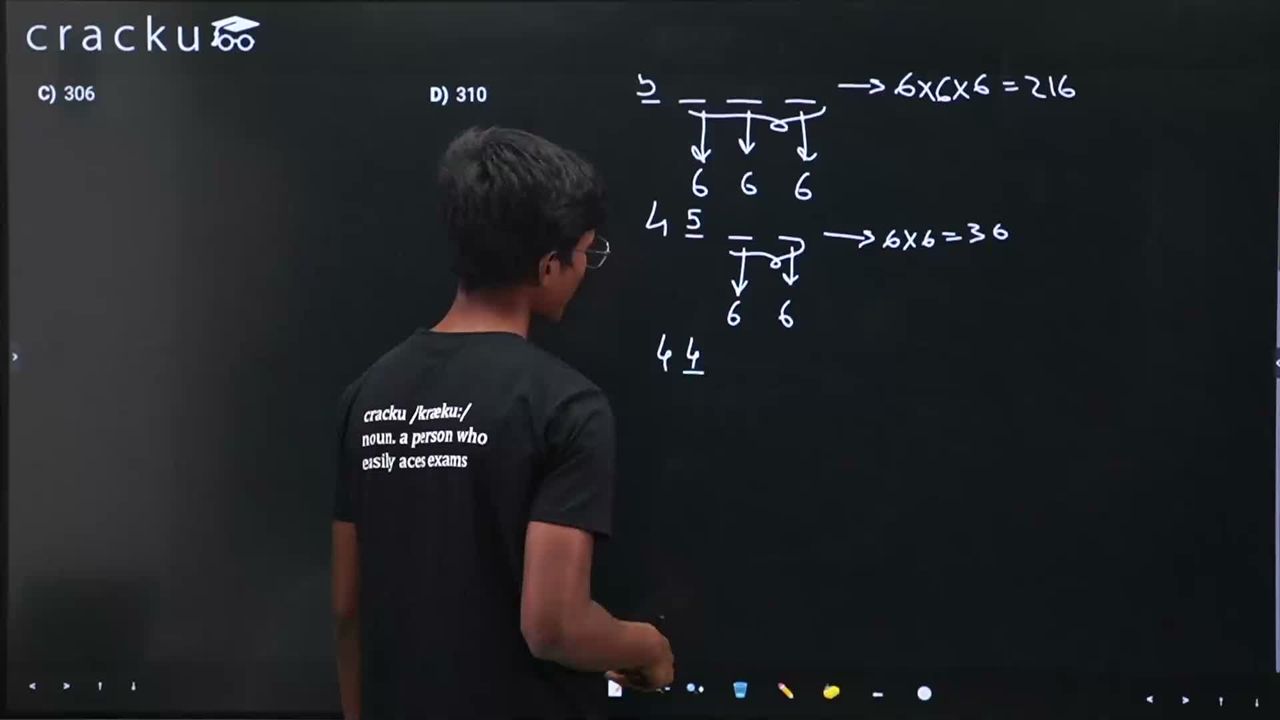
Case 1: $$\boldsymbol{a=5.}$$
Every number beginning with 5 is automatically greater than $$4321.$$ For $$a=5$$ we have
$$1\text{ (choice for }a)\;\times\;6\;\times\;6\;\times\;6 \;=\;216$$ numbers.
Case 2: $$\boldsymbol{a=4.}$$
When $$a=4,$$ the remaining three-digit block $$bcd$$ must exceed $$321$$ so that the entire number $$4bcd$$ exceeds $$4321.$$ First we count all possibilities with $$a=4,$$ then subtract those in which $$bcd\le 321.$$
Total possibilities with $$a=4$$ (no further restriction):
$$1\times6\times6\times6 = 216.$$
We now count the “bad” possibilities where $$bcd\le 321$$ using lexicographic comparison digit by digit.
• If $$b<3$$ (i.e. $$b=0,1,2$$), $$c$$ and $$d$$ can be anything:
$$3\text{ choices for }b\times6\times6 = 108.$$
• If $$b=3,$$ then $$c$$ must be $$\le2.$$ We examine $$c$$ in turn.
- If $$c<2$$ (i.e. $$c=0$$ or $$1$$), $$d$$ can still be any of the six digits:
$$2\times6 = 12.$$
- If $$c=2,$$ the final comparison goes to $$d\le1$$ (because $$321$$ ends with $$1$$):
$$1\times2 = 2.$$
Adding these, the total number of “bad” triples $$bcd\le321$$ is
$$108 + 12 + 2 = 122.$$
Therefore, the required (“good”) numbers with $$a=4$$ are
$$216 - 122 = 94.$$
Case 3: $$\boldsymbol{a\le3.}$$
If $$a$$ is $$1,2,$$ or $$3,$$ the entire number is automatically less than or equal to $$3\_999,$$ and hence cannot exceed $$4321.$$ So there are no admissible numbers in this case.
Combining the admissible cases:
$$\text{Total numbers}>4321 = 216 \;+\; 94 \;=\; 310.$$
Hence, the correct answer is Option D.
Was this solution helpful?
Click on the Email ☝️ to Watch the Video Solution
Create a FREE account and get:
_1.webp)

Educational materials for JEE preparation

Ask our AI anything

AI can make mistakes. Please verify important information.
AI can make mistakes. Please verify important information.


