
Join Our JEE Preparation Group
Prep with like-minded aspirants; Get access to free daily tests and study material.
Sign in
Please select an account to continue using cracku.in
↓ →
Join Our JEE Preparation Group
Prep with like-minded aspirants; Get access to free daily tests and study material.
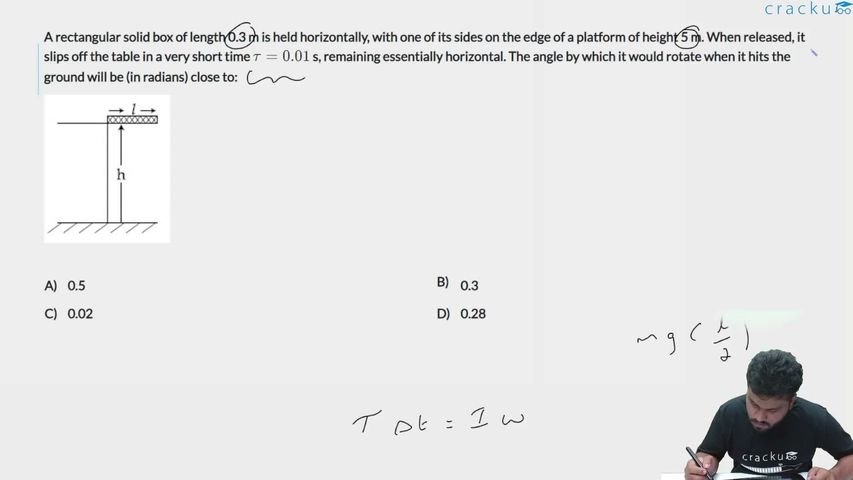
A rectangular solid box of length 0.3 m is held horizontally, with one of its sides on the edge of a platform of height 5 m. When released, it slips off the table in a very short time $$\tau = 0.01$$ s, remaining essentially horizontal. The angle by which it would rotate when it hits the ground will be (in radians) close to:
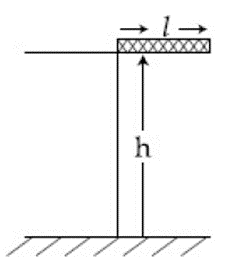
The rotation of the box is determined by the angular impulse it receives as it slips off the platform.
When the box slips off the edge, the torque is provided by gravity acting at its center of mass ($l/2$) relative to the edge of the platform. Using the impulse-momentum theorem for rotation:
$$\text{Angular Impulse} = \Delta L$$
$$\tau \cdot \Delta t = I\omega$$
Where:
Substituting the values:
$$mg \frac{l}{2} \times 0.01 = \frac{ml^2}{3} \omega$$
$$\omega = \frac{3g \times 0.01}{2l}$$
Given $$l = 0.3 \text{ m}$ and $g = 10 \text{ m/s}^2$$:
$$\omega = \frac{3 \times 10 \times 0.01}{2 \times 0.3} = \frac{0.3}{0.6} = 0.5 \text{ rad/s}$$
The box falls from a height $$h = 5 \text{ m}$$. The time taken to hit the ground is:
$$t = \sqrt{\frac{2h}{g}}$$
$$t = \sqrt{\frac{2 \times 5}{10}} = 1 \text{ s}$$
Since the box rotates at a constant angular velocity $\omega$ during its fall:
$$\theta = \omega \cdot t$$$$\theta = 0.5 \times 1$$
$$\boxed{\theta = 0.5 \text{ radian}}$$
Was this solution helpful?
Click on the Email ☝️ to Watch the Video Solution
Create a FREE account and get:
_1.webp)

Educational materials for JEE preparation

Ask our AI anything

AI can make mistakes. Please verify important information.
AI can make mistakes. Please verify important information.


