
Join Our JEE Preparation Group
Prep with like-minded aspirants; Get access to free daily tests and study material.
Sign in
Please select an account to continue using cracku.in
↓ →
Join Our JEE Preparation Group
Prep with like-minded aspirants; Get access to free daily tests and study material.
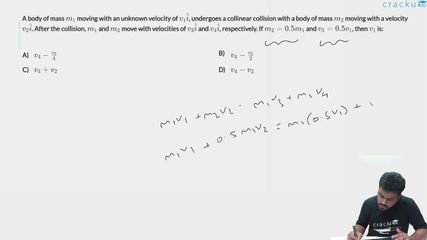
A body of mass $$m_1$$ moving with an unknown velocity of $$v_1 \hat{i}$$, undergoes a collinear collision with a body of mass $$m_2$$ moving with a velocity $$v_2 \hat{i}$$. After the collision, $$m_1$$ and $$m_2$$ move with velocities of $$v_3 \hat{i}$$ and $$v_4 \hat{i}$$, respectively. If $$m_2 = 0.5 m_1$$ and $$v_3 = 0.5 v_1$$, then $$v_1$$ is:
For any collision in a straight line, the total linear momentum before impact equals the total linear momentum after impact. We therefore start with the conservation of momentum equation:
$$m_1 v_1 + m_2 v_2 = m_1 v_3 + m_2 v_4.$$
The data given in the question are
$$m_2 = 0.5\,m_1 \quad\text{and}\quad v_3 = 0.5\,v_1.$$
Substituting these two relations into the momentum equation, we obtain
$$m_1 v_1 + \bigl(0.5\,m_1\bigr) v_2 = m_1 \bigl(0.5\,v_1\bigr) + \bigl(0.5\,m_1\bigr) v_4.$$
Now every term contains the common factor $$m_1,$$ so we divide the entire equation by $$m_1$$ to simplify:
$$v_1 + 0.5\,v_2 = 0.5\,v_1 + 0.5\,v_4.$$
We next collect like terms. First, move the term $$0.5\,v_1$$ on the right side to the left:
$$v_1 - 0.5\,v_1 + 0.5\,v_2 = 0.5\,v_4.$$
Simplifying the coefficients of $$v_1$$ gives
$$0.5\,v_1 + 0.5\,v_2 = 0.5\,v_4.$$
To clear the factor $$0.5$$ from every term, multiply the entire equation by $$2$$:
$$v_1 + v_2 = v_4.$$
Finally, solving for $$v_1$$ yields
$$v_1 = v_4 - v_2.$$
Comparing this expression with the options supplied, we see that it exactly matches Option D.
Hence, the correct answer is Option D.
Was this solution helpful?
Click on the Email ☝️ to Watch the Video Solution
Create a FREE account and get:
_1.webp)

Educational materials for JEE preparation

Ask our AI anything

AI can make mistakes. Please verify important information.
AI can make mistakes. Please verify important information.


