
Join Our JEE Preparation Group
Prep with like-minded aspirants; Get access to free daily tests and study material.
Sign in
Please select an account to continue using cracku.in
↓ →
Join Our JEE Preparation Group
Prep with like-minded aspirants; Get access to free daily tests and study material.
A solid sphere and solid cylinder of identical radii approach an incline with the same linear velocity (see figure). Both roll without slipping all throughout. The two climb maximum heights $$h_{sph}$$ and $$h_{cyl}$$ on the incline. The ratio $$\frac{h_{sph}}{h_{cyl}}$$ is given by:
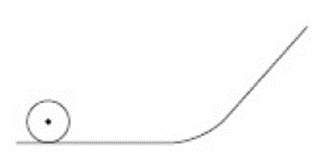
We begin by recalling a basic energy principle: when a body rolls without slipping, its total mechanical energy is the sum of its translational kinetic energy, its rotational kinetic energy, and its gravitational potential energy. On the horizontal surface (before climbing the incline) the potential energy is taken to be zero, so the total energy consists only of the two kinetic terms. As the body climbs the incline, it slows down, and at the highest point its speed becomes zero. At that instant the whole initial kinetic energy has converted into gravitational potential energy $$mgh$$.
Let the common mass of the bodies be $$m$$, the common radius be $$r$$ and the common initial linear speed be $$v$$. The acceleration due to gravity is denoted by $$g$$. We now treat the two bodies separately.
For the solid sphere, we first state the moment of inertia formula for a solid sphere of radius $$r$$ about its centre:
$$I_{sph}=\frac{2}{5}mr^{2}.$$
Because the sphere rolls without slipping, the condition $$v=\omega r$$ holds, where $$\omega$$ is the angular speed. Therefore $$\omega=\dfrac{v}{r}$$.
The total kinetic energy of the sphere just before climbing is:
$$ \begin{aligned} K_{sph} &= \text{translational KE} + \text{rotational KE} \\ &= \frac{1}{2}mv^{2} + \frac{1}{2}I_{sph}\omega^{2}. \end{aligned} $$
Substituting $$I_{sph}=\dfrac{2}{5}mr^{2}$$ and $$\omega=\dfrac{v}{r}$$, we obtain
$$ \begin{aligned} K_{sph} &= \frac{1}{2}mv^{2} + \frac{1}{2}\left(\frac{2}{5}mr^{2}\right)\left(\frac{v}{r}\right)^{2} \\ &= \frac{1}{2}mv^{2} + \frac{1}{2}\left(\frac{2}{5}m\right)v^{2} \\ &= \frac{1}{2}mv^{2} + \frac{1}{5}mv^{2} \\ &= \left(\frac{5}{10} + \frac{2}{10}\right)mv^{2} \\ &= \frac{7}{10}mv^{2}. \end{aligned} $$
At the maximum height $$h_{sph}$$ the velocity is zero, hence energy conservation gives
$$mgh_{sph} = \frac{7}{10}mv^{2} \;\;\Longrightarrow\;\; h_{sph} = \frac{7}{10}\frac{v^{2}}{g}.$$
For the solid cylinder, we now state its moment of inertia formula about its central axis:
$$I_{cyl}=\frac{1}{2}mr^{2}.$$
Using the same rolling condition $$\omega=\dfrac{v}{r}$$, the cylinder’s kinetic energy is
$$ \begin{aligned} K_{cyl} &= \frac{1}{2}mv^{2} + \frac{1}{2}I_{cyl}\omega^{2} \\ &= \frac{1}{2}mv^{2} + \frac{1}{2}\left(\frac{1}{2}mr^{2}\right)\left(\frac{v}{r}\right)^{2} \\ &= \frac{1}{2}mv^{2} + \frac{1}{2}\left(\frac{1}{2}m\right)v^{2} \\ &= \frac{1}{2}mv^{2} + \frac{1}{4}mv^{2} \\ &= \left(\frac{2}{4} + \frac{1}{4}\right)mv^{2} \\ &= \frac{3}{4}mv^{2}. \end{aligned} $$
Converting this kinetic energy into gravitational potential energy at the maximum height $$h_{cyl}$$ gives
$$mgh_{cyl} = \frac{3}{4}mv^{2} \;\;\Longrightarrow\;\; h_{cyl} = \frac{3}{4}\frac{v^{2}}{g}.$$
We are asked for the ratio $$\dfrac{h_{sph}}{h_{cyl}}$$. Substituting the two heights we derived, we have
$$ \begin{aligned} \frac{h_{sph}}{h_{cyl}} &= \frac{\dfrac{7}{10}\dfrac{v^{2}}{g}}{\dfrac{3}{4}\dfrac{v^{2}}{g}} \\ &= \frac{7}{10}\times\frac{4}{3} \\ &= \frac{28}{30} \\ &= \frac{14}{15}. \end{aligned} $$
The numerical value $$\dfrac{14}{15}$$ matches Option C.
Hence, the correct answer is Option C.
Was this solution helpful?
Create a FREE account and get:
_1.webp)

Educational materials for JEE preparation

Ask our AI anything

AI can make mistakes. Please verify important information.
AI can make mistakes. Please verify important information.


