
Join Our JEE Preparation Group
Prep with like-minded aspirants; Get access to free daily tests and study material.
Sign in
Please select an account to continue using cracku.in
↓ →
Join Our JEE Preparation Group
Prep with like-minded aspirants; Get access to free daily tests and study material.
Two very long, straight, and insulated wires are kept at 90° angle from each other in xy-plane as shown in figure. These wires carry currents of equal magnitude I, whose direction are shown in the figure. The net magnetic field at point P will be:
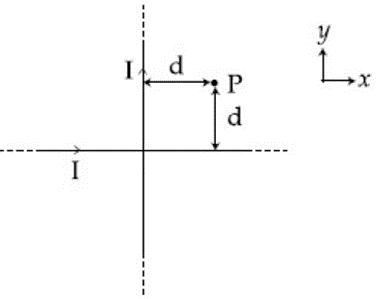
Based on the principle of superposition and the Right-Hand Thumb Rule, the net magnetic field at point P is calculated as follows:
The magnetic field $\vec{B}$ due to a long straight wire at a distance $d$ is given by:
$$B = \frac{\mu_0 i}{2\pi d}$$
Assuming point P is at an equal distance $d$ from both wires in the xy-plane:
Net Magnetic Field:
The total magnetic field is the vector sum of the individual fields:
$$\vec{B}_{\text{net}} = \vec{B}_1 + \vec{B}_2$$
$$\vec{B}_{\text{net}} = \frac{\mu_0 i}{2\pi d} \hat{k} - \frac{\mu_0 i}{2\pi d} \hat{k}$$
$$\boxed{\vec{B}_{\text{net}} = 0}$$
Was this solution helpful?
Create a FREE account and get:
_1.webp)

Educational materials for JEE preparation

Ask our AI anything

AI can make mistakes. Please verify important information.
AI can make mistakes. Please verify important information.


