
Join Our JEE Preparation Group
Prep with like-minded aspirants; Get access to free daily tests and study material.
Sign in
Please select an account to continue using cracku.in
↓ →
Join Our JEE Preparation Group
Prep with like-minded aspirants; Get access to free daily tests and study material.
Two magnetic dipoles X and Y are placed at a separation d, with their axes perpendicular to each other. The dipole moment of Y is twice that of X. A particle of charge q is passing through their mid-point P, at angle $$\theta = 45°$$ with the horizontal line, as shown in figure. What would be the magnitude of force on the particle at that instant? (d is much larger than the dimension of the dipole)
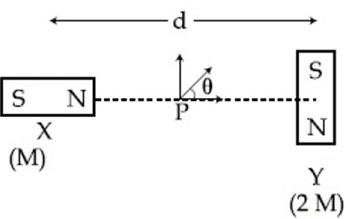
The magnetic field at the midpoint P between the two dipoles is calculated using the formulas for axial and equatorial fields.
Let the dipole moment of X be M. Then the dipole moment of Y is 2M. The distance from each dipole to the midpoint P is r = d/2.
1. Magnetic field due to Dipole X (Axial point):
$$B_1 = \frac{\mu_0}{4\pi} \frac{2M}{(d/2)^3}$$
This field acts horizontally (along the axis of X).
2. Magnetic field due to Dipole $Y$ (Equatorial point):
$$B_2 = \frac{\mu_0}{4\pi} \frac{(2M)}{(d/2)^3}$$
This field acts vertically (perpendicular to the axis of Y).
3. Net Magnetic Field ($$B_{\text{net}}$$):
Since $$B_1 = B_2$$ and they are perpendicular to each other, the net magnetic field vector makes an angle with the horizontal:
$$\tan \phi = \frac{B_2}{B_1} = 1 \implies \phi = 45^\circ$$
4. Magnetic Force on the Particle:
The force on a charge $q$ moving with velocity $$\vec{v}$$ in a magnetic field $$\vec{B}$$ is:
$$\vec{F} = q(\vec{v} \times \vec{B})$$
$$F = qvB \sin \alpha$$
The particle is moving at an angle $$\theta = 45^\circ$$ with the horizontal, which is the same direction as $$\vec{B}_{\text{net}}$$. Therefore, the angle $$\alpha$$ between velocity and the magnetic field is $$0^\circ$$.
$$\sin(0^\circ) = 0$$
$$\boxed{F = 0}$$
Was this solution helpful?
Create a FREE account and get:
_1.webp)

Educational materials for JEE preparation

Ask our AI anything

AI can make mistakes. Please verify important information.
AI can make mistakes. Please verify important information.


