
Join Our JEE Preparation Group
Prep with like-minded aspirants; Get access to free daily tests and study material.
Sign in
Please select an account to continue using cracku.in
↓ →
Join Our JEE Preparation Group
Prep with like-minded aspirants; Get access to free daily tests and study material.
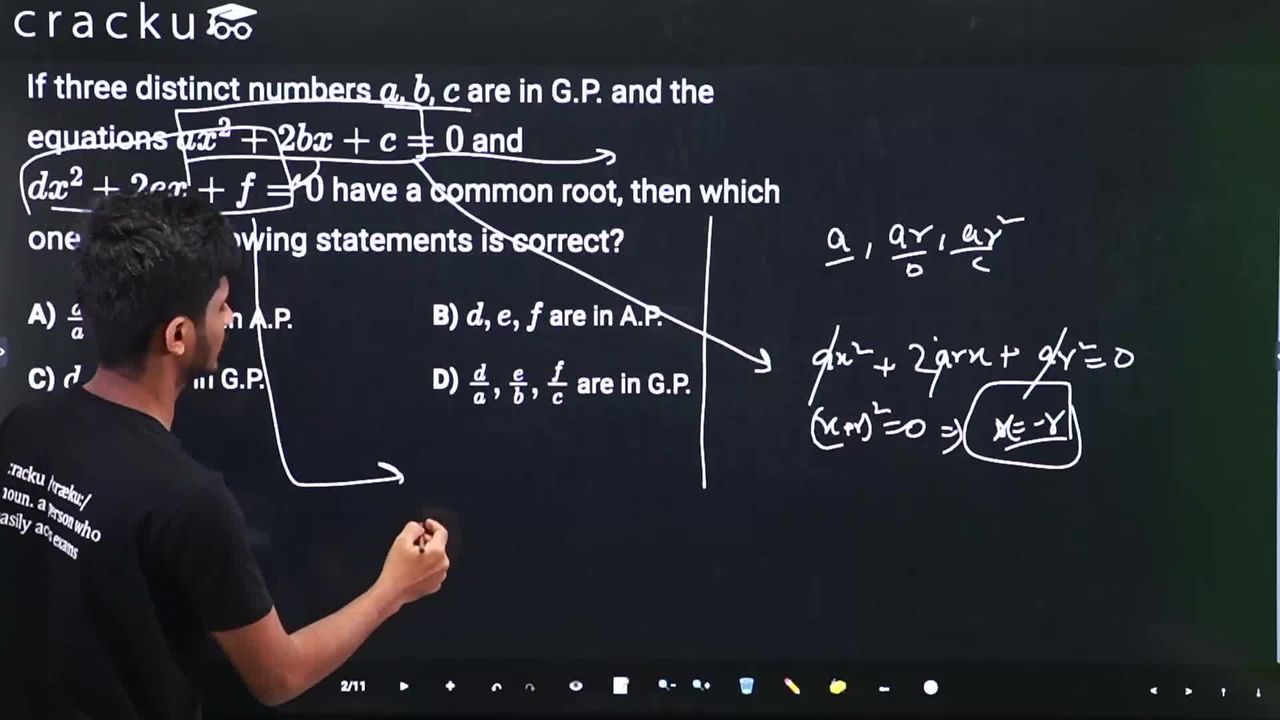
If three distinct numbers $$a$$, $$b$$, $$c$$ are in G.P. and the equations $$ax^{2} + 2bx + c = 0$$ and $$dx^{2} + 2ex + f = 0$$ have a common root, then which one of the following statements is correct?
We are told that the three non-zero and distinct numbers $$a$$, $$b$$, $$c$$ are in geometric progression (G.P.).
When three numbers are in G.P. we always write them as
$$b = ar \quad\text{and}\quad c = ar^{2},$$
where $$r \neq 1$$ is the common ratio. (Because the numbers are distinct, $$r$$ cannot be $$1$$.)
The first quadratic equation is
$$ax^{2}+2bx+c = 0.$$
Substituting $$b = ar$$ and $$c = ar^{2}$$ we obtain
$$a x^{2} + 2(ar)x + ar^{2} = 0.$$
Now we divide every term by $$a\;( \neq 0 )$$ to simplify:
$$x^{2} + 2rx + r^{2} = 0.$$
Next we examine the nature of this quadratic. Its discriminant is
$$\Delta = (2r)^{2} - 4(1)(r^{2}) = 4r^{2} - 4r^{2} = 0.$$
Because the discriminant is zero, the quadratic has a repeated (double) root. Using the standard relation “for $$x^{2}+2px+p^{2}=0$$ the root is $$x=-p$$”, we get
$$x = -r.$$
Thus the first equation has the single root
$$\alpha = -r.$$
The statement of the question says that the two quadratics
$$ax^{2}+2bx+c = 0 \quad\text{and}\quad dx^{2}+2ex+f = 0$$
have a common root. Therefore that common root must be $$\alpha = -r$$. Hence $$x=-r$$ must satisfy the second equation, giving
$$d(-r)^{2} + 2e(-r) + f = 0.$$
Simplifying term by term we have
$$dr^{2} - 2er + f = 0.$$
We now want to investigate the three numbers
$$\frac{d}{a},\quad\frac{e}{b},\quad\frac{f}{c}.$$
Remember that $$b = ar$$ and $$c = ar^{2}$$, so
$$\frac{e}{b} = \frac{e}{ar},\quad\frac{f}{c} = \frac{f}{ar^{2}}.$$
To show that these three numbers are in arithmetic progression (A.P.) we must verify the defining relation for an A.P.:
$$2\left(\frac{e}{b}\right) = \frac{d}{a} + \frac{f}{c}.$$
Let us compute each side separately and then compare.
Left side:
$$2\!\left(\frac{e}{b}\right) = 2\!\left(\frac{e}{ar}\right) = \frac{2e}{ar}.$$
Right side:
$$\frac{d}{a} + \frac{f}{c} = \frac{d}{a} + \frac{f}{ar^{2}}.$$
To compare them conveniently, we eliminate denominators by multiplying every term by $$ar^{2}$$:
Left side × $$ar^{2}$$:
$$\frac{2e}{ar}\; \cdot ar^{2} = 2er.$$
Right side × $$ar^{2}$$:
$$\left(\frac{d}{a}\right)ar^{2} + \left(\frac{f}{ar^{2}}\right)ar^{2} = dr^{2} + f.$$
Hence the A.P. condition becomes the equality
$$2er = dr^{2} + f.$$
But this is exactly the relation we obtained earlier from the common-root condition $$dr^{2} - 2er + f = 0$$, because that equation rearranges to
$$dr^{2} + f = 2er.$$
Since the required equality holds, the three numbers $$\dfrac{d}{a},\ \dfrac{e}{b},\ \dfrac{f}{c}$$ are indeed in arithmetic progression. None of the other options can be justified by the given information.
Hence, the correct answer is Option A.
Was this solution helpful?
Click on the Email ☝️ to Watch the Video Solution
Create a FREE account and get:
_1.webp)

Educational materials for JEE preparation

Ask our AI anything

AI can make mistakes. Please verify important information.
AI can make mistakes. Please verify important information.


