
Join Our JEE Preparation Group
Prep with like-minded aspirants; Get access to free daily tests and study material.
Sign in
Please select an account to continue using cracku.in
↓ →
Join Our JEE Preparation Group
Prep with like-minded aspirants; Get access to free daily tests and study material.
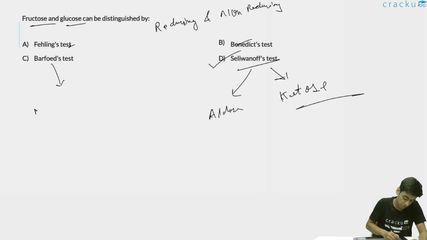
We are asked to decide which one of the four classical qualitative tests can tell fructose apart from glucose. Let us first recall the structural difference between the two sugars. Glucose is an aldohexose; that is, the carbonyl group is an aldehyde, written schematically as $$\mathrm{-CHO}$$ at the C-1 position. Fructose, on the other hand, is a ketohexose; its carbonyl group is a ketone, written as $$\mathrm{>C=O}$$ at the C-2 position. Therefore any test that responds differently to an aldose versus a ketose will serve to distinguish the two.
We now examine each test:
• Fehling’s test and Benedict’s test are both based on the same principle: an alkaline cupric ion complex $$\mathrm{Cu^{2+}}$$ is reduced by any reducing sugar to give a red precipitate of cuprous oxide $$\mathrm{Cu_2O}$$. Both glucose and fructose possess free or enolisable carbonyl groups, so both reduce the reagent: $$\text{Reducing sugar} + 2\;\mathrm{Cu^{2+}} + 5\;\mathrm{OH^-} \;\longrightarrow\; \text{oxidized sugar} + \mathrm{Cu_2O}\downarrow + 3\;\mathrm{H_2O}.$$ Since the outcome is the same for the two sugars, neither Fehling’s nor Benedict’s test can differentiate them.
• Barfoed’s test employs a weakly acidic solution of cupric acetate to distinguish monosaccharides from disaccharides because monosaccharides reduce $$\mathrm{Cu^{2+}}$$ more rapidly under mildly acidic conditions. Both glucose and fructose are monosaccharides, so both will give the same positive result; again, no distinction is possible.
• Seliwanoff’s test is specifically designed to distinguish ketoses from aldoses. The reagent is a solution of resorcinol in concentrated hydrochloric acid. Under these strongly acidic conditions, a ketose such as fructose undergoes dehydration much faster than an aldose like glucose, producing hydroxymethylfurfural, which then condenses with resorcinol to yield a characteristic cherry-red complex: $$\text{Ketose} \;\xrightarrow[\text{conc. } \mathrm{HCl}]{\text{dehydration}} \text{hydroxymethylfurfural}$$ $$\text{hydroxymethylfurfural} + \text{resorcinol} \;\longrightarrow\; \text{red condensation product}.$$ An aldose forms the same furfural derivative far more slowly, so glucose either remains colorless or develops only a faint pink colour after a prolonged period. Thus, by observing the rapid appearance of an intense red colour with fructose and its absence (or delayed appearance) with glucose, the two sugars can be clearly distinguished.
Because only Seliwanoff’s test reacts differently with fructose and glucose, it is the unique choice that fulfills the requirement.
Hence, the correct answer is Option D.
Was this solution helpful?
Click on the Email ☝️ to Watch the Video Solution
Create a FREE account and get:
_1.webp)

Educational materials for JEE preparation

Ask our AI anything

AI can make mistakes. Please verify important information.
AI can make mistakes. Please verify important information.


