
Join Our JEE Preparation Group
Prep with like-minded aspirants; Get access to free daily tests and study material.
Sign in
Please select an account to continue using cracku.in
↓ →
Join Our JEE Preparation Group
Prep with like-minded aspirants; Get access to free daily tests and study material.
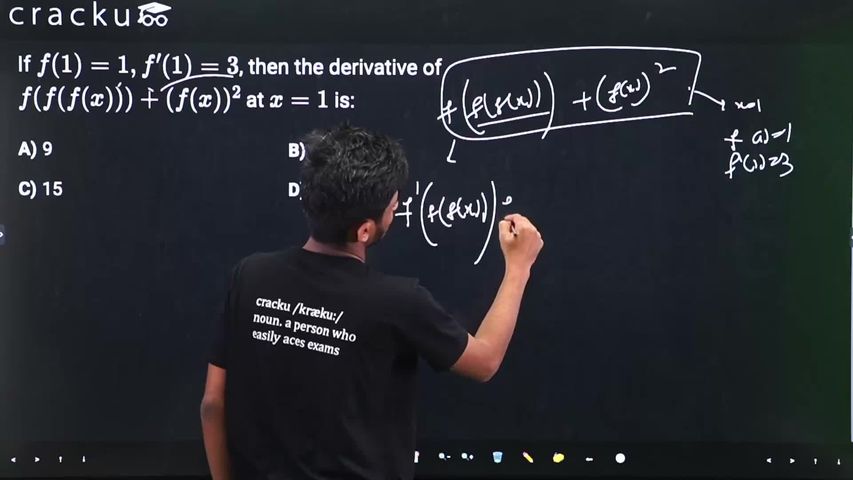
If $$f(1) = 1, f'(1) = 3$$, then the derivative of $$f(f(f(x))) + (f(x))^{2}$$ at $$x = 1$$ is:
We have to find the derivative at $$x = 1$$ of the function
$$g(x)=f\!\left(f\!\left(f(x)\right)\right)+\left(f(x)\right)^{2}.$$
The given data are
$$f(1)=1 \qquad\text{and}\qquad f'(1)=3.$$
First we tackle the derivative of the composite term $$f\!\left(f\!\left(f(x)\right)\right).$$
By the chain rule, which states that if $$h(x)=f\!\bigl(u(x)\bigr)$$ then $$h'(x)=f'\!\bigl(u(x)\bigr)\,u'(x),$$ we proceed step by step through every layer of the composition.
Let us denote successively
$$u(x)=f(x),$$
$$v(x)=f(u(x))=f\!\left(f(x)\right),$$
so that
$$f\!\left(f\!\left(f(x)\right)\right)=f(v(x)).$$
Applying the chain rule twice in succession we write
$$\frac{d}{dx}\,f\!\left(f\!\left(f(x)\right)\right) =f'\!\bigl(v(x)\bigr)\cdot v'(x).$$
Now we still need $$v'(x).$$ Again by the chain rule,
$$v'(x)=\frac{d}{dx}\,f\!\left(f(x)\right)=f'\!\bigl(u(x)\bigr)\cdot u'(x).$$
Finally $$u'(x)=f'(x)$$ directly from the definition of $$u(x).$$ Collecting all three factors, the complete derivative of the triple composition is
$$\frac{d}{dx}\,f\!\left(f\!\left(f(x)\right)\right) =f'\!\bigl(v(x)\bigr)\;f'\!\bigl(u(x)\bigr)\;f'(x).$$
In compact form, using the original names, this is
$$\frac{d}{dx}\,f\!\left(f\!\left(f(x)\right)\right) =f'\!\Bigl(f\!\bigl(f(x)\bigr)\Bigr)\;f'\!\bigl(f(x)\bigr)\;f'(x).$$
Now we evaluate this at $$x=1.$$
First compute the necessary inner values:
$$f(1)=1\quad\text{(given)}.$$
Therefore $$f\!\bigl(f(1)\bigr)=f(1)=1$$ again.
Now substitute these into each derivative factor one by one:
$$f'\!\Bigl(f\!\bigl(f(1)\bigr)\Bigr) =f'(1)=3,$$
$$f'\!\bigl(f(1)\bigr)=f'(1)=3,$$
and directly $$f'(1)=3.$$
Hence
$$\left.\frac{d}{dx}\,f\!\left(f\!\left(f(x)\right)\right)\right|_{x=1} =3 \times 3 \times 3 = 27.$$
Next, we differentiate the square term $$\bigl(f(x)\bigr)^{2}.$$ Using the rule for a square, namely $$\displaystyle\frac{d}{dx}\bigl(u^{2}\bigr)=2u\,u',$$ with $$u=f(x),$$ we get
$$\frac{d}{dx}\left(f(x)\right)^{2}=2\,f(x)\,f'(x).$$
Evaluating at $$x=1$$ gives
$$2\,f(1)\,f'(1)=2 \times 1 \times 3 = 6.$$
Now we add the two derivative parts to obtain the derivative of the whole function $$g(x)$$ at $$x=1$$:
$$g'(1)=27+6=33.$$
Hence, the correct answer is Option D.
Was this solution helpful?
Click on the Email ☝️ to Watch the Video Solution
Create a FREE account and get:
_1.webp)

Educational materials for JEE preparation

Ask our AI anything

AI can make mistakes. Please verify important information.
AI can make mistakes. Please verify important information.


