
Join Our JEE Preparation Group
Prep with like-minded aspirants; Get access to free daily tests and study material.
Sign in
Please select an account to continue using cracku.in
↓ →
Join Our JEE Preparation Group
Prep with like-minded aspirants; Get access to free daily tests and study material.
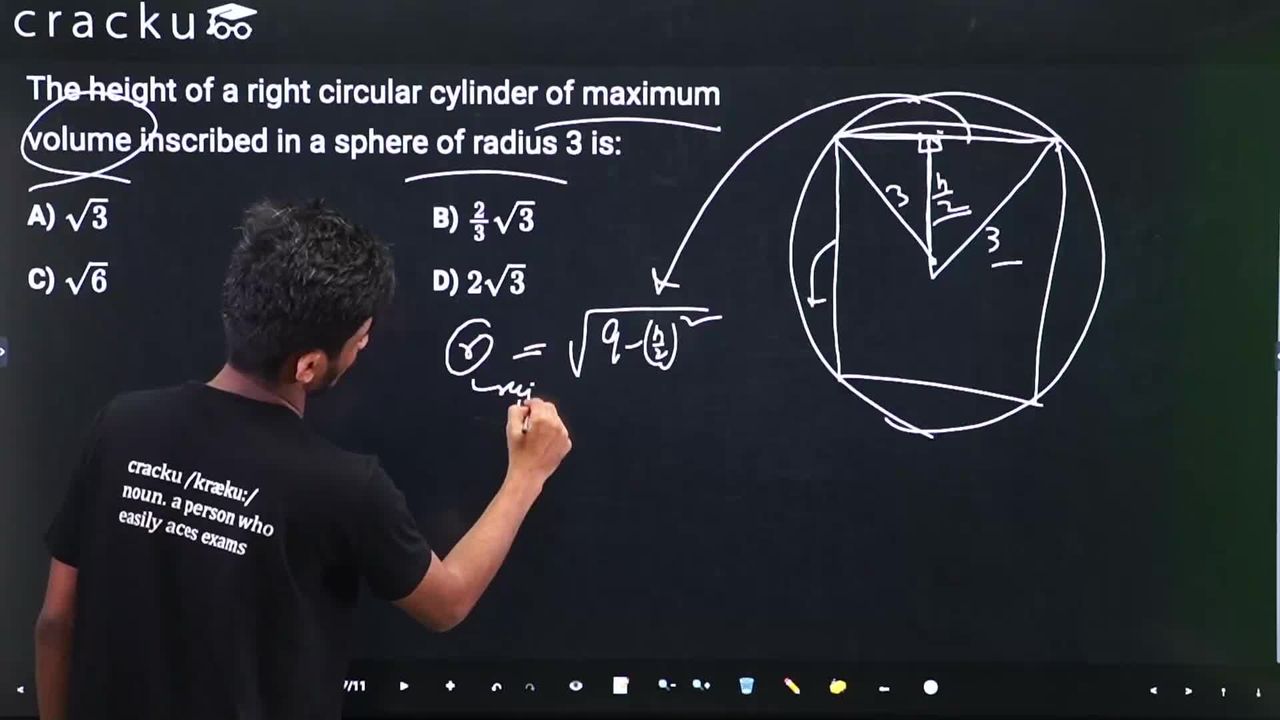
The height of a right circular cylinder of maximum volume inscribed in a sphere of radius 3 is:
Let the given sphere have centre at the origin and radius $$R=3$$.
Inside this sphere we place a right circular cylinder whose base radius is $$r$$ and whose height is $$h$$. The symmetry axis of the cylinder coincides with a diameter of the sphere, so its top face is at $$z=\dfrac h2$$ and its bottom face is at $$z=-\dfrac h2$$.
A point on the rim of the top face has co-ordinates $$\bigl(r,\,0,\,\dfrac h2\bigr)$$. Because this point lies on the surface of the sphere, its distance from the origin must equal the sphere’s radius. Therefore
$$r^{2}+\left(\dfrac h2\right)^{2}=R^{2}.$$
Substituting $$R=3$$ we have
$$r^{2}+\dfrac{h^{2}}{4}=9.$$
Solving for $$r^{2}$$ gives
$$r^{2}=9-\dfrac{h^{2}}{4}.$$
Now we write the volume of the cylinder. The standard formula for the volume of a right circular cylinder is
$$V=\pi r^{2}h.$$
Substituting the expression for $$r^{2}$$ obtained above, we get
$$V=\pi\left(9-\dfrac{h^{2}}{4}\right)h =\pi\left(9h-\dfrac{h^{3}}{4}\right).$$
To maximise $$V$$ with respect to $$h$$ we differentiate with respect to $$h$$ and set the derivative equal to zero. We compute
$$\dfrac{dV}{dh} =\pi\left(9-\dfrac{3h^{2}}{4}\right).$$
Setting $$\dfrac{dV}{dh}=0$$ gives
$$9-\dfrac{3h^{2}}{4}=0.$$
Multiplying both sides by 4 we obtain
$$36-3h^{2}=0.$$
Dividing by 3 yields
$$12-h^{2}=0,$$
so
$$h^{2}=12.$$
Taking the positive square root (because height is positive), we get
$$h=\sqrt{12}=2\sqrt{3}.$$
The diameter of the sphere is $$2R=6$$, and the critical value $$h=2\sqrt{3}$$ clearly lies between 0 and 6, so it indeed gives the maximum volume.
Hence, the correct answer is Option D.
Was this solution helpful?
Click on the Email ☝️ to Watch the Video Solution
Create a FREE account and get:
_1.webp)

Educational materials for JEE preparation

Ask our AI anything

AI can make mistakes. Please verify important information.
AI can make mistakes. Please verify important information.


