
Join Our JEE Preparation Group
Prep with like-minded aspirants; Get access to free daily tests and study material.
Sign in
Please select an account to continue using cracku.in
↓ →
Join Our JEE Preparation Group
Prep with like-minded aspirants; Get access to free daily tests and study material.
Consider the bcc unit cells of the solids 1 and 2 with the position of atoms as shown below. The radius of atom B is twice that of atom A. The unit cell edge length is 50% more in solid 2 than in 1. What is the approximate packing efficiency in solid 2?
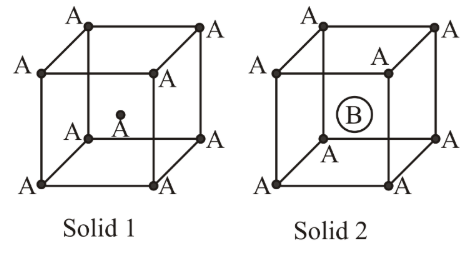
In a body-centered cubic (BCC) unit cell, the constituent atoms touch along the body diagonal of the cube. Let the edge length of Solid 2 be $$a_2$$. The length of its body diagonal is equal to $$\sqrt{3}a_2$$.
According to the diagram for Solid 2:
Therefore, along the body diagonal:
$$\sqrt{3}a_2 = 2r_A + 2r_B$$
We are given that the radius of atom B is twice that of atom A ($$r_B = 2r_A$$). Substituting this in:
$$\sqrt{3}a_2 = 2r_A + 2(2r_A) = 6r_A$$
Solving for the unit cell edge length $$a_2$$ in terms of $$r_A$$:
$$a_2 = \frac{6r_A}{\sqrt{3}} = 2\sqrt{3}r_A$$
Let's calculate the effective number of atoms and their volumes contained inside the unit cell:
The total volume occupied by the spheres ($$V_{\text{atoms}}$$) is:
$$V_{\text{atoms}} = \left(1 \times \frac{4}{3}\pi r_A^3\right) + \left(1 \times \frac{4}{3}\pi r_B^3\right)$$
Substitute $$r_B = 2r_A$$:
$$V_{\text{atoms}} = \frac{4}{3}\pi r_A^3 + \frac{4}{3}\pi(2r_A)^3 = \frac{4}{3}\pi r_A^3 (1 + 8) = 12\pi r_A^3$$
The total volume of the cube ($$V_{\text{cell}}$$) is given by $$(a_2)^3$$:
$$V_{\text{cell}} = (2\sqrt{3}r_A)^3 = 24\sqrt{3}r_A^3$$
Packing efficiency is the percentage of total space occupied by the spheres:
$$\text{Packing Efficiency} = \frac{V_{\text{atoms}}}{V_{\text{cell}}} \times 100\%$$
$$\text{Packing Efficiency} = \frac{12\pi r_A^3}{24\sqrt{3}r_A^3} \times 100\% = \frac{\pi}{2\sqrt{3}} \times 100\%$$
Substituting the values $$\pi \approx 3.1416$$ and $$\sqrt{3} \approx 1.732$$:
$$\text{Packing Efficiency} \approx \frac{3.1416}{3.464} \times 100\% \approx 90.7\%$$
The calculated value yields an approximate space occupancy of roughly $$90\%$$, which matches Option A perfectly.
Answer: Option A — 90 %
Was this solution helpful?
Click on the Email ☝️ to Watch the Video Solution
Create a FREE account and get:
_1.webp)

Educational materials for JEE preparation

Ask our AI anything

AI can make mistakes. Please verify important information.
AI can make mistakes. Please verify important information.


