
Join Our JEE Preparation Group
Prep with like-minded aspirants; Get access to free daily tests and study material.
Sign in
Please select an account to continue using cracku.in
↓ →
Join Our JEE Preparation Group
Prep with like-minded aspirants; Get access to free daily tests and study material.
First, let us recall the meaning of the unit “ppm”. The abbreviation “ppm” stands for “parts per million”. When we say that a substance has a concentration of so many ppm in water, we mean that out of one million parts by mass of the solution, that many parts are the solute. Mathematically we write this definition as $$1\;\text{ppm}= \dfrac{1\;\text{part}}{10^{6}\;\text{parts}}.$$
In the context of drinking-water standards, national and international agencies such as the Bureau of Indian Standards (BIS) and the World Health Organization (WHO) specify upper limits for different metal ions to protect human health. Copper is an essential trace element, but excess copper can cause gastrointestinal irritation and other toxic effects. Hence the allowable limit is fixed after careful toxicological studies.
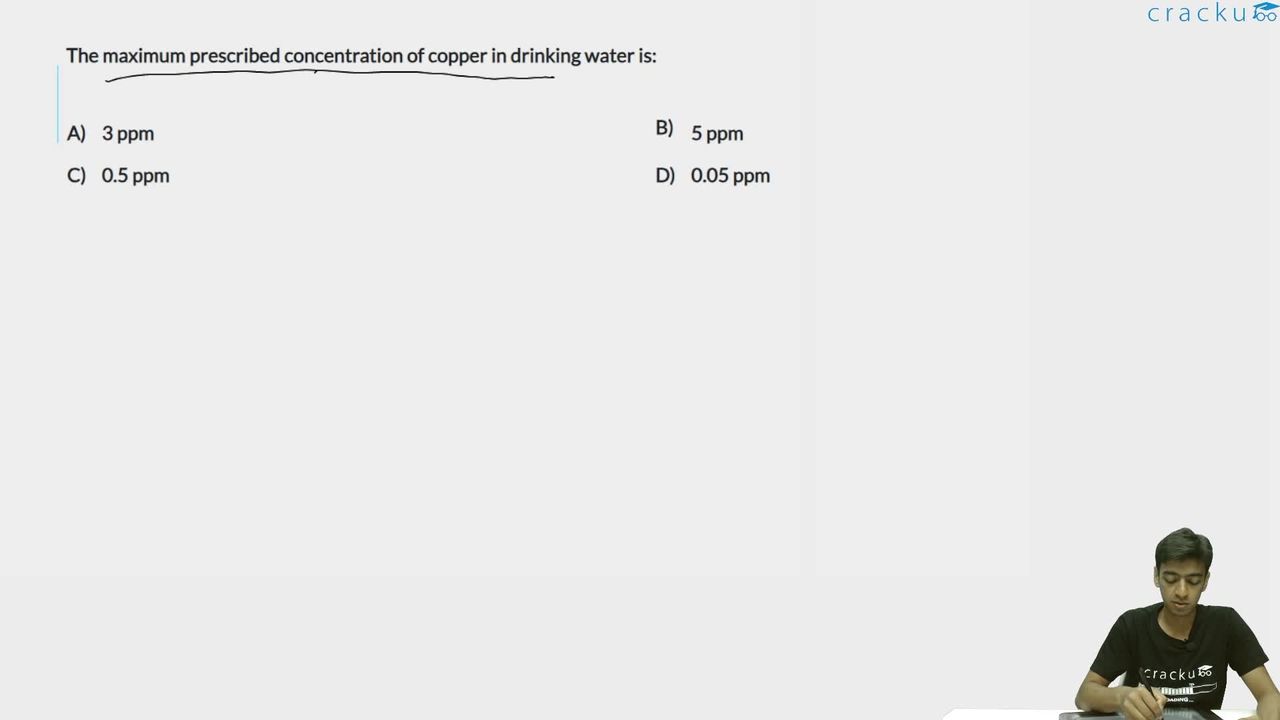
The value prescribed in the BIS standard IS 10500 : 2012 for copper in potable water is $$3\;\text{ppm},$$ which is also written as $$3\;\text{mg L}^{-1}$$ because $$1\;\text{ppm}=1\;\text{mg per litre}$$ for dilute aqueous solutions (density ≈ 1 g mL−1). Therefore, the maximum permitted concentration of copper that should not be exceeded in drinking water is $$3\;\text{ppm}.$$
Comparing this value with the given options - 3 ppm, 5 ppm, 0.5 ppm and 0.05 ppm - we see that the correct numerical match is 3 ppm.
Hence, the correct answer is Option A.
Was this solution helpful?
Click on the Email ☝️ to Watch the Video Solution
Create a FREE account and get:
_1.webp)

Educational materials for JEE preparation

Ask our AI anything

AI can make mistakes. Please verify important information.
AI can make mistakes. Please verify important information.


