
Join Our JEE Preparation Group
Prep with like-minded aspirants; Get access to free daily tests and study material.
Sign in
Please select an account to continue using cracku.in
↓ →
Join Our JEE Preparation Group
Prep with like-minded aspirants; Get access to free daily tests and study material.
A positive point charge is released from rest at a distance $$r_0$$ from a positive line charge with uniform charge density. The speed (v) of the point charge, as a function of instantaneous distance r from line charge, is proportional to:
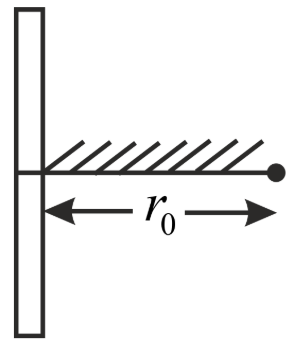
According to the principles of electrostatics and dynamics, the solution is derived as follows:
At any point P at a distance x from the line charge, the force f_P experienced by the point charge q is:
$$f_P = \frac{2k\lambda q}{x}$$
Using Newton's second law of motion (F = ma) and the expression for acceleration in terms of velocity and displacement ($$a = v \frac{dv}{dx}$$):
$$mv \frac{dv}{dx} = \frac{2k\lambda q}{x}$$
Rearranging the terms to integrate:
$$m \int_{0}^{v} v \, dv = 2k\lambda q \int_{r_0}^{r} \frac{1}{x} \, dx$$
Performing the integration:
$$\left[ \frac{1}{2}mv^2 \right]_0^v = 2k\lambda q \left[ \ln x \right]_{r_0}^r$$
$$\frac{1}{2}mv^2 = 2k\lambda q \ln \left( \frac{r}{r_0} \right)$$
Solving for velocity v:
$$v = \sqrt{\frac{4k\lambda q}{m} \ln \left( \frac{r}{r_0} \right)}$$
Since k, $$\lambda$$, q, and m are constants for this scenario:
$$\boxed{v \propto \sqrt{\ln \left( \frac{r}{r_0} \right)}}$$
Was this solution helpful?
Create a FREE account and get:
_1.webp)

Educational materials for JEE preparation

Ask our AI anything

AI can make mistakes. Please verify important information.
AI can make mistakes. Please verify important information.


