
Join Our JEE Preparation Group
Prep with like-minded aspirants; Get access to free daily tests and study material.
Sign in
Please select an account to continue using cracku.in
↓ →
Join Our JEE Preparation Group
Prep with like-minded aspirants; Get access to free daily tests and study material.
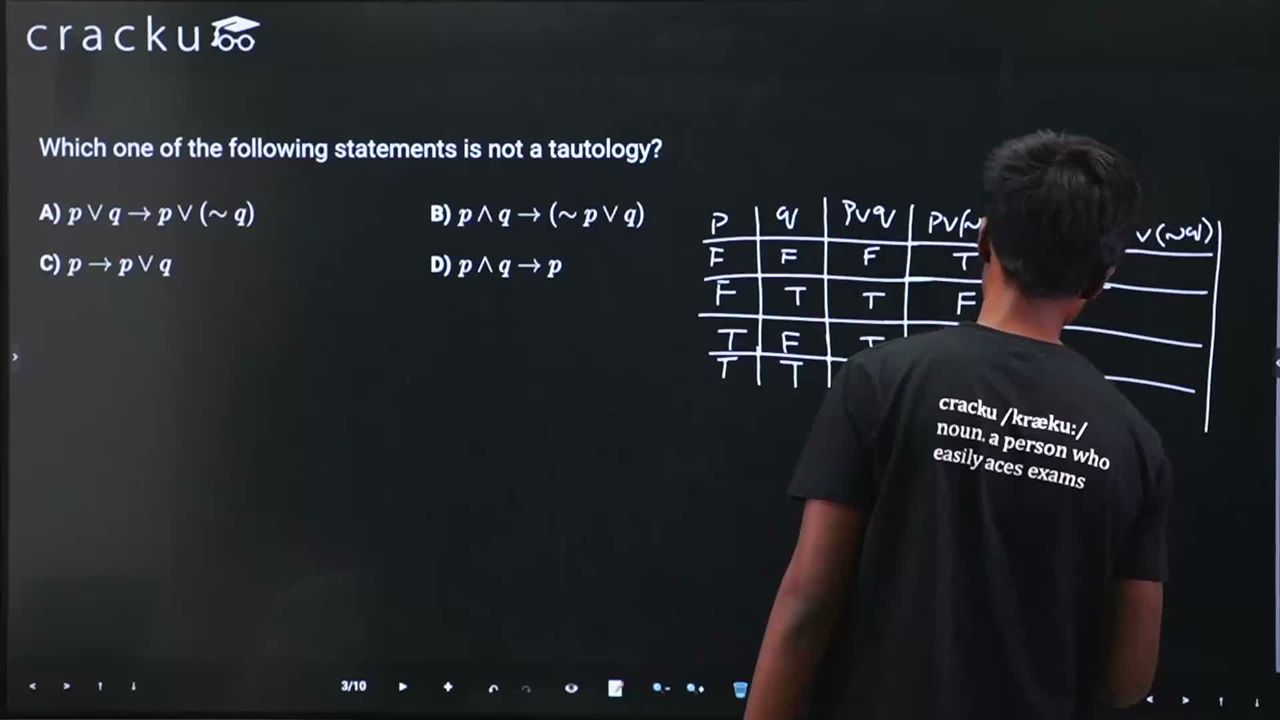
Which one of the following statements is not a tautology?
First, recall the definition: a statement (propositional formula) is called a tautology if it evaluates to $$\text{True}$$ for every possible assignment of truth-values to its constituent propositions.
Let us examine each option by constructing its complete truth table. Because we have two simple propositions, $$p$$ and $$q$$, there are exactly four possible ordered pairs $$(p,q)$$, namely $$(T,T),\;(T,F),\;(F,T),\;(F,F).$$ We shall evaluate each compound statement row by row.
Option A is $$\;(p \lor q)\;\rightarrow\;(p \lor \sim q).$$ We compute step by step.
We have
$$\begin{array}{|c|c||c|c||c|} \hline p & q & p\lor q & \sim q & p\lor\sim q \\ \hline T & T & T & F & T \\ \hline T & F & T & T & T \\ \hline F & T & T & F & F \\ \hline F & F & F & T & T \\ \hline \end{array}$$
Now, the implication $$A\rightarrow B$$ is false only when $$A$$ is $$T$$ and $$B$$ is $$F$$. Introducing one extra column for the entire statement, we get
$$\begin{array}{|c|c||c|c|c||c|} \hline p & q & p\lor q & \sim q & p\lor\sim q & (p\lor q)\rightarrow(p\lor\sim q) \\ \hline T & T & T & F & T & T \\ \hline T & F & T & T & T & T \\ \hline F & T & T & F & F & F \\ \hline F & F & F & T & T & T \\ \hline \end{array}$$
Because the third row yields the value $$F$$, the statement is not always true; therefore Option A is not a tautology.
Option B is $$\;(p \land q)\;\rightarrow\;(\sim p \lor q).$$ We proceed similarly:
$$\begin{array}{|c|c||c|c||c|} \hline p & q & p\land q & \sim p & \sim p\lor q \\ \hline T & T & T & F & T \\ \hline T & F & F & F & F \\ \hline F & T & F & T & T \\ \hline F & F & F & T & T \\ \hline \end{array}$$
Adding the implication column,
$$\begin{array}{|c|c||c|c|c||c|} \hline p & q & p\land q & \sim p & \sim p\lor q & (p\land q)\rightarrow(\sim p\lor q) \\ \hline T & T & T & F & T & T \\ \hline T & F & F & F & F & T \\ \hline F & T & F & T & T & T \\ \hline F & F & F & T & T & T \\ \hline \end{array}$$
Every row is $$T$$, so Option B is a tautology.
Option C is $$\;p\;\rightarrow\;(p \lor q).$$ Observe that whenever $$p$$ is $$T$$, the consequent $$p \lor q$$ is automatically $$T$$ (since a disjunction is true if any component is true). Whenever $$p$$ is $$F$$, the implication is vacuously true. Hence every row is $$T$$, confirming that Option C is a tautology.
Option D is $$\;(p \land q)\;\rightarrow\;p.$$ The antecedent can be $$T$$ only when both $$p$$ and $$q$$ are $$T$$, in which case $$p$$ is certainly $$T$$, making the implication true. In all other rows the antecedent is $$F$$, so the implication is again vacuously true. Thus Option D is also a tautology.
Summarising, only Option A fails to remain true under every valuation. It is therefore the single statement that is not a tautology.
Hence, the correct answer is Option A.
Was this solution helpful?
Click on the Email ☝️ to Watch the Video Solution
Create a FREE account and get:
_1.webp)

Educational materials for JEE preparation

Ask our AI anything

AI can make mistakes. Please verify important information.
AI can make mistakes. Please verify important information.


