
Join Our JEE Preparation Group
Prep with like-minded aspirants; Get access to free daily tests and study material.
Sign in
Please select an account to continue using cracku.in
↓ →
Join Our JEE Preparation Group
Prep with like-minded aspirants; Get access to free daily tests and study material.
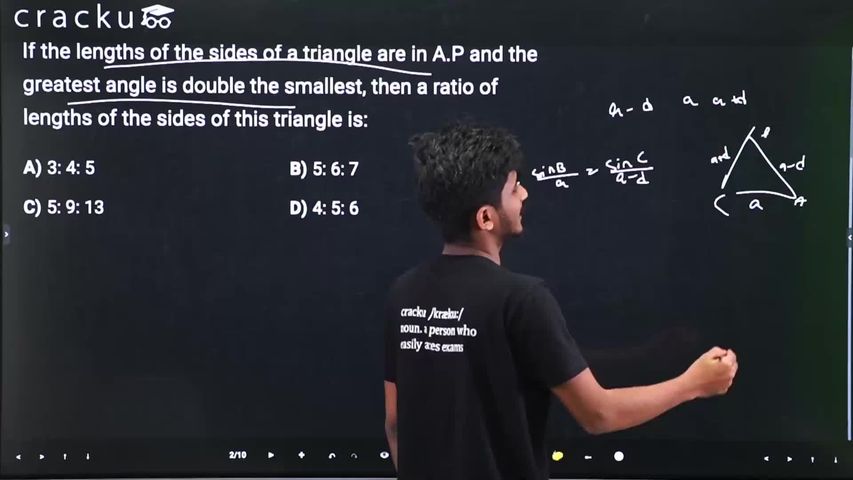
If the lengths of the sides of a triangle are in A.P and the greatest angle is double the smallest, then a ratio of lengths of the sides of this triangle is:
Let the three sides, taken in ascending order, be $$(b-d),\;b,\;b+d$$ where $$b>d>0$$ so that they form an arithmetic progression of common difference $$d$$. Call the angles opposite these sides $$\alpha,\;\beta,\;\gamma$$ respectively, so $$\gamma$$ is the largest and $$\alpha$$ is the smallest.
The statement “the greatest angle is double the smallest” translates to $$\gamma = 2\alpha.$$ Because a triangle’s angles sum to $$180^\circ,$$ we have
$$\alpha+\beta+\gamma=\alpha+\beta+2\alpha=180^\circ\;\Longrightarrow\;\beta = 180^\circ-3\alpha.$$
Invoke the Law of Sines:
$$\frac{b-d}{\sin\alpha}=\frac{b}{\sin\beta}=\frac{b+d}{\sin2\alpha}.$$
For convenience set the smallest side $$b-d$$ equal to one unit, i.e. $$b-d=1.$$ Then, writing the equalities in pairwise form,
$$\frac{b}{1}= \frac{\sin\beta}{\sin\alpha}$$ $$\text{and}$$ $$\frac{b+d}{1}= \frac{\sin2\alpha}{\sin\alpha}.$$
First simplify the right-hand ratios. Using $$\beta=180^\circ-3\alpha$$ and the identity $$\sin(180^\circ-\theta)=\sin\theta,$$
$$\frac{\sin\beta}{\sin\alpha}=\frac{\sin3\alpha}{\sin\alpha}.$$ Write $$\sin3\alpha=3\sin\alpha-4\sin^3\alpha,$$ so
$$\frac{\sin3\alpha}{\sin\alpha}=3-4\sin^2\alpha.$$
Similarly, $$\frac{\sin2\alpha}{\sin\alpha}= \frac{2\sin\alpha\cos\alpha}{\sin\alpha}=2\cos\alpha.$$
Hence
$$\boxed{b = 3-4\sin^2\alpha}$$ and $$\boxed{\,b+d = 2\cos\alpha\,}.$$
Because $$\sin^2\alpha + \cos^2\alpha =1,$$ convert the first boxed equation entirely into $$\cos\alpha$$ :
$$b = 3-4(1-\cos^2\alpha)=4\cos^2\alpha-1.$$
Now relate $$b+d$$ to $$b$$ and the unit length choice. Since $$b-d=1,$$ we have $$d=b-1,$$ so
$$b+d = b+(b-1)=2b-1.$$
But $$b+d$$ also equals $$2\cos\alpha,$$ therefore
$$2b-1 = 2\cos\alpha.$$
Insert $$b = 4\cos^2\alpha-1$$ from above:
$$2\left(4\cos^2\alpha-1\right)-1 = 2\cos\alpha.$$
Simplify step by step:
$$8\cos^2\alpha-2-1 = 2\cos\alpha$$
$$8\cos^2\alpha - 3 = 2\cos\alpha$$
$$8\cos^2\alpha - 2\cos\alpha - 3 = 0.$$
Let $$x=\cos\alpha.$$ The quadratic becomes
$$8x^2 - 2x - 3 = 0.$$
Apply the quadratic formula:
$$x = \frac{2 \pm \sqrt{2^2 - 4(8)(-3)}}{16}= \frac{2 \pm \sqrt{4+96}}{16}= \frac{2 \pm 10}{16}.$$
This gives two roots, $$x=\dfrac{12}{16}=\dfrac34$$ or $$x=-\dfrac12.$$ Because the smallest angle $$\alpha$$ must be acute, $$\cos\alpha>0,$$ so retain $$\cos\alpha=\dfrac34.$$
Consequently,
$$\sin\alpha = \sqrt{1-\left(\dfrac34\right)^2}= \sqrt{1-\dfrac9{16}}=\sqrt{\dfrac7{16}}=\dfrac{\sqrt7}{4}.$$
Now compute the side lengths relative to the unit smallest side.
Middle side:
$$b = 4\cos^2\alpha - 1 = 4\left(\dfrac34\right)^2 - 1 = 4\cdot\dfrac9{16}-1 = \dfrac9{4}-1 = \dfrac54.$$
Largest side:
$$b+d = 2b-1 = 2\left(\dfrac54\right)-1 = \dfrac{10}{4}-\dfrac4{4}= \dfrac6{4}=\dfrac32.$$
Hence, with $$b-d=1,\;b=\dfrac54,\;b+d=\dfrac32,$$ the proportional sides are
$$1 : \dfrac54 : \dfrac32.$$
Multiply every length by $$4$$ to clear denominators:
$$4 : 5 : 6.$$
Thus the three sides are in the ratio $$4:5:6,$$ which corresponds to Option D.
Hence, the correct answer is Option D.
Was this solution helpful?
Click on the Email ☝️ to Watch the Video Solution
Create a FREE account and get:
_1.webp)

Educational materials for JEE preparation

Ask our AI anything

AI can make mistakes. Please verify important information.
AI can make mistakes. Please verify important information.


