
Join Our JEE Preparation Group
Prep with like-minded aspirants; Get access to free daily tests and study material.
Sign in
Please select an account to continue using cracku.in
↓ →
Join Our JEE Preparation Group
Prep with like-minded aspirants; Get access to free daily tests and study material.
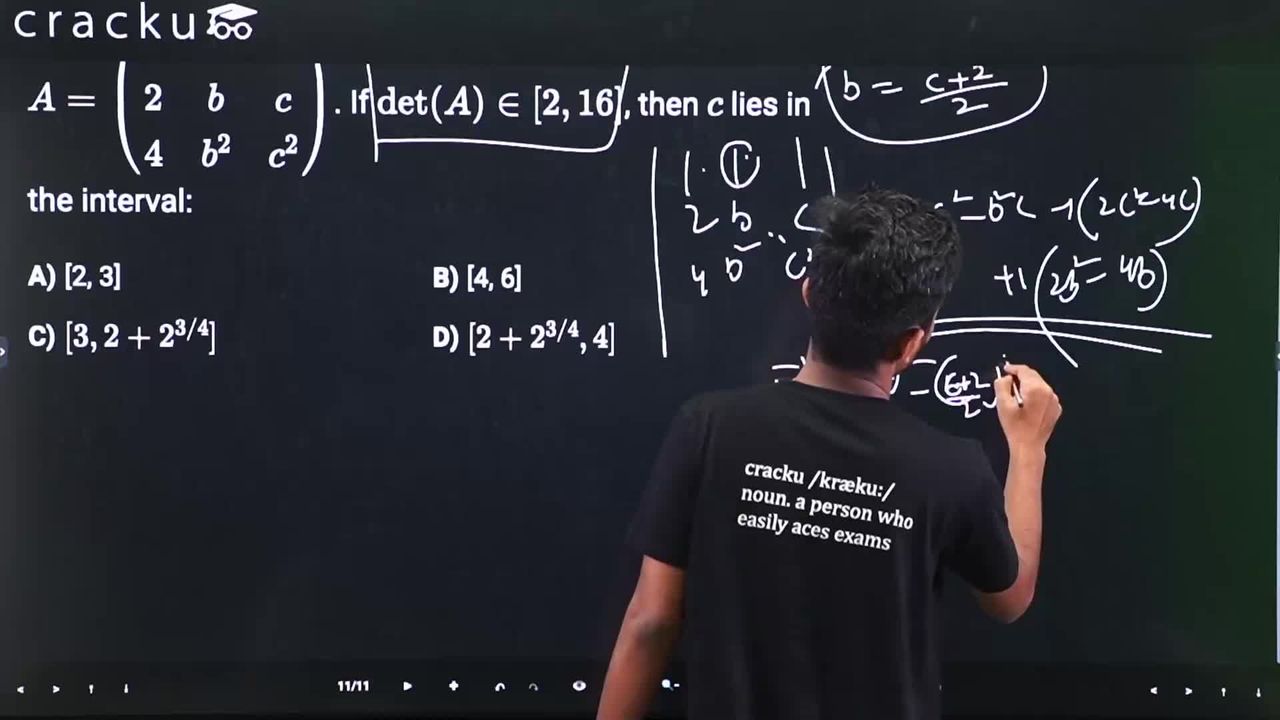
Let the numbers 2, b, c be in an A.P. and $$A = \begin{pmatrix} 1 & 1 & 1 \\ 2 & b & c \\ 4 & b^{2} & c^{2} \end{pmatrix}$$. If $$\det(A) \in [2, 16]$$, then $$c$$ lies in the interval:
We are told that the three real numbers 2, $$b$$ and $$c$$ are in an arithmetic progression. For any three numbers $$a_1 , a_2 , a_3$$ to be in an A.P. we must have the common difference equal, that is
$$a_2-a_1 = a_3-a_2.$$
Here $$a_1 = 2,\; a_2 = b,\; a_3 = c$$, so we write
$$b-2 = c-b.$$
Transposing and simplifying,
$$2b = 2 + c \;\;\Rightarrow\;\; c = 2b-2$$ or $$b = \dfrac{2+c}{2}.$$
Next we analyse the determinant of the given matrix $$A=\begin{pmatrix}1 & 1 & 1 \\ 2 & b & c \\ 4 & b^{2} & c^{2}\end{pmatrix}.$$ For a $$3\times3$$ matrix $$\begin{pmatrix}x_{11}&x_{12}&x_{13}\\x_{21}&x_{22}&x_{23}\\x_{31}&x_{32}&x_{33}\end{pmatrix},$$ the determinant is obtained from the expansion along the first row:
$$\det = x_{11}\begin{vmatrix}x_{22}&x_{23}\\x_{32}&x_{33}\end{vmatrix}\; -\;x_{12}\begin{vmatrix}x_{21}&x_{23}\\x_{31}&x_{33}\end{vmatrix}\; +\;x_{13}\begin{vmatrix}x_{21}&x_{22}\\x_{31}&x_{32}\end{vmatrix}.$$
Applying this to our matrix we have
$$\det(A)= 1\begin{vmatrix}b & c\\ b^{2} & c^{2}\end{vmatrix} -1\begin{vmatrix}2 & c\\ 4 & c^{2}\end{vmatrix} +1\begin{vmatrix}2 & b\\ 4 & b^{2}\end{vmatrix}.$$
Evaluating each $$2\times2$$ determinant,
$$\begin{aligned} \det(A) &= 1\,(b\,c^{2}-c\,b^{2}) \;-\; 1\,(2\,c^{2}-4c)\;+\;1\,(2\,b^{2}-4b)\\[4pt] &= bc^{2}-cb^{2}\;-\;2c^{2}+4c\;+\;2b^{2}-4b. \end{aligned}$$
Because $$b$$ and $$c$$ are linked through the A.P. relation $$b=\dfrac{2+c}{2},$$ we now substitute this value everywhere it occurs.
First find some helpful expressions: $$c-b = c-\dfrac{2+c}{2}= \dfrac{c-2}{2},$$ $$bc = c\cdot\dfrac{2+c}{2}= \dfrac{c(2+c)}{2},$$ and therefore $$bc(c-b)=\dfrac{c(2+c)}{2}\cdot\dfrac{c-2}{2}= \dfrac{c(c+2)(c-2)}{4}= \dfrac{c(c^{2}-4)}{4}=\dfrac{c^{3}-4c}{4}.$$
Re-writing each term of $$\det(A)$$ with the substitutions,
$$\begin{aligned} \det(A) &= \dfrac{c^{3}-4c}{4}\;-\;2c^{2}+4c\;+\;2\!\left(\dfrac{2+c}{2}\right)^{2}-4\!\left(\dfrac{2+c}{2}\right)\\[6pt] &= \dfrac{c^{3}-4c}{4}\;-\;2c^{2}+4c\;+\;\dfrac{(c+2)^{2}}{2}-2(2+c). \end{aligned}$$
Expand and combine like terms step by step:
$$\dfrac{c^{3}-4c}{4}= \dfrac{1}{4}c^{3}-c,$$ $$\dfrac{(c+2)^{2}}{2}= \dfrac{c^{2}+4c+4}{2}= \dfrac{1}{2}c^{2}+2c+2,$$ $$-2(2+c)= -4-2c.$$
Adding everything:
$$\begin{aligned} \det(A) &= \Bigl(\dfrac{1}{4}c^{3}-c\Bigr) + (-2c^{2}) + 4c + \Bigl(\dfrac{1}{2}c^{2}+2c+2\Bigr) + (-4-2c)\\[4pt] &= \dfrac{1}{4}c^{3} \;+\; \Bigl(-2c^{2}+\dfrac{1}{2}c^{2}\Bigr)\;+\;\bigl(-c+4c+2c-2c\bigr)\;+\;(2-4)\\[4pt] &= \dfrac{1}{4}c^{3}-\dfrac{3}{2}c^{2}+3c-2. \end{aligned}$$
To clear the fractional coefficients, multiply the entire expression by 4:
$$4\det(A)=c^{3}-6c^{2}+12c-8.$$
Notice that the right-hand side is a perfect cube expansion, namely
$$c^{3}-6c^{2}+12c-8 \;=\; (c-2)^{3}.$$
Hence we may write the determinant in the compact form
$$\det(A)=\dfrac{(c-2)^{3}}{4}.$$
The problem statement now supplies the bound
$$2 \,\le\,\det(A)\,\le\,16.$$
Substituting the expression just found,
$$2 \;\le\; \dfrac{(c-2)^{3}}{4}\;\le\;16.$$
Multiply every part of the inequality by 4 (which is positive, so the inequality direction does not change):
$$8 \;\le\; (c-2)^{3} \;\le\; 64.$$
The cube function is strictly increasing for all real numbers, so we can safely take the real cube roots term by term:
$$\sqrt[3]{8}\; \le\; c-2 \;\le\; \sqrt[3]{64}.$$
Since $$\sqrt[3]{8}=2$$ and $$\sqrt[3]{64}=4,$$ this becomes
$$2 \le c-2 \le 4.$$
Finally add 2 throughout:
$$4 \le c \le 6.$$
Thus $$c$$ must lie in the closed interval $$[4,6]$$.
Comparing with the given options, we see that this corresponds exactly to Option B.
Hence, the correct answer is Option B.
Was this solution helpful?
Click on the Email ☝️ to Watch the Video Solution
Create a FREE account and get:
_1.webp)

Educational materials for JEE preparation

Ask our AI anything

AI can make mistakes. Please verify important information.
AI can make mistakes. Please verify important information.


