
Join Our JEE Preparation Group
Prep with like-minded aspirants; Get access to free daily tests and study material.
Sign in
Please select an account to continue using cracku.in
↓ →
Join Our JEE Preparation Group
Prep with like-minded aspirants; Get access to free daily tests and study material.
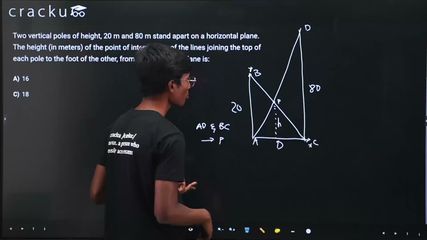
Two vertical poles of height, 20 m and 80 m stand apart on a horizontal plane. The height (in meters) of the point of intersection of the lines joining the top of each pole to the foot of the other, from this horizontal plane is:
Let the feet of the two vertical poles be denoted by $$A$$ and $$B$$. The pole at $$A$$ is $$20\text{ m}$$ high, while the pole at $$B$$ is $$80\text{ m}$$ high. Assume the (unknown) horizontal distance between the two feet to be $$L$$ metres. Because everything lies in one vertical plane, we introduce a convenient coordinate system:
• Choose the foot $$A$$ as the origin, giving $$A\equiv(0,0)$$, where the first coordinate is horizontal and the second is vertical (height). • Then the foot $$B$$ has coordinates $$B\equiv(L,0)$$. • The top of the shorter pole is $$A'\equiv(0,20)$$, and the top of the taller pole is $$B'\equiv(L,80)$$.
We draw two straight segments: 1. $$A'B$$ joins the top of the shorter pole to the foot of the taller pole. 2. $$B'A$$ joins the top of the taller pole to the foot of the shorter pole.
Let the two lines intersect at $$P(x_P,h)$$, where $$h$$ is the required height above the horizontal plane.
Parametric form of each line.
Along $$A'B$$, take a parameter $$\lambda\;(0\le\lambda\le1)$$ measured from $$A'$$ to $$B$$. Using the two-point formula, a general point on $$A'B$$ is
$$\begin{aligned} x &= 0 + \lambda(L-0) = \lambda L,\\[4pt] z &= 20 + \lambda(0-20) = 20\,(1-\lambda). \end{aligned}$$
Along $$B'A$$, take a parameter $$\mu\;(0\le\mu\le1)$$ measured from $$B'$$ to $$A$$. A general point on $$B'A$$ is
$$\begin{aligned} x &= L + \mu(0-L) = L\,(1-\mu),\\[4pt] z &= 80 + \mu(0-80) = 80\,(1-\mu). \end{aligned}$$
Equating the coordinates at the intersection $$P$$.
The same point $$P$$ must satisfy both sets of equations, so first equate the horizontal coordinates:
$$\lambda L = L(1-\mu)\;\Longrightarrow\;\lambda = 1-\mu.$$
Next, equate the vertical (height) coordinates:
$$20(1-\lambda) = 80(1-\mu).$$
Substituting $$\lambda = 1-\mu$$ into this equation, we obtain
$$20\bigl[1-(1-\mu)\bigr] = 80(1-\mu) \;\Longrightarrow\; 20\mu = 80(1-\mu).$$
Now solve step by step:
$$\begin{aligned} 20\mu &= 80 - 80\mu,\\[4pt] 20\mu + 80\mu &= 80,\\[4pt] 100\mu &= 80,\\[4pt] \mu &= \frac{80}{100} = 0.8. \end{aligned}$$
Since $$\lambda = 1 - \mu$$, we have $$\lambda = 1 - 0.8 = 0.2.$$ Height of the point $$P$$. Using either expression for $$z$$, say $$z = 80(1-\mu)$$, we get
$$h = 80(1 - 0.8) = 80 \times 0.2 = 16.$$
Checking with the other formula $$z = 20(1-\lambda)$$ gives the same value:
$$h = 20(1 - 0.2) = 20 \times 0.8 = 16,$$
confirming the consistency.
The point of intersection therefore lies $$16\text{ m}$$ above the horizontal plane.
Hence, the correct answer is Option A.
Was this solution helpful?
Click on the Email ☝️ to Watch the Video Solution
Create a FREE account and get:
_1.webp)

Educational materials for JEE preparation

Ask our AI anything

AI can make mistakes. Please verify important information.
AI can make mistakes. Please verify important information.


