
Join Our JEE Preparation Group
Prep with like-minded aspirants; Get access to free daily tests and study material.
Sign in
Please select an account to continue using cracku.in
↓ →
Join Our JEE Preparation Group
Prep with like-minded aspirants; Get access to free daily tests and study material.
Let $$f(x) = a^x$$ ($$a > 0$$) be written as $$f(x) = f_1(x) + f_2(x)$$, where $$f_1(x)$$ is an even function and $$f_2(x)$$ is an odd function. Then $$f_1(x + y) + f_1(x - y)$$ equals:
We start with the given exponential function $$f(x)=a^{\,x}$$ where $$a>0$$.
Every real-valued function can be split uniquely into an even part and an odd part. The standard identities are
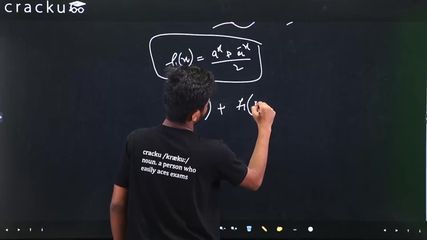
$$ f_1(x)=\frac{f(x)+f(-x)}{2}\qquad\text{(even part)},\qquad f_2(x)=\frac{f(x)-f(-x)}{2}\qquad\text{(odd part)}. $$
Substituting $$f(x)=a^{\,x}$$, we obtain
$$ f_1(x)=\frac{a^{\,x}+a^{-x}}{2},\qquad f_2(x)=\frac{a^{\,x}-a^{-x}}{2}. $$
Now we compute $$f_1(x+y)$$:
$$ f_1(x+y)=\frac{a^{\,x+y}+a^{-(x+y)}}{2} =\frac{a^{\,x+y}+a^{-x-y}}{2}. $$
Next, we compute $$f_1(x-y)$$:
$$ f_1(x-y)=\frac{a^{\,x-y}+a^{-(x-y)}}{2} =\frac{a^{\,x-y}+a^{-x+y}}{2}. $$
Adding these two expressions term-by-term gives
$$ f_1(x+y)+f_1(x-y) =\frac{a^{\,x+y}+a^{-x-y}+a^{\,x-y}+a^{-x+y}}{2}. $$
To see the desired pattern, we now form $$2f_1(x)f_1(y)$$. First compute the individual factors:
$$ f_1(x)=\frac{a^{\,x}+a^{-x}}{2},\qquad f_1(y)=\frac{a^{\,y}+a^{-y}}{2}. $$
Multiplying these and then doubling gives
$$ 2f_1(x)f_1(y) =2\left(\frac{a^{\,x}+a^{-x}}{2}\right)\left(\frac{a^{\,y}+a^{-y}}{2}\right) =\frac{(a^{\,x}+a^{-x})(a^{\,y}+a^{-y})}{2}. $$
Expanding the product in the numerator, we have
$$ (a^{\,x}+a^{-x})(a^{\,y}+a^{-y}) =a^{\,x+y}+a^{\,x-y}+a^{-x+y}+a^{-x-y}. $$
Therefore
$$ 2f_1(x)f_1(y) =\frac{a^{\,x+y}+a^{\,x-y}+a^{-x+y}+a^{-x-y}}{2}. $$
Comparing this expression with the earlier result for $$f_1(x+y)+f_1(x-y)$$, we see they are identical:
$$ f_1(x+y)+f_1(x-y)=2f_1(x)f_1(y). $$
Hence, the correct answer is Option A.
Was this solution helpful?
Click on the Email ☝️ to Watch the Video Solution
Create a FREE account and get:
_1.webp)

Educational materials for JEE preparation

Ask our AI anything

AI can make mistakes. Please verify important information.
AI can make mistakes. Please verify important information.


