
Join Our JEE Preparation Group
Prep with like-minded aspirants; Get access to free daily tests and study material.
Sign in
Please select an account to continue using cracku.in
↓ →
Join Our JEE Preparation Group
Prep with like-minded aspirants; Get access to free daily tests and study material.
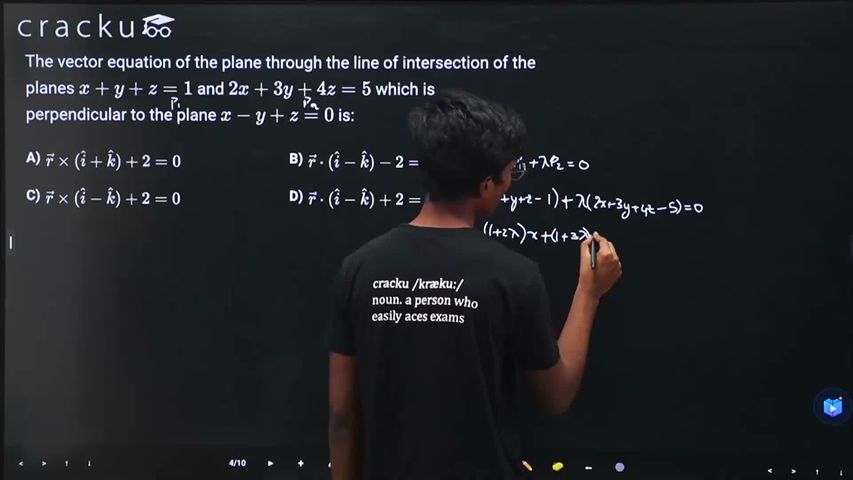
The vector equation of the plane through the line of intersection of the planes $$x + y + z = 1$$ and $$2x + 3y + 4z = 5$$ which is perpendicular to the plane $$x - y + z = 0$$ is:
We are asked to obtain the equation of a plane which
(i) passes through the line of intersection of the two planes $$x + y + z = 1$$ and $$2x + 3y + 4z = 5,$$ and
(ii) is perpendicular to the plane $$x - y + z = 0.$$
First we recall a standard fact: the family of all planes passing through the line of intersection of the two given planes $$P_{1}: \; x + y + z - 1 = 0$$ and $$P_{2}: \; 2x + 3y + 4z - 5 = 0$$ is obtained by adding the equations with an arbitrary parameter. Thus the general required plane can be written as
$$\bigl(x + y + z - 1\bigr) + \lambda \,\bigl(2x + 3y + 4z - 5\bigr) = 0,$$
where $$\lambda$$ is a real constant yet to be determined.
Now we translate this equation into its normal-vector form. The normal vector of $$P_{1}$$ is $$\vec{n}_{1} = (1,1,1),$$ and that of $$P_{2}$$ is $$\vec{n}_{2} = (2,3,4).$$ When we add the planes with the parameter $$\lambda,$$ their normals add in the same way. Hence the normal vector of the sought plane is
$$\vec{n} = \vec{n}_{1} + \lambda \,\vec{n}_{2} = (\,1 + 2\lambda,\; 1 + 3\lambda,\; 1 + 4\lambda\,).$$
Condition (ii) says that this desired plane must be perpendicular to the plane $$x - y + z = 0.$$ The normal vector of that given plane is
$$\vec{n}_{0} = (1,\,-1,\,1).$$
Two planes are perpendicular if and only if their normal vectors are perpendicular, that is, their dot product is zero. Therefore we impose
$$\vec{n} \cdot \vec{n}_{0} = 0.$$
Writing this dot product explicitly, we get
$$\bigl(1 + 2\lambda\bigr)\,(1) \;+\; \bigl(1 + 3\lambda\bigr)\,(-1) \;+\; \bigl(1 + 4\lambda\bigr)\,(1) \;=\; 0.$$
Now we expand term by term:
$$\bigl(1 + 2\lambda\bigr) \;-\; \bigl(1 + 3\lambda\bigr) \;+\; \bigl(1 + 4\lambda\bigr) = 0.$$
Collecting like terms carefully:
$$1 + 2\lambda \;-\; 1 - 3\lambda \;+\; 1 + 4\lambda = 0.$$
Simplify the constants and the coefficients of $$\lambda$$ separately:
$$\bigl(1 - 1 + 1\bigr) \;+\; \bigl(2\lambda - 3\lambda + 4\lambda\bigr) = 0,$$ so
$$1 + 3\lambda = 0.$$
Solving for $$\lambda$$ gives
$$\lambda = -\dfrac{1}{3}.$$
We substitute this specific value of $$\lambda$$ back into the general family equation:
$$\bigl(x + y + z - 1\bigr) - \dfrac{1}{3}\,\bigl(2x + 3y + 4z - 5\bigr) = 0.$$
To remove the fraction, multiply every term by $$3$$:
$$3\,(x + y + z - 1) - \bigl(2x + 3y + 4z - 5\bigr) = 0.$$
Now distribute each bracket:
$$\bigl(3x + 3y + 3z - 3\bigr) - 2x - 3y - 4z + 5 = 0.$$
Combine like terms carefully:
• For $$x$$: $$3x - 2x = x,$$
• For $$y$$: $$3y - 3y = 0,$$
• For $$z$$: $$3z - 4z = -z,$$
• Constant term: $$-3 + 5 = 2.$$
So the required plane simplifies to
$$x - z + 2 = 0.$$
We rewrite this compactly in vector notation. A position vector $$\vec{r} = x\,\hat{i} + y\,\hat{j} + z\,\hat{k}$$ satisfies the plane if its dot product with the normal vector $$\vec{n} = \hat{i} - \hat{k}$$ equals $$-2$$ (bringing the $$+2$$ to the other side). Therefore,
$$\vec{r} \cdot (\hat{i} - \hat{k}) + 2 = 0.$$
This matches Option D given in the question statement.
Hence, the correct answer is Option 4.
Was this solution helpful?
Click on the Email ☝️ to Watch the Video Solution
Create a FREE account and get:
_1.webp)

Educational materials for JEE preparation

Ask our AI anything

AI can make mistakes. Please verify important information.
AI can make mistakes. Please verify important information.


