
Join Our JEE Preparation Group
Prep with like-minded aspirants; Get access to free daily tests and study material.
Sign in
Please select an account to continue using cracku.in
↓ →
Join Our JEE Preparation Group
Prep with like-minded aspirants; Get access to free daily tests and study material.
In the circuit shown, a four-wire potentiometer is made of a 400 cm long wire, which extends between A and B. The resistance per unit length of the potentiometer wire is r = 0.01 $$\Omega$$/cm. If an ideal voltmeter is connected as shown with jockey J at 50 cm from end A, the expected reading of the voltmeter will be:
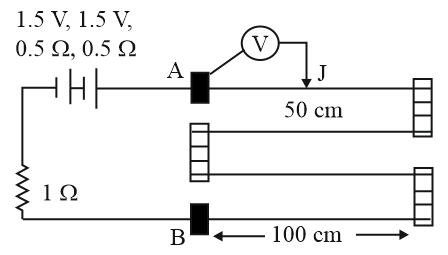
We are given that the potentiometer wire AB has a length of $$L = 400\;\text{cm}$$ and a resistance per unit length of $$r = 0.01\;\Omega/\text{cm}$$.
First we find the total resistance of the potentiometer wire. Using the relation $$R = rL$$ we have
$$R_{AB} \;=\; r\,L \;=\; 0.01\;\Omega/\text{cm}\;\times\;400\;\text{cm} \;=\; 4\;\Omega.$$
The driver battery connected between A and B (shown in the figure that accompanies the question) has an emf of $$E = 2\;\text{V}$$ and, being ideal for this calculation, contributes no extra internal resistance. The entire emf therefore appears across the resistance $$R_{AB}$$ of the potentiometer wire.
Now we apply Ohm’s law, which states
$$V = IR.$$
Here the potential difference across the whole wire is $$E = 2\;\text{V}$$ and the resistance of the whole wire is $$R_{AB}=4\;\Omega$$. So the steady current through the wire is
$$I = \dfrac{E}{R_{AB}} = \dfrac{2\;\text{V}}{4\;\Omega} = 0.5\;\text{A}.$$
With a uniform wire carrying a steady current, the potential drop is uniform along its length. The potential gradient (potential drop per centimetre) is therefore
$$k = I\,r = 0.5\;\text{A}\;\times\;0.01\;\Omega/\text{cm} = 0.005\;\text{V/cm}.$$
The jockey J touches the wire at a point 50 cm from end A. Let us call this segment AJ. The resistance of segment AJ is
$$R_{AJ} = r \times 50\;\text{cm} = 0.01\;\Omega/\text{cm}\;\times\;50\;\text{cm} = 0.5\;\Omega.$$
The potential difference between A and the jockey J is then, again by Ohm’s law,
$$V_{AJ} = I\,R_{AJ} = 0.5\;\text{A}\;\times\;0.5\;\Omega = 0.25\;\text{V}.$$
An ideal voltmeter has infinite resistance, so it draws no current; it merely reads the existing potential difference between its terminals. One terminal of the ideal voltmeter is connected to point A, and the other to the jockey J. Consequently, the voltmeter reading is exactly the potential difference we have just calculated:
$$V_{\text{reading}} = 0.25\;\text{V}.$$
Hence, the correct answer is Option B.
Was this solution helpful?
Create a FREE account and get:
_1.webp)

Educational materials for JEE preparation

Ask our AI anything

AI can make mistakes. Please verify important information.
AI can make mistakes. Please verify important information.


