
Join Our JEE Preparation Group
Prep with like-minded aspirants; Get access to free daily tests and study material.
Sign in
Please select an account to continue using cracku.in
↓ →
Join Our JEE Preparation Group
Prep with like-minded aspirants; Get access to free daily tests and study material.
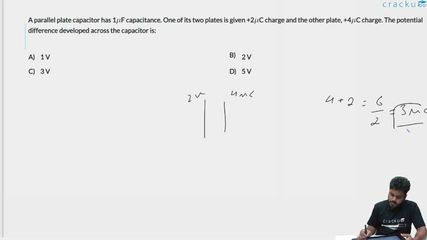
A parallel plate capacitor has 1$$\mu$$F capacitance. One of its two plates is given +2$$\mu$$C charge and the other plate, +4$$\mu$$C charge. The potential difference developed across the capacitor is:
We have an isolated parallel-plate capacitor whose capacitance is given as $$C = 1\;\mu\text{F} = 1 \times 10^{-6}\,\text{F}.$$
The problem states that one conducting plate is provided with a charge of $$+2\;\mu\text{C}$$ while the other plate is provided with a charge of $$+4\;\mu\text{C}.$$ Let us denote these charges as
$$Q_1 = +2\;\mu\text{C}, \qquad Q_2 = +4\;\mu\text{C}.$$
For any capacitor, the electric field (and therefore the potential difference) is produced only by that part of the charge which is opposite and equal on the two plates. Any charge that is common to both plates does not contribute to the field between them because its electric effects cancel out internally.
Mathematically we decompose the charges on the plates into two parts:
1. A common charge that is present, with the same sign and magnitude, on both plates.
2. An opposite charge that is equal in magnitude and opposite in sign on the two plates; this part alone decides the potential difference.
The common charge is obtained by averaging the two given charges:
$$Q_{\text{common}} = \frac{Q_1 + Q_2}{2} = \frac{(+2\;\mu\text{C}) + (+4\;\mu\text{C})}{2} = \frac{6\;\mu\text{C}}{2} = 3\;\mu\text{C}.$$
Subtracting this common charge from each plate’s total charge leaves us with the opposite (effective) charge:
For plate 1: $$Q_{1,\text{eff}} = Q_1 - Q_{\text{common}} = 2\;\mu\text{C} - 3\;\mu\text{C} = -1\;\mu\text{C}.$$
For plate 2: $$Q_{2,\text{eff}} = Q_2 - Q_{\text{common}} = 4\;\mu\text{C} - 3\;\mu\text{C} = +1\;\mu\text{C}.$$
Clearly, the two effective charges are equal in magnitude (1 μC) and opposite in sign, which is exactly the situation for an ordinarily charged capacitor.
Hence the magnitude of the charge that actually participates in producing the potential difference is
$$Q_{\text{eff}} = 1\;\mu\text{C} = 1 \times 10^{-6}\,\text{C}.$$
Now we use the fundamental capacitor formula relating charge, capacitance and potential difference:
$$V = \frac{Q_{\text{eff}}}{C}.$$
Substituting the known values,
$$V = \frac{1 \times 10^{-6}\,\text{C}}{1 \times 10^{-6}\,\text{F}} = 1\;\text{V}.$$
Therefore, the potential difference developed across the capacitor is $$1\;\text{volt}.$$ Hence, the correct answer is Option A.
Was this solution helpful?
Click on the Email ☝️ to Watch the Video Solution
Create a FREE account and get:
_1.webp)

Educational materials for JEE preparation

Ask our AI anything

AI can make mistakes. Please verify important information.
AI can make mistakes. Please verify important information.


