NTA JEE Main 10th January 2019 Shift 1
For the following questions answer them individually
NTA JEE Main 10th January 2019 Shift 1 - Question 11
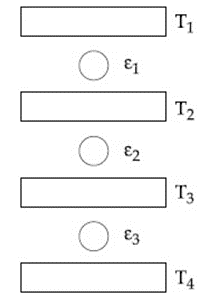
Three Carnot engines operate in series between a heat source at a temperature $$T_1$$ and a heat sink at temperature $$T_4$$ (see figure). There are two other reservoirs at temperature $$T_2$$ and $$T_3$$, as shown, with $$T_1 > T_2 > T_3 > T_4$$. The three engines are equally efficient if:
NTA JEE Main 10th January 2019 Shift 1 - Question 12
A train moves towards a stationary observer with speed 34 m/s. The train sounds a whistle and its frequency registered by the observer is $$f_1$$. If the speed of the train is reduced to 17 m/s, the frequency registered is $$f_2$$. If speed of sound is 340 m/s, then the ratio $$f_1/f_2$$ is:
NTA JEE Main 10th January 2019 Shift 1 - Question 13
A string of length 1 m and mass 5 g is fixed at both ends. The tension in the string is 8.0 N. The string is set into vibration using an external vibrator of frequency 100 Hz. The separation between successive nodes on the string is close to:

NTA JEE Main 10th January 2019 Shift 1 - Question 14
Two electric dipoles, A, B with respective dipole moments $$\vec{d_A} = -4qa\hat{i}$$ and $$\vec{d_B} = -2qa\hat{i}$$ are placed on the $$x$$-axis with a separation $$R$$, as shown in the figure.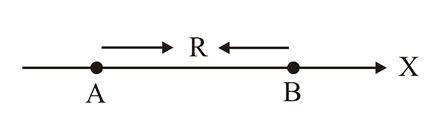
The distance from A at which both of them produce the same potential is:
NTA JEE Main 10th January 2019 Shift 1 - Question 15
A charge $$Q$$ is distributed over three concentric spherical shells of radii $$a$$, $$b$$, $$c$$ ($$a < b < c$$) such that their surface charge densities are equal to one another. The total potential at a point at distance $$r$$ from their common centre, where $$r < a$$, would be:
NTA JEE Main 10th January 2019 Shift 1 - Question 16
A parallel plate capacitor is of area 6 cm$$^2$$ and a separation 3 mm. The gap is filled with three dielectric materials of equal thickness (see figure) with dielectric constant $$K_1 = 10$$, $$K_2 = 12$$ and $$K_3 = 14$$. The dielectric constant of a material which when fully inserted in above capacitor, gives same capacitance would be: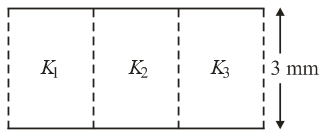
NTA JEE Main 10th January 2019 Shift 1 - Question 17
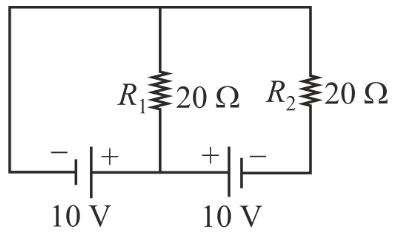
In the given circuit the cells have zero internal resistance. The currents (in amperes) passing through resistance $$R_1$$ and $$R_2$$ respectively, are:
NTA JEE Main 10th January 2019 Shift 1 - Question 18
A uniform metallic wire has a resistance of 18 $$\Omega$$ and is bent into an equilateral triangle. Then, the resistance between any two vertices of the triangle is:
NTA JEE Main 10th January 2019 Shift 1 - Question 19
A 2 W carbon resistor is color coded with green, black, red and silver respectively. The maximum current which can be passed through this resistor is:
NTA JEE Main 10th January 2019 Shift 1 - Question 20
A magnet of total magnetic moment $$10^{-2} \hat{i}$$ A m$$^2$$ is placed in a time varying magnetic field, $$B\hat{i}(\cos\omega t)$$ where $$B = 1$$ Tesla and $$\omega = 0.125$$ rad s$$^{-1}$$. The work done for reversing the direction of the magnetic moment at $$t = 1$$ second, is: