
Join Our JEE Preparation Group
Prep with like-minded aspirants; Get access to free daily tests and study material.
Sign in
Please select an account to continue using cracku.in
↓ →
Join Our JEE Preparation Group
Prep with like-minded aspirants; Get access to free daily tests and study material.
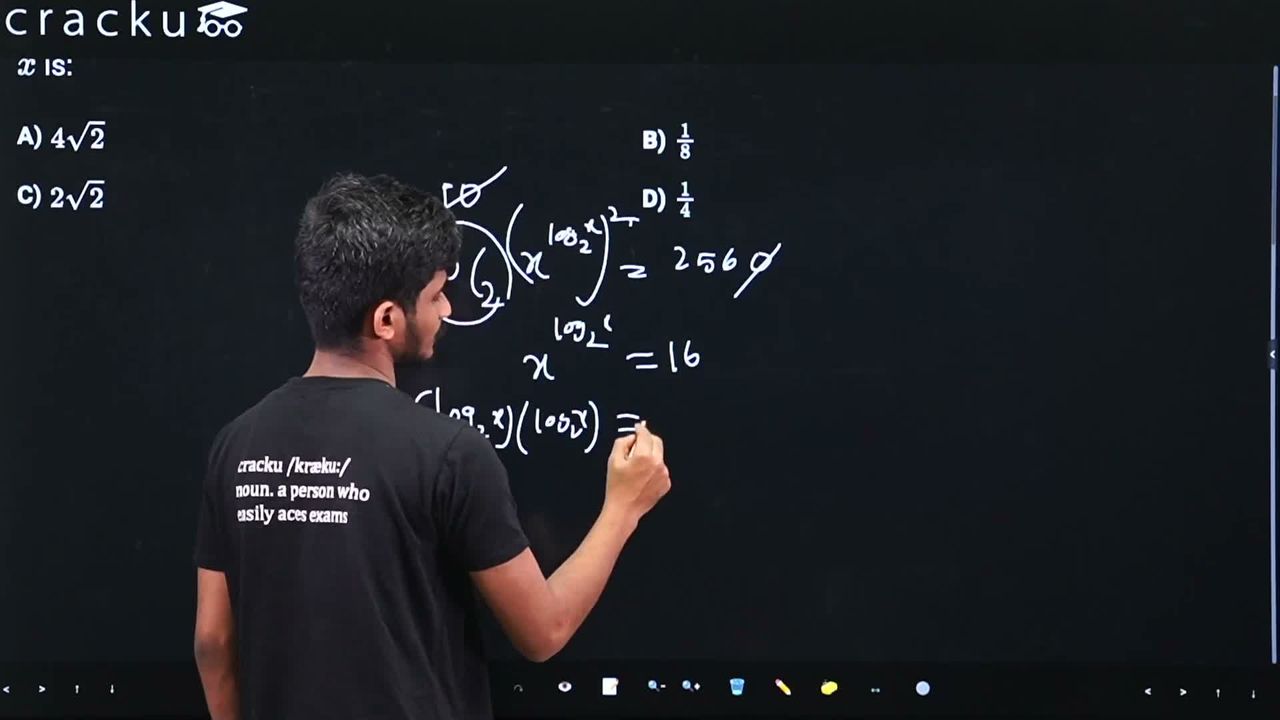
If the third term in the binomial expansion of $$(1 + x^{\log_2 x})^5$$ equals 2560, then a possible value of $$x$$ is:
We recall the binomial theorem, which says that in the expansion of $$(a+b)^n$$ the general term (often called the $$(r+1)^{\text{th}}$$ term, starting the count from $$r=0$$) is
$$T_{r+1}=\,\,{^{n}C_{r}}\,a^{\,n-r}\,b^{\,r}.$$
In the given expression $$(1+x^{\log_{2}x})^{5}$$ we have $$a=1,\;b=x^{\log_{2}x},\;n=5.$$
The third term corresponds to $$r=2$$ (because for the first term $$r=0$$, for the second $$r=1$$, and for the third $$r=2$$). Substituting these values in the formula we obtain
$$T_{3}=\,\,{^{5}C_{2}}\,(1)^{5-2}\,\bigl(x^{\log_{2}x}\bigr)^{2}.$$
Since any power of 1 is 1, the factor $$(1)^{5-2}$$ is simply 1, and we are left with
$$T_{3}=\,\,{^{5}C_{2}}\;x^{2\log_{2}x}.$$
We know that $${^{5}C_{2}}=\dfrac{5!}{2!\,3!}=10,$$ so
$$T_{3}=10\,x^{2\log_{2}x}.$$
The problem states that this third term equals 2560, so we set
$$10\,x^{2\log_{2}x}=2560.$$
Dividing both sides by 10 gives
$$x^{2\log_{2}x}=256.$$
Next we express 256 as a power of 2. We know $$256=2^{8},$$ so the equation becomes
$$x^{2\log_{2}x}=2^{8}.$$
To simplify the left-hand side, let us write $$\log_{2}x=k.$$ Then $$x=2^{k}.$$ Substituting this into the left-hand side gives
$$x^{2\log_{2}x}=(2^{k})^{2k}=2^{k\cdot2k}=2^{2k^{2}}.$$
Therefore our equation is now
$$2^{2k^{2}}=2^{8}.$$
Because the bases are equal, we equate the exponents:
$$2k^{2}=8.$$
Dividing by 2 yields
$$k^{2}=4.$$
Taking square roots,
$$k=\pm2.$$
Recall that $$k=\log_{2}x,$$ so we have two cases:
1. $$\log_{2}x=2\;\;\Longrightarrow\;\;x=2^{2}=4.$$
2. $$\log_{2}x=-2\;\;\Longrightarrow\;\;x=2^{-2}=\dfrac{1}{4}.$$
Both values are positive and hence admissible, but only one of them appears among the given options. Inspecting the options, we see that $$\dfrac{1}{4}$$ is listed, whereas 4 is not.
Hence, the correct answer is Option 4.
Was this solution helpful?
Click on the Email ☝️ to Watch the Video Solution
Create a FREE account and get:
_1.webp)

Educational materials for JEE preparation

Ask our AI anything

AI can make mistakes. Please verify important information.
AI can make mistakes. Please verify important information.
