
Join Our JEE Preparation Group
Prep with like-minded aspirants; Get access to free daily tests and study material.
Sign in
Please select an account to continue using cracku.in
↓ →
Join Our JEE Preparation Group
Prep with like-minded aspirants; Get access to free daily tests and study material.
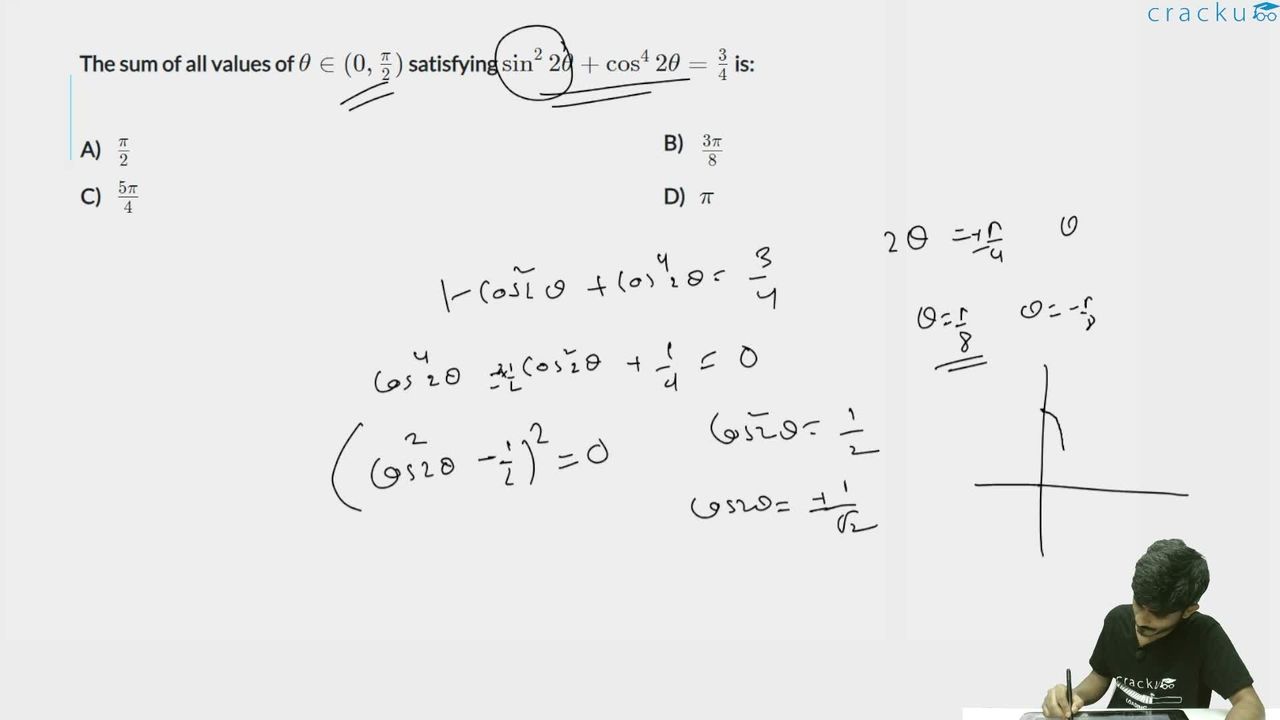
The sum of all values of $$\theta \in (0, \frac{\pi}{2})$$ satisfying $$\sin^2 2\theta + \cos^4 2\theta = \frac{3}{4}$$ is:
We need all angles $$\theta$$ lying in the open interval $$(0,\dfrac{\pi}{2})$$ that satisfy the trigonometric equation
$$\sin^2 2\theta+\cos^4 2\theta=\dfrac34.$$
First, to simplify the expression, we put
$$x=2\theta.$$
Because $$\theta\in(0,\dfrac{\pi}{2})$$, doubling every number in this interval gives
$$x\in(0,\pi).$$
Under this substitution the equation becomes
$$\sin^2 x+\cos^4 x=\dfrac34.$$
Next, we use the Pythagorean identity $$\sin^2 x+\cos^2 x=1.$$ Solving this for $$\sin^2 x$$ gives
$$\sin^2 x=1-\cos^2 x.$$
Substituting this in the transformed equation produces
$$\bigl(1-\cos^2 x\bigr)+\cos^4 x=\dfrac34.$$
Now let us introduce another temporary variable to avoid writing $$\cos$$ repeatedly. Put
$$y=\cos^2 x.$$
Because $$x\in(0,\pi),$$ the value of $$\cos x$$ ranges from ±1 down to 0, so $$y=\cos^2 x$$ must satisfy $$0<y<1.$$
Under this change of variable, the equation simplifies to a quadratic:
$$1-y+y^2=\dfrac34.$$
We move every term to the left so that the right-hand side becomes zero:
$$1-y+y^2-\dfrac34=0.$$
Combining the constant terms on the left, we have
$$y^2-y+\bigl(1-\dfrac34\bigr)=0,$$
so
$$y^2-y+\dfrac14=0.$$
Observe that the left side is a perfect square. Indeed,
$$(y-\dfrac12)^2=y^2-y+\dfrac14.$$
Therefore we can rewrite the quadratic as
$$(y-\dfrac12)^2=0.$$
Solving this gives a single real root
$$y=\dfrac12.$$
But $$y=\cos^2 x,$$ so
$$\cos^2 x=\dfrac12.$$
Taking square roots on both sides, we obtain
$$\cos x=\pm\dfrac1{\sqrt2}.$$
Now we must find every $$x$$ in the interval $$(0,\pi)$$ that satisfies this relation.
We know from basic trigonometry that
$$\cos x=\dfrac1{\sqrt2}\quad\text{at}\quad x=\dfrac{\pi}{4},$$
and
$$\cos x=-\dfrac1{\sqrt2}\quad\text{at}\quad x=\dfrac{3\pi}{4}.$$
Both of these angles indeed lie strictly between $$0$$ and $$\pi,$$ so the corresponding values of $$x$$ are
$$x_1=\dfrac{\pi}{4},\qquad x_2=\dfrac{3\pi}{4}.$$
We now reverse the substitution $$x=2\theta$$ to back-substitute for $$\theta$$:
For $$x_1$$:
$$2\theta_1=\dfrac{\pi}{4}\;\Longrightarrow\;\theta_1=\dfrac{\pi}{8}.$$
For $$x_2$$:
$$2\theta_2=\dfrac{3\pi}{4}\;\Longrightarrow\;\theta_2=\dfrac{3\pi}{8}.$$
Both values $$\dfrac{\pi}{8}$$ and $$\dfrac{3\pi}{8}$$ lie inside the required interval $$(0,\dfrac{\pi}{2}),$$ so they are the only solutions for $$\theta.$$
The question asks for the sum of all such $$\theta.$$ Adding the two values we get
$$\theta_1+\theta_2=\dfrac{\pi}{8}+\dfrac{3\pi}{8}=\dfrac{4\pi}{8}=\dfrac{\pi}{2}.$$
Hence, the correct answer is Option A.
Click on the Email ☝️ to Watch the Video Solution
Create a FREE account and get:
_1.webp)

Educational materials for JEE preparation

Ask our AI anything

AI can make mistakes. Please verify important information.
AI can make mistakes. Please verify important information.


