
Join Our JEE Preparation Group
Prep with like-minded aspirants; Get access to free daily tests and study material.
Sign in
Please select an account to continue using cracku.in
↓ →
Join Our JEE Preparation Group
Prep with like-minded aspirants; Get access to free daily tests and study material.
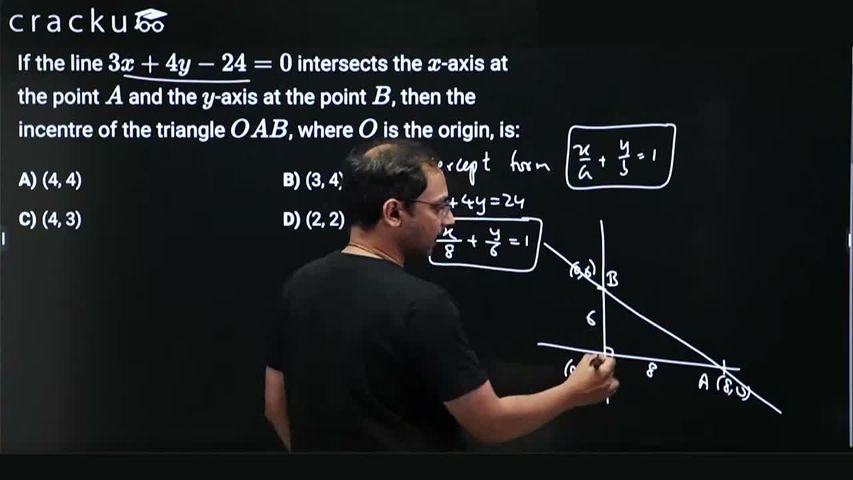
If the line $$3x + 4y - 24 = 0$$ intersects the $$x$$-axis at the point $$A$$ and the $$y$$-axis at the point $$B$$, then the incentre of the triangle $$OAB$$, where $$O$$ is the origin, is:
We have the straight line $$3x + 4y - 24 = 0$$. To find where it cuts the $$x$$-axis, we put $$y = 0$$.
Substituting $$y = 0$$ gives $$3x + 4(0) - 24 = 0 \;\Rightarrow\; 3x - 24 = 0 \;\Rightarrow\; x = \dfrac{24}{3} = 8$$.
So the intersection with the $$x$$-axis is the point $$A(8,\,0)$$.
Next, to find where the same line meets the $$y$$-axis, we set $$x = 0$$.
Putting $$x = 0$$ yields $$3(0) + 4y - 24 = 0 \;\Rightarrow\; 4y - 24 = 0 \;\Rightarrow\; y = \dfrac{24}{4} = 6$$.
Hence the intersection with the $$y$$-axis is the point $$B(0,\,6)$$.
The origin is $$O(0,\,0)$$, so the three vertices of the triangle $$OAB$$ are now fixed: $$O(0,0),\; A(8,0),\; B(0,6)$$.
Let us calculate the three side lengths. Using the distance formula we obtain
$$OA = \sqrt{(8-0)^2 + (0-0)^2} = \sqrt{64} = 8,$$
$$OB = \sqrt{(0-0)^2 + (6-0)^2} = \sqrt{36} = 6,$$
$$AB = \sqrt{(8-0)^2 + (0-6)^2} = \sqrt{64 + 36} = \sqrt{100} = 10.$$
Because $$OA$$ lies along the $$x$$-axis and $$OB$$ lies along the $$y$$-axis, they are perpendicular; so the triangle is right-angled at $$O$$.
In a right triangle with the right angle at the origin and legs on the coordinate axes, the angle bisector of the right angle is the line $$y = x$$. Therefore the incentre must have equal $$x$$ and $$y$$ coordinates. Let us denote the incentre by $$I(r,\,r)$$; the value $$r$$ will in fact be the inradius.
To obtain $$r$$, we first recall the formulas:
1. Semiperimeter: $$s = \dfrac{a + b + c}{2},$$ where $$a, b, c$$ are the side lengths.
2. Relation between area, semiperimeter and inradius: $$\Delta = r\,s.$$
The side lengths we just found are $$a = 8,\; b = 6,\; c = 10$$. Hence
$$s = \dfrac{8 + 6 + 10}{2} = \dfrac{24}{2} = 12.$$
The area of a right triangle is $$\dfrac12 \times (\text{product of the perpendicular sides})$$, so
$$\Delta = \dfrac12 \times 8 \times 6 = 24.$$
Using $$\Delta = r\,s$$, we get
$$24 = r \times 12 \;\Longrightarrow\; r = \dfrac{24}{12} = 2.$$
Thus the incentre is $$I(2,\,2)$$.
Hence, the correct answer is Option D.
Was this solution helpful?
Click on the Email ☝️ to Watch the Video Solution
Create a FREE account and get:
_1.webp)

Educational materials for JEE preparation

Ask our AI anything

AI can make mistakes. Please verify important information.
AI can make mistakes. Please verify important information.
