
Join Our JEE Preparation Group
Prep with like-minded aspirants; Get access to free daily tests and study material.
Sign in
Please select an account to continue using cracku.in
↓ →
Join Our JEE Preparation Group
Prep with like-minded aspirants; Get access to free daily tests and study material.
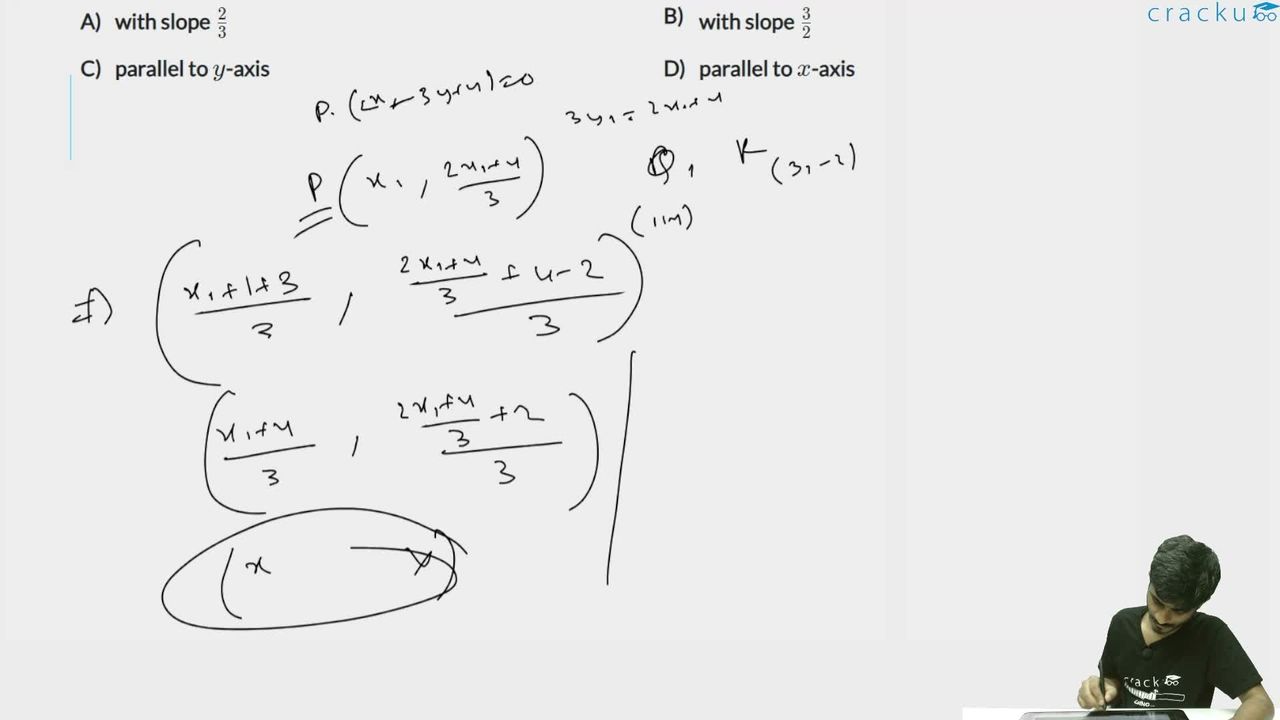
A point $$P$$ moves on the line $$2x - 3y + 4 = 0$$. If $$Q(1, 4)$$ and $$R(3, -2)$$ are fixed points, then the locus of the centroid of $$\triangle PQR$$ is a line:
Let the moving point be $$P(x,\,y)$$. According to the question, $$P$$ always satisfies the straight-line equation $$2x - 3y + 4 = 0$$.
We also have two fixed points: $$Q(1,\,4)$$ and $$R(3,\,-2)$$.
For any triangle with vertices $$P(x,\,y)$$, $$Q(1,\,4)$$ and $$R(3,\,-2)$$, the centroid formula states:
$$\bigl(X,\,Y\bigr)\;=\;\Bigl(\dfrac{x + 1 + 3}{3},\;\dfrac{y + 4 - 2}{3}\Bigr).$$
So the centroid $$G$$ of $$\triangle PQR$$ has coordinates
$$X \;=\;\dfrac{x + 4}{3}, \qquad Y \;=\;\dfrac{y + 2}{3}.$$
Next, we use the condition that $$P(x,\,y)$$ lies on the line $$2x - 3y + 4 = 0$$. Rearranging that equation, we obtain
$$2x - 3y + 4 = 0 \;\;\Longrightarrow\;\; 2x = 3y - 4 \;\;\Longrightarrow\;\; x = \dfrac{3y - 4}{2}.$$
We substitute this expression for $$x$$ into the formula for $$X$$:
$$X \;=\;\dfrac{\dfrac{3y - 4}{2} + 4}{3}.$$
Combining the terms in the numerator,
$$\dfrac{3y - 4}{2} + 4 \;=\;\dfrac{3y - 4 + 8}{2} \;=\;\dfrac{3y + 4}{2}.$$
Thus
$$X \;=\;\dfrac{\dfrac{3y + 4}{2}}{3} \;=\;\dfrac{3y + 4}{6}.$$
From the expression for $$Y$$ we have
$$Y \;=\;\dfrac{y + 2}{3} \;\;\Longrightarrow\;\; y \;=\;3Y - 2.$$
We now eliminate $$y$$ by replacing it in the equation for $$X$$:
$$X \;=\;\dfrac{3(3Y - 2) + 4}{6}.$$
Expanding the numerator gives
$$3(3Y - 2) + 4 \;=\;9Y - 6 + 4 \;=\;9Y - 2,$$
so
$$X \;=\;\dfrac{9Y - 2}{6}.$$
To obtain the relation between $$X$$ and $$Y$$, we cross-multiply:
$$6X \;=\;9Y - 2.$$
Re-arranging,
$$9Y \;=\;6X + 2 \;\;\Longrightarrow\;\; Y = \dfrac{6}{9}X + \dfrac{2}{9}.$$
Simplifying the coefficient,
$$Y \;=\;\dfrac{2}{3}X + \dfrac{2}{9}.$$
This is the equation of a straight line whose slope is $$\dfrac{2}{3}$$. Therefore, the locus of the centroid $$G$$ is a line with slope $$\frac{2}{3}$$.
Hence, the correct answer is Option A.
Click on the Email ☝️ to Watch the Video Solution
Create a FREE account and get:
_1.webp)

Educational materials for JEE preparation

Ask our AI anything

AI can make mistakes. Please verify important information.
AI can make mistakes. Please verify important information.


