
Join Our JEE Preparation Group
Prep with like-minded aspirants; Get access to free daily tests and study material.
Sign in
Please select an account to continue using cracku.in
↓ →
Join Our JEE Preparation Group
Prep with like-minded aspirants; Get access to free daily tests and study material.
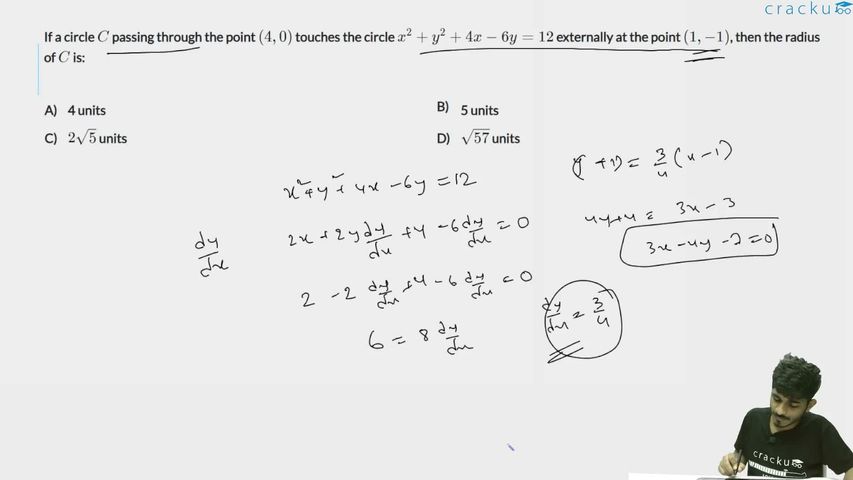
If a circle $$C$$ passing through the point $$(4, 0)$$ touches the circle $$x^2 + y^2 + 4x - 6y = 12$$ externally at the point $$(1, -1)$$, then the radius of $$C$$ is:
We are asked to find the radius of a circle $$C$$ which
• passes through the point $$(4,0)$$, and
• touches the fixed circle $$x^2+y^2+4x-6y=12$$ externally at the common point $$(1,-1)$$.
First, we rewrite the fixed circle in centre-radius form. We complete squares:
$$\begin{aligned} x^2+4x + y^2-6y &= 12 \\ (x^2+4x+4) + (y^2-6y+9) &= 12+4+9 \\ (x+2)^2 + (y-3)^2 &= 25. \end{aligned}$$
So its centre is $$S(-2,\,3)$$ and its radius is $$5$$.
Let the required circle $$C$$ have centre $$P(h,k)$$ and radius $$r$$. Its equation is
$$ (x-h)^2 + (y-k)^2 = r^2. $$
Because $$(4,0)$$ lies on $$C$$, we have
$$ (4-h)^2 + (0-k)^2 = r^2. \qquad (1) $$
Because the two circles touch externally at $$(1,-1)$$, that point lies on $$C$$ as well, giving
$$ (1-h)^2 + (-1-k)^2 = r^2. \qquad (2) $$
Subtracting (2) from (1) eliminates $$r^2$$:
$$\bigl[(4-h)^2+k^2\bigr] - \bigl[(1-h)^2+(-1-k)^2\bigr] = 0.$$
We expand every term explicitly:
$$\begin{aligned} (4-h)^2 &= h^2-8h+16, \\ k^2 &= k^2, \\ (1-h)^2 &= h^2-2h+1, \\ (-1-k)^2 &= k^2+2k+1. \end{aligned}$$
Substituting these expansions we get
$$ \bigl[h^2-8h+16 + k^2\bigr] - \bigl[h^2-2h+1 + k^2+2k+1\bigr] = 0. $$
All $$h^2$$ and $$k^2$$ terms cancel, leaving
$$ -8h +16 -(-2h+2k+2) = 0 \;\Longrightarrow\; -8h +16 +2h -2k -2 = 0. $$
Simplifying,
$$ -6h -2k +14 = 0 \;\Longrightarrow\; 3h + k -7 = 0. $$
Hence
$$ k = 7 - 3h. \qquad (3) $$
Next, because the circles touch externally, the distance between their centres equals the sum of their radii. The distance formula is
$$ \text{Distance}= \sqrt{(x_2-x_1)^2 + (y_2-y_1)^2}. $$
Thus
$$ \sqrt{(h+2)^2 + (k-3)^2} = r + 5. \qquad (4) $$
We square (4) to remove the square root:
$$ (h+2)^2 + (k-3)^2 = (r+5)^2. \qquad (5) $$
Now we express everything in terms of $$h$$ using (3). First we find $$r^2$$ from condition (2):
Using (3) we have $$k = 7-3h$$, so
$$\begin{aligned} r^2 &= (1-h)^2 + (-1-k)^2 \\[2mm] &= (1-h)^2 + (3h-8)^2 \\[2mm] &= (h^2-2h+1) + (9h^2-48h+64) \\[2mm] &= 10h^2 - 50h + 65. \qquad (6) \end{aligned}$$
Next, we expand the left side of (5):
$$\begin{aligned} (h+2)^2 + (k-3)^2 &= (h+2)^2 + (4-3h)^2 \\[2mm] &= (h^2+4h+4) + (9h^2-24h+16) \\[2mm] &= 10h^2 - 20h + 20. \qquad (7) \end{aligned}$$
The right side of (5) is
$$ (r+5)^2 = r^2 + 10r + 25. $$
Equating (7) to that expression and substituting (6) for $$r^2$$, we obtain
$$ 10h^2 - 20h + 20 = (10h^2 - 50h + 65) + 10r + 25. $$
All $$10h^2$$ terms cancel, giving
$$ -20h + 20 = -50h + 90 + 10r. $$
Re-arranging,
$$ 30h - 70 = 10r \;\Longrightarrow\; r = 3h - 7. \qquad (8) $$
Equations (6) and (8) must be consistent, so we substitute $$r = 3h-7$$ into (6):
$$ (3h-7)^2 = 10h^2 - 50h + 65. $$
Expanding the left side,
$$ 9h^2 - 42h + 49 = 10h^2 - 50h + 65. $$
Bringing every term to one side,
$$ 0 = 10h^2 - 50h + 65 - 9h^2 + 42h - 49 = h^2 - 8h + 16. $$
This quadratic factors neatly:
$$ (h-4)^2 = 0 \;\Longrightarrow\; h = 4. $$
Putting $$h=4$$ into (8) gives
$$ r = 3(4) - 7 = 12 - 7 = 5. $$
Therefore, the radius of the required circle $$C$$ is $$5$$ units.
Hence, the correct answer is Option B.
Was this solution helpful?
Click on the Email ☝️ to Watch the Video Solution
Create a FREE account and get:
_1.webp)

Educational materials for JEE preparation

Ask our AI anything

AI can make mistakes. Please verify important information.
AI can make mistakes. Please verify important information.
