
Join Our JEE Preparation Group
Prep with like-minded aspirants; Get access to free daily tests and study material.
Sign in
Please select an account to continue using cracku.in
↓ →
Join Our JEE Preparation Group
Prep with like-minded aspirants; Get access to free daily tests and study material.
Consider a triangular plot $$ABC$$ with sides $$AB = 7$$ m, $$BC = 5$$ m and $$CA = 6$$ m. A vertical lamp-post at the mid-point $$D$$ of $$AC$$ subtends an angle 30$$^{\circ}$$ at $$B$$. The height (in m) of the lamp-post is:
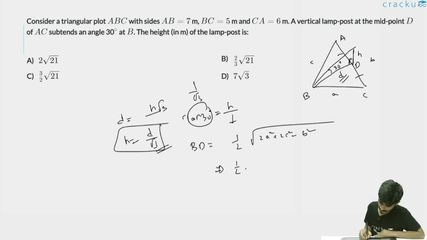
We are given a triangle $$ABC$$ whose sides are $$AB = 7\text{ m}$$, $$BC = 5\text{ m}$$ and $$CA = 6\text{ m}$$. The point $$D$$ is the mid-point of $$AC$$, so $$AD = DC = \dfrac{6}{2} = 3\text{ m}$$. A vertical lamp-post is erected at $$D$$; let its height be $$h\text{ m}$$. From point $$B$$ the top of the lamp-post is seen under an angle of elevation of $$30^{\circ}$$.
Because the lamp-post is vertical, the right-angled triangle that matters is $$\triangle BDT$$, where $$T$$ is the top of the lamp-post. In this right-angled triangle, the horizontal leg is $$BD$$ and the vertical leg is $$DT = h$$. The angle at $$B$$ is $$30^{\circ}$$. By the definition of the tangent of an angle, we have
$$\tan 30^{\circ} \;=\; \dfrac{\text{opposite side}}{\text{adjacent side}} =\dfrac{h}{BD}.$$
So, if we can determine $$BD$$, we can immediately obtain $$h$$. The point $$D$$ is the mid-point of $$AC$$, hence $$BD$$ is a median drawn from vertex $$B$$ to the side $$AC$$. There is a standard formula for the length of a median in a triangle:
For a triangle with sides $$a,\,b,\,c$$ opposite to vertices $$A,\,B,\,C$$ respectively, the length of the median $$m_b$$ from vertex $$B$$ to side $$AC$$ (whose length is $$b$$) is
$$m_b \;=\;\dfrac{1}{2}\sqrt{2a^{2}+2c^{2}-b^{2}}.$$
In our triangle we identify $$a = BC = 5,\quad b = AC = 6,\quad c = AB = 7.$$
Substituting these values into the median formula, we get
$$ \begin{aligned} BD &= m_b \\ &= \dfrac{1}{2}\sqrt{2a^{2}+2c^{2}-b^{2}} \\ &= \dfrac{1}{2}\sqrt{2(5)^{2}+2(7)^{2}-(6)^{2}} \\ &= \dfrac{1}{2}\sqrt{2\cdot25 + 2\cdot49 - 36} \\ &= \dfrac{1}{2}\sqrt{50 + 98 - 36} \\ &= \dfrac{1}{2}\sqrt{112} \\ &= \dfrac{1}{2}\sqrt{16\cdot7} \\ &= \dfrac{1}{2}\cdot4\sqrt{7} \\ &= 2\sqrt{7}\text{ m}. \end{aligned} $$
Now we return to the right-angled triangle $$\triangle BDT$$. We have already stated
$$\tan 30^{\circ} = \dfrac{h}{BD}.$$
We also know the trigonometric value $$\tan 30^{\circ} = \dfrac{1}{\sqrt{3}}$$. Therefore
$$ \begin{aligned} \dfrac{1}{\sqrt{3}} &= \dfrac{h}{2\sqrt{7}} \\[4pt] \Rightarrow h &= \dfrac{2\sqrt{7}}{\sqrt{3}}. \end{aligned} $$
To give the height in a more conventional radical form, we rationalise the denominator:
$$ \begin{aligned} h &= \dfrac{2\sqrt{7}}{\sqrt{3}}\times\dfrac{\sqrt{3}}{\sqrt{3}} \\[4pt] &= \dfrac{2\sqrt{7}\,\sqrt{3}}{3} \\[4pt] &= \dfrac{2\sqrt{21}}{3}\text{ m}. \end{aligned} $$
So the lamp-post is $$\dfrac{2}{3}\sqrt{21}\text{ m}$$ tall.
Hence, the correct answer is Option B.
Was this solution helpful?
Click on the Email ☝️ to Watch the Video Solution
Create a FREE account and get:
_1.webp)

Educational materials for JEE preparation

Ask our AI anything

AI can make mistakes. Please verify important information.
AI can make mistakes. Please verify important information.
