
Join Our JEE Preparation Group
Prep with like-minded aspirants; Get access to free daily tests and study material.
Sign in
Please select an account to continue using cracku.in
↓ →
Join Our JEE Preparation Group
Prep with like-minded aspirants; Get access to free daily tests and study material.
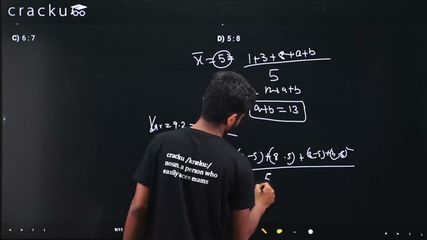
The mean of five observations is 5 and their variance is 9.20. If three of the given five observations are 1, 3 and 8, then a ratio of other two observations is:
We are told that five observations have a mean of $$5$$ and a variance of $$9.20$$. Three of these observations are already known to be $$1,\,3$$ and $$8$$. Let us denote the remaining two unknown observations by $$x$$ and $$y$$.
First we translate the information about the mean into an equation. The mean (average) of $$n$$ numbers is defined as
$$\text{Mean}=\dfrac{\text{Sum of all observations}}{n}.$$
Here $$n=5$$ and the mean is $$5$$, so
$$5=\dfrac{1+3+8+x+y}{5}.$$
Multiplying both sides by $$5$$ gives
$$1+3+8+x+y = 25.$$
Simplifying the left‐hand side, $$1+3+8=12$$, and therefore
$$x+y = 25-12 = 13.$$ So we have our first key relation: $$x+y=13.$$
Next we use the information about the variance. For a set of $$n$$ observations $$x_1,x_2,\ldots,x_n,$$ the population variance is defined as
$$\sigma^2=\dfrac{\sum_{i=1}^{n}(x_i-\bar{x})^2}{n},$$
where $$\bar{x}$$ is the mean. Here $$n=5,$$ $$\bar{x}=5$$ and $$\sigma^2=9.20$$, so
$$9.20=\dfrac{(1-5)^2+(3-5)^2+(8-5)^2+(x-5)^2+(y-5)^2}{5}.$$
Multiplying both sides by $$5$$ yields
$$(1-5)^2\;+\;(3-5)^2\;+\;(8-5)^2\;+\;(x-5)^2\;+\;(y-5)^2 = 9.20\times5.$$
Because $$9.20\times5=46,$$ we write
$$(1-5)^2 + (3-5)^2 + (8-5)^2 + (x-5)^2 + (y-5)^2 = 46.$$
Now we evaluate each known square one by one:
$$\begin{aligned} (1-5)^2 &= (-4)^2 = 16,\\ (3-5)^2 &= (-2)^2 = 4,\\ (8-5)^2 &= 3^2 = 9. \end{aligned}$$
Adding these three gives $$16+4+9=29.$$ Substitute this sum back into the variance equation:
$$29 + (x-5)^2 + (y-5)^2 = 46.$$
Subtracting $$29$$ from both sides we obtain
$$(x-5)^2 + (y-5)^2 = 46 - 29 = 17.$$
So far we have the system of two equations:
$$\begin{cases} x+y = 13,\\ (x-5)^2 + (y-5)^2 = 17. \end{cases}$$
To simplify, introduce new variables $$a$$ and $$b$$ defined by
$$a = x-5,\qquad b = y-5.$$
Then $$a+b = (x-5)+(y-5) = (x+y)-10 = 13-10 = 3.$$
Moreover, $$a^2 + b^2 = 17$$ from the squared‐deviation equation. We now have
$$\begin{cases} a+b = 3,\\ a^2 + b^2 = 17. \end{cases}$$
We square the first relation and use it to find the product $$ab$$. The algebraic identity we need is
$$(a+b)^2 = a^2 + b^2 + 2ab.$$
Substituting $$a+b=3$$ and $$a^2+b^2=17,$$ we get
$$3^2 = 17 + 2ab.$$
Hence
$$9 = 17 + 2ab \quad\Longrightarrow\quad 2ab = 9 - 17 = -8 \quad\Longrightarrow\quad ab = -4.$$
Now $$a$$ and $$b$$ satisfy both $$a+b=3$$ and $$ab=-4.$$ Therefore they are the roots of the quadratic equation
$$t^2 - (a+b)t + ab = 0 \;\Longrightarrow\; t^2 - 3t - 4 = 0.$$
We solve this quadratic using the quadratic formula: $$t = \dfrac{3 \pm \sqrt{(-3)^2 - 4(1)(-4)}}{2} = \dfrac{3 \pm \sqrt{9+16}}{2} = \dfrac{3 \pm 5}{2}.$$
Thus $$t = \dfrac{3+5}{2}=4 \quad\text{or}\quad t = \dfrac{3-5}{2}=-1.$$
Consequently one of $$a,b$$ equals $$4$$ and the other equals $$-1.$$
Recall that $$a = x-5$$ and $$b = y-5,$$ so we have two possibilities:
$$\begin{aligned} \text{(i)}\; a=4 &\;\Longrightarrow\; x=4+5=9,\quad b=-1 \;\Longrightarrow\; y=-1+5=4,\\ \text{(ii)}\; a=-1 &\;\Longrightarrow\; x=-1+5=4,\quad b=4 \;\Longrightarrow\; y=4+5=9. \end{aligned}$$
Either way, the two unknown observations are $$4$$ and $$9$$. Writing them as a ratio,
$$4 : 9.$$
Hence, the correct answer is Option B.
Was this solution helpful?
Click on the Email ☝️ to Watch the Video Solution
Create a FREE account and get:
_1.webp)

Educational materials for JEE preparation

Ask our AI anything

AI can make mistakes. Please verify important information.
AI can make mistakes. Please verify important information.
