
Join Our JEE Preparation Group
Prep with like-minded aspirants; Get access to free daily tests and study material.
Sign in
Please select an account to continue using cracku.in
↓ →
Join Our JEE Preparation Group
Prep with like-minded aspirants; Get access to free daily tests and study material.
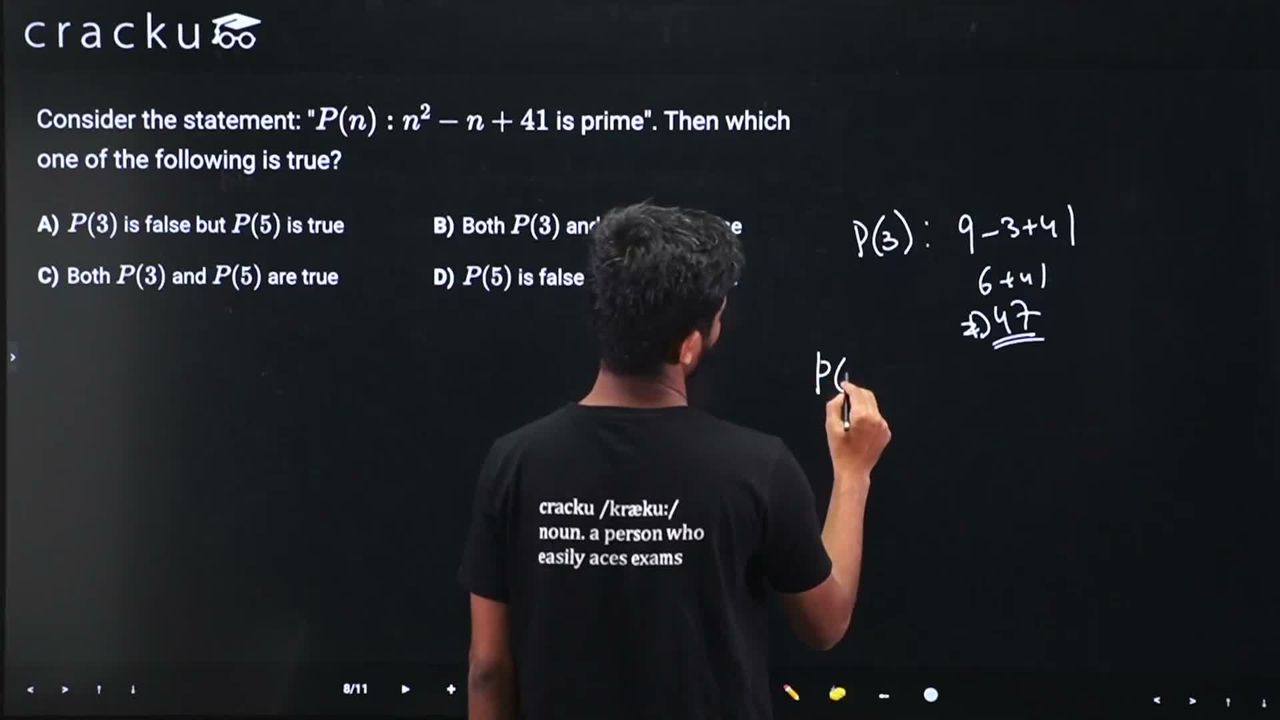
Consider the statement: "$$P(n): n^2 - n + 41$$ is prime". Then which one of the following is true?
We have the statement $$P(n): n^{2}-n+41$$ is prime, and we wish to test it for the two particular natural numbers $$n = 3$$ and $$n = 5$$ that appear in the options.
First we take $$n = 3$$. Substituting $$3$$ into the expression we get
$$\begin{aligned} P(3) &= 3^{2}-3+41 \\ &= 9-3+41 \\ &= 6+41 \\ &= 47. \end{aligned}$$
Now we check whether $$47$$ is prime. A prime number is a positive integer greater than $$1$$ that has no positive divisors other than $$1$$ and itself. The possible prime divisors less than $$\sqrt{47}$$ are $$2,3,5$$. Clearly, $$47$$ is not divisible by $$2$$ because it is odd, not divisible by $$3$$ because the sum of its digits $$4+7=11$$ is not a multiple of $$3$$, and not divisible by $$5$$ because it does not end in $$0$$ or $$5$$. Hence $$47$$ has no divisors other than $$1$$ and $$47$$, so $$47$$ is prime. Therefore $$P(3)$$ is true.
Next we take $$n = 5$$. Substituting $$5$$ into the expression gives
$$\begin{aligned} P(5) &= 5^{2}-5+41 \\ &= 25-5+41 \\ &= 20+41 \\ &= 61. \end{aligned}$$
We again test for primality. The square root of $$61$$ is a little less than $$8$$, so we only need to test divisibility by the primes $$2,3,5,7$$. The number $$61$$ is odd, so it is not divisible by $$2$$. The sum of its digits is $$6+1=7$$, which is not a multiple of $$3$$, so it is not divisible by $$3$$. It does not end in $$0$$ or $$5$$, so it is not divisible by $$5$$. Finally, dividing by $$7$$ gives $$61/7 = 8.714\ldots$$, which is not an integer, so it is not divisible by $$7$$. Thus $$61$$ has no divisors other than $$1$$ and $$61$$, so $$61$$ is prime. Therefore $$P(5)$$ is also true.
We have shown that $$P(3)$$ is true and $$P(5)$$ is true. Comparing with the given options, the only option that matches this outcome is:
Option C: Both $$P(3)$$ and $$P(5)$$ are true.
Hence, the correct answer is Option C.
Was this solution helpful?
Click on the Email ☝️ to Watch the Video Solution
Create a FREE account and get:
_1.webp)

Educational materials for JEE preparation

Ask our AI anything

AI can make mistakes. Please verify important information.
AI can make mistakes. Please verify important information.
