
Join Our JEE Preparation Group
Prep with like-minded aspirants; Get access to free daily tests and study material.
Sign in
Please select an account to continue using cracku.in
↓ →
Join Our JEE Preparation Group
Prep with like-minded aspirants; Get access to free daily tests and study material.
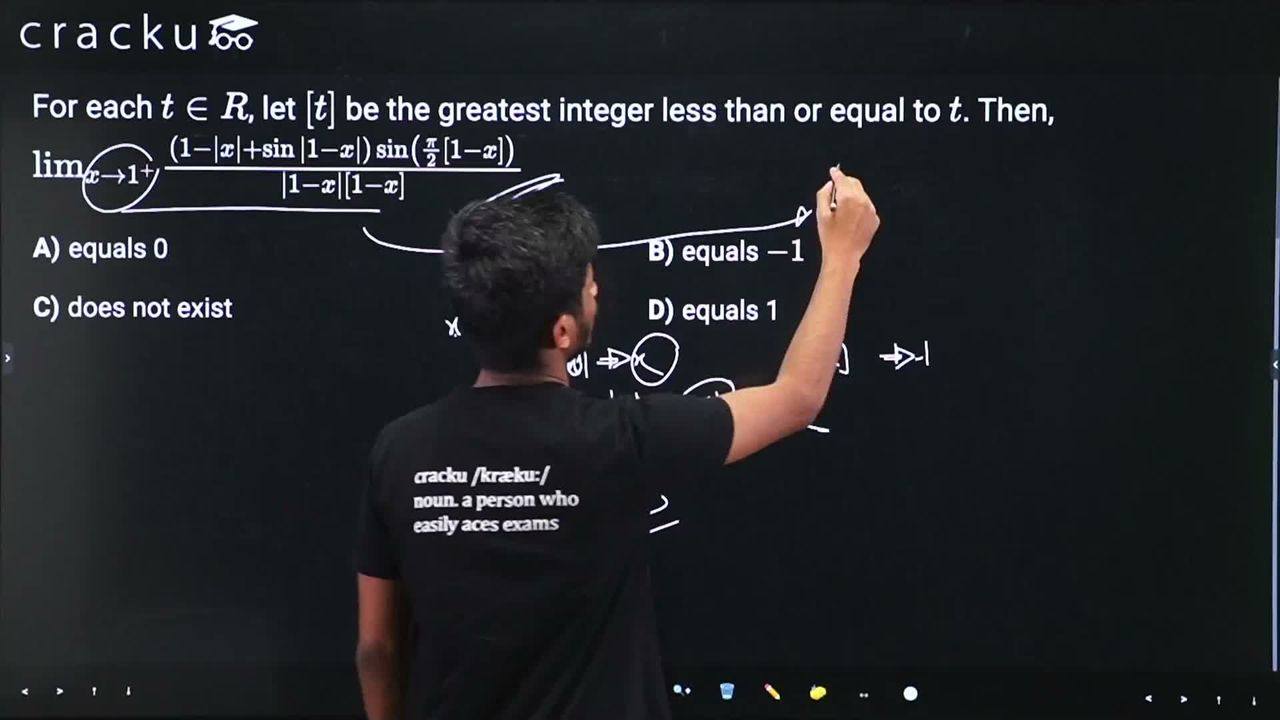
For each $$t \in R$$, let $$[t]$$ be the greatest integer less than or equal to $$t$$. Then, $$\lim_{x \to 1^+} \frac{(1-|x|+\sin|1-x|)\sin\left(\frac{\pi}{2}[1-x]\right)}{|1-x|[1-x]}$$
We have to evaluate the one-sided limit
$$\lim_{x\to 1^{+}}\; \dfrac{ \bigl(1-|x|+\sin|1-x|\bigr)\; \sin\!\left(\dfrac{\pi}{2}\,[\,1-x\,]\right)} {|1-x|\,[\,1-x\,]},$$ where $$[t]$$ denotes the greatest integer less than or equal to $$t$$ (the “greatest-integer” or “floor” function).
Because $$x\to 1^{+}$$ we are interested only in values of $$x$$ that are just a little larger than $$1$$. Write
$$ x = 1+h,\qquad\text{where }h>0\text{ and }h\to 0^{+}. $$
All the pieces of the given expression can now be rewritten in terms of this small positive quantity $$h$$.
First observe that
$$ 1-x \;=\; 1-(1+h)= -h, \qquad\text{so}\qquad |1-x| = |-h| = h. $$
Next we need the value of the floor function $$[\,1-x\,] = [\, -h\,]$$ when $$0<h<1$$. Since $$-1 < -h \le 0,$$ the greatest integer that does not exceed $$-h$$ is $$-1$$. Therefore
$$ [\,1-x\,]= -1\quad\text{for all }x\text{ with }1<x<2. $$
With these elementary facts we can rewrite every factor of the original expression.
(i) The first bracket.
$$ 1-|x|+\sin|1-x| = 1-(1+h)+\sin(h) = -h+\sin h. $$
(ii) The sine containing the floor function.
$$\sin\!\left(\dfrac{\pi}{2}\,[\,1-x\,]\right) =\sin\!\Bigl(\dfrac{\pi}{2}\cdot(-1)\Bigr) =\sin\!\bigl(-\tfrac{\pi}{2}\bigr) =-1.$$
(iii) The entire denominator.
$$ |1-x|\,[\,1-x\,] =h\cdot(-1) =-h. $$
Putting (i), (ii) and (iii) together gives
$$\frac{\bigl(1-|x|+\sin|1-x|\bigr) \sin\!\left(\dfrac{\pi}{2}[1-x]\right)} {|1-x|[1-x]} = \frac{(-h+\sin h)\,(-1)}{-h}.$$
Multiplying out the two minus-signs in the numerator we get
$$ \frac{(-h+\sin h)\,(-1)}{-h} = \frac{h-\sin h}{-h} = -\frac{h-\sin h}{h}. $$
Now recall the standard Maclaurin expansion $$\sin h = h-\dfrac{h^{3}}{6}+O(h^{5})$$ for small $$h$$. Subtracting this from $$h$$ gives
$$h-\sin h = h-\left(h-\dfrac{h^{3}}{6}+O(h^{5})\right) = \dfrac{h^{3}}{6}+O(h^{5}).$$
Therefore
$$-\frac{h-\sin h}{h} = -\frac{\dfrac{h^{3}}{6}+O(h^{5})}{h} = -\left(\dfrac{h^{2}}{6}+O(h^{4})\right).$$
Because the factor in parentheses contains the square of the small quantity $$h$$, it approaches $$0$$ as $$h\to 0^{+}$$. Hence the whole expression tends to $$0$$.
Formally, using the well-known limit $$\displaystyle\lim_{h\to 0}\frac{\sin h}{h}=1,$$ we may write more compactly
$$-\frac{h-\sin h}{h} = -\Bigl(1-\frac{\sin h}{h}\Bigr) \;\xrightarrow[h\to 0]{}\; -(1-1)=0.$$
Thus
$$\boxed{\,\displaystyle\lim_{x\to 1^{+}} \frac{(1-|x|+\sin|1-x|)\sin\!\left(\dfrac{\pi}{2}[1-x]\right)} {|1-x|[1-x]}\;=\;0\,}.$$
Hence, the correct answer is Option A.
Was this solution helpful?
Click on the Email ☝️ to Watch the Video Solution
Create a FREE account and get:
_1.webp)

Educational materials for JEE preparation

Ask our AI anything

AI can make mistakes. Please verify important information.
AI can make mistakes. Please verify important information.
