
Join Our JEE Preparation Group
Prep with like-minded aspirants; Get access to free daily tests and study material.
Sign in
Please select an account to continue using cracku.in
↓ →
Join Our JEE Preparation Group
Prep with like-minded aspirants; Get access to free daily tests and study material.
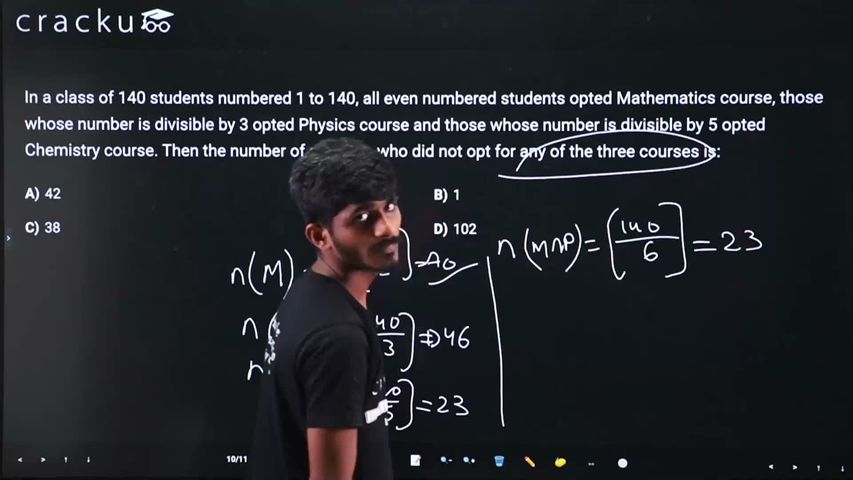
In a class of 140 students numbered 1 to 140, all even numbered students opted Mathematics course, those whose number is divisible by 3 opted Physics course and those whose number is divisible by 5 opted Chemistry course. Then the number of students who did not opt for any of the three courses is:
We are given that the students are numbered from $$1$$ to $$140$$, so the total number of students is
$$|U| = 140.$$
Define three sets:
$$M = \{\text{students whose numbers are divisible by }2\},$$
$$P = \{\text{students whose numbers are divisible by }3\},$$
$$C = \{\text{students whose numbers are divisible by }5\}.$$
Our task is to find the number of students who do not belong to any of these three sets, i.e. the number of students in the complement set $$U - (M\cup P\cup C).$$
First we count each set individually.
• A number is divisible by $$2$$ if it is even. The largest even number ≤ $$140$$ is $$140$$ itself, and half of the numbers from $$1$$ to $$140$$ are even, so
$$|M| = \left\lfloor\frac{140}{2}\right\rfloor = 70.$$
• A number is divisible by $$3$$ if it is a multiple of $$3$$. The greatest multiple of $$3$$ in our range is $$138$$, so
$$|P| = \left\lfloor\frac{140}{3}\right\rfloor = 46.$$
• A number is divisible by $$5$$ if it ends in $$0$$ or $$5$$. The greatest multiple of $$5$$ ≤ $$140$$ is $$140$$, hence
$$|C| = \left\lfloor\frac{140}{5}\right\rfloor = 28.$$
Next we count the pairwise intersections, that is, the students who satisfy two divisibility conditions at once.
• A number is divisible by both $$2$$ and $$3$$ exactly when it is divisible by their least common multiple $$\text{lcm}(2,3)=6$$. Hence
$$|M\cap P| = \left\lfloor\frac{140}{6}\right\rfloor = 23.$$
• A number is divisible by both $$2$$ and $$5$$ when it is a multiple of $$\text{lcm}(2,5)=10$$, so
$$|M\cap C| = \left\lfloor\frac{140}{10}\right\rfloor = 14.$$
• A number is divisible by both $$3$$ and $$5$$ when it is a multiple of $$\text{lcm}(3,5)=15$$, therefore
$$|P\cap C| = \left\lfloor\frac{140}{15}\right\rfloor = 9.$$
Finally, we count the triple intersection, i.e. numbers divisible by $$2,3$$ and $$5$$ simultaneously. These are multiples of $$\text{lcm}(2,3,5)=30$$, so
$$|M\cap P\cap C| = \left\lfloor\frac{140}{30}\right\rfloor = 4.$$
Now we apply the principle of inclusion-exclusion for three sets. The formula is
$$|M\cup P\cup C| = |M| + |P| + |C| - |M\cap P| - |M\cap C| - |P\cap C| + |M\cap P\cap C|.$$
Substituting every value we have just calculated,
$$\begin{aligned} |M\cup P\cup C| &= 70 + 46 + 28 \\ &\quad - (23 + 14 + 9) \\ &\quad + 4 \\ &= 144 - 46 + 4 \\ &= 98 + 4 \\ &= 102. \end{aligned}$$
Thus $$102$$ students chose at least one of the three courses. The students who chose none are the complement of this union inside the universal set of $$140$$ students. Therefore,
$$\text{Number of students choosing no course} = |U| - |M\cup P\cup C| = 140 - 102 = 38.$$
Hence, the correct answer is Option C.
Was this solution helpful?
Click on the Email ☝️ to Watch the Video Solution
Create a FREE account and get:
_1.webp)

Educational materials for JEE preparation

Ask our AI anything

AI can make mistakes. Please verify important information.
AI can make mistakes. Please verify important information.
