Join Our JEE Preparation Group
Prep with like-minded aspirants; Get access to free daily tests and study material.
Sign in
Please select an account to continue using cracku.in
↓ →
Join Our JEE Preparation Group
Prep with like-minded aspirants; Get access to free daily tests and study material.
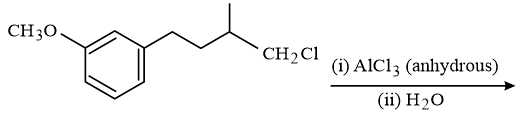
The primary alkyl chloride reacts with the Lewis acid, anhydrous aluminium chloride (AlCl3), to form a complex. Because it is a primary carbon, it can undergo a synchronized hydride shift as the leaving group departs to form a more stable carbocation directly:
The newly formed secondary carbocation is separated from the electron-rich aromatic ring by a chain of CH2 groups. To achieve the most stable intermediate before ring closure, another 1,2-hydride shift occurs along the alkyl chain.
The methoxy group (-OCH3) attached to the benzene ring is a strong ortho/para-directing group due to resonance activation.
Loss of a proton (H+) restores the aromaticity of the benzene ring. The subsequent addition of water (H2O) during the workup step breaks down the aluminum complexes.
The final product is a 6-membered saturated ring fused to the methoxybenzene ring system, specifically forming at the position para to the methoxy group.
Click on the Email ☝️ to Watch the Video Solution
Create a FREE account and get:
_1.webp)

Educational materials for JEE preparation

Ask our AI anything

AI can make mistakes. Please verify important information.
AI can make mistakes. Please verify important information.