
Join Our JEE Preparation Group
Prep with like-minded aspirants; Get access to free daily tests and study material.
Sign in
Please select an account to continue using cracku.in
↓ →
Join Our JEE Preparation Group
Prep with like-minded aspirants; Get access to free daily tests and study material.
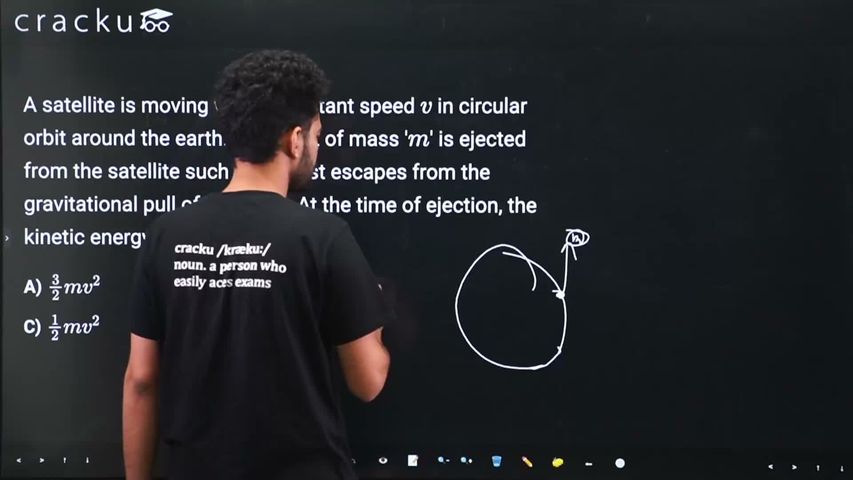
A satellite is moving with a constant speed $$v$$ in circular orbit around the earth. An object of mass '$$m$$' is ejected from the satellite such that it just escapes from the gravitational pull of the earth. At the time of ejection, the kinetic energy of the object is:
First, recall the formula for the speed of a satellite moving in a stable circular orbit of radius $$r$$ around the Earth (mass $$M$$, gravitational constant $$G$$). For circular motion, the required centripetal force is supplied entirely by gravity:
$$\frac{mv^{2}}{r}= \frac{GMm}{r^{2}}.$$
On cancelling the mass $$m$$ of the satellite (or of the object before ejection) and one factor of $$r$$, we get:
$$v^{2}= \frac{GM}{r}, \qquad\text{so}\qquad v = \sqrt{\frac{GM}{r}}.$$
Next, recall the escape-speed formula. The minimum speed required at a distance $$r$$ from the centre of the Earth for an object to reach infinity with zero final speed is
$$v_{e} = \sqrt{\frac{2GM}{r}}.$$
Notice that we can relate this escape speed to the satellite’s orbital speed by substituting $$\displaystyle v^{2}=\frac{GM}{r}$$ just obtained:
$$v_{e} = \sqrt{2}\,\sqrt{\frac{GM}{r}} = \sqrt{2}\,v.$$
The problem says the object is “ejected … such that it just escapes the gravitational pull of the Earth.” Therefore, right after ejection its speed relative to the Earth must be exactly the escape speed $$v_{e}=\sqrt{2}\,v$$.
The kinetic energy of the object of mass $$m$$ at that instant is, by definition,
$$K = \frac{1}{2} m v_{e}^{2}.$$
Substituting $$v_{e}^{2}=2v^{2}$$ obtained above, we get
$$K = \frac{1}{2} m \bigl(2v^{2}\bigr) = m v^{2}.$$
So the kinetic energy equals $$mv^{2}$$.
Hence, the correct answer is Option B.
Was this solution helpful?
Click on the Email ☝️ to Watch the Video Solution
Create a FREE account and get:
_1.webp)

Educational materials for JEE preparation

Ask our AI anything

AI can make mistakes. Please verify important information.
AI can make mistakes. Please verify important information.
