
Join Our JEE Preparation Group
Prep with like-minded aspirants; Get access to free daily tests and study material.
Sign in
Please select an account to continue using cracku.in
↓ →
Join Our JEE Preparation Group
Prep with like-minded aspirants; Get access to free daily tests and study material.
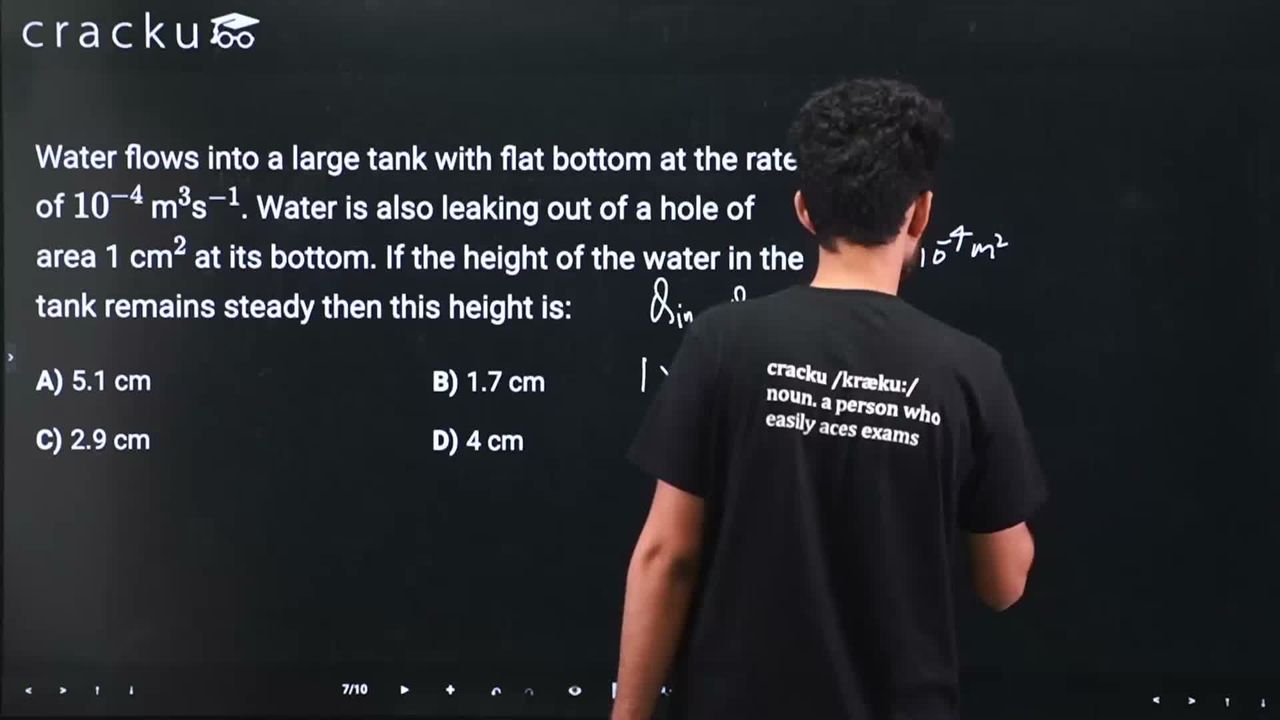
Water flows into a large tank with flat bottom at the rate of $$10^{-4}$$ m$$^3$$s$$^{-1}$$. Water is also leaking out of a hole of area 1 cm$$^2$$ at its bottom. If the height of the water in the tank remains steady then this height is:
We are told that water enters the tank with a volume flow rate $$Q_{\text{in}} = 10^{-4}\, \text{m}^3\text{s}^{-1}$$. At the same time, water leaves through a small hole in the bottom.
The cross-sectional area of this hole is given as $$1\; \text{cm}^2$$. Converting to SI units, $$1\; \text{cm}^2 = 1 \times 10^{-4}\; \text{m}^2$$.
For the speed of efflux of a liquid through a small orifice at depth $$h$$ below the free surface, we use Torricelli’s theorem, which states:
$$v = \sqrt{2gh},$$
where $$g$$ is the acceleration due to gravity (take $$g = 9.8\; \text{m s}^{-2}$$) and $$h$$ is the height of the liquid column above the hole.
The volume flow rate of water leaking out is therefore
$$Q_{\text{out}} = A\,v = (1 \times 10^{-4}) \sqrt{2gh}\; \text{m}^3\text{s}^{-1}.$$
Because the water level is steady, the inflow and outflow rates are equal:
$$Q_{\text{in}} = Q_{\text{out}}.$$
Substituting the expressions for the two flow rates, we have
$$10^{-4} = (1 \times 10^{-4}) \sqrt{2gh}.$$
Dividing both sides by $$1 \times 10^{-4}$$ gives
$$1 = \sqrt{2gh}.$$
Now we square both sides to remove the square root:
$$1^2 = ( \sqrt{2gh} )^2 \;\;\Longrightarrow\;\; 1 = 2gh.$$
Solving for $$h$$:
$$h = \frac{1}{2g}.$$
Substituting $$g = 9.8\; \text{m s}^{-2}$$, we obtain
$$h = \frac{1}{2 \times 9.8} = \frac{1}{19.6} \approx 0.05102\; \text{m}.$$
Converting meters to centimeters:
$$0.05102\; \text{m} = 0.05102 \times 100\; \text{cm} \approx 5.1\; \text{cm}.$$
Hence, the correct answer is Option A.
Was this solution helpful?
Click on the Email ☝️ to Watch the Video Solution
Create a FREE account and get:
_1.webp)

Educational materials for JEE preparation

Ask our AI anything

AI can make mistakes. Please verify important information.
AI can make mistakes. Please verify important information.
