
Join Our JEE Preparation Group
Prep with like-minded aspirants; Get access to free daily tests and study material.
Sign in
Please select an account to continue using cracku.in
↓ →
Join Our JEE Preparation Group
Prep with like-minded aspirants; Get access to free daily tests and study material.
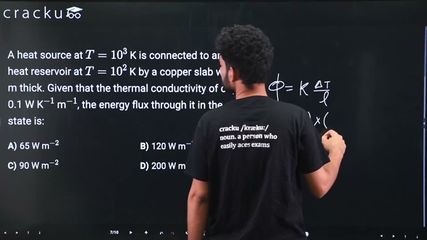
A heat source at $$T = 10^3$$ K is connected to another heat reservoir at $$T = 10^2$$ K by a copper slab which is 1 m thick. Given that the thermal conductivity of copper is 0.1 W K$$^{-1}$$ m$$^{-1}$$, the energy flux through it in the steady-state is:
We recall the steady-state heat conduction law, also called Fourier’s law of thermal conduction. It states that the energy flux $$\phi$$ (heat current density) through a homogeneous slab is given by
$$\phi \;=\; k \,\dfrac{\Delta T}{L}$$
where $$k$$ is the thermal conductivity of the material, $$\Delta T$$ is the temperature difference between the two faces of the slab, and $$L$$ is the thickness of the slab.
For the present problem we have the following data:
Thermal conductivity: $$k = 0.1\; \text{W K}^{-1}\text{ m}^{-1}$$
Temperatures of the reservoirs: $$T_\text{hot} = 10^{3}\; \text{K}$$ and $$T_\text{cold} = 10^{2}\; \text{K}$$
Therefore the temperature difference is
$$\Delta T = T_\text{hot} - T_\text{cold} = 10^{3} - 10^{2} = 1000 - 100 = 900\ \text{K}$$
The thickness of the copper slab is given as $$L = 1\ \text{m}$$.
Now we substitute these values into Fourier’s law:
$$\phi = k \,\dfrac{\Delta T}{L} = 0.1\;\text{W K}^{-1}\text{ m}^{-1} \times \dfrac{900\ \text{K}}{1\ \text{m}}$$
Carrying out the multiplication and division step by step, we first note that dividing by 1 m leaves the numerator unchanged in magnitude and only attaches the correct units:
$$\phi = 0.1 \times 900\ \text{W m}^{-2}$$
Multiplying $$0.1$$ and $$900$$ gives
$$\phi = 90\ \text{W m}^{-2}$$
Thus the steady-state energy flux through the copper slab is $$90\ \text{W m}^{-2}$$.
Looking at the provided options, this value corresponds to Option C.
Hence, the correct answer is Option C.
Was this solution helpful?
Click on the Email ☝️ to Watch the Video Solution
Create a FREE account and get:
_1.webp)

Educational materials for JEE preparation

Ask our AI anything

AI can make mistakes. Please verify important information.
AI can make mistakes. Please verify important information.
