
Join Our JEE Preparation Group
Prep with like-minded aspirants; Get access to free daily tests and study material.
Sign in
Please select an account to continue using cracku.in
↓ →
Join Our JEE Preparation Group
Prep with like-minded aspirants; Get access to free daily tests and study material.
The plane passing through the point $$(4, -1, 2)$$ and parallel to the lines $$\frac{x+2}{3} = \frac{y-2}{-1} = \frac{z+1}{2}$$ and $$\frac{x-2}{1} = \frac{y-3}{2} = \frac{z-4}{3}$$ also passes through the point:
We want a plane which
$$\text{(i)}\; \text{passes through }(4,-1,2),$$
$$\text{(ii)}\; \text{is parallel to the two given lines } \frac{x+2}{3}=\frac{y-2}{-1}=\frac{z+1}{2}\; \text{and}\; \frac{x-2}{1}=\frac{y-3}{2}=\frac{z-4}{3}.$$
From the symmetric form of a line we recall that the numbers in the denominators are the direction ratios (components of a direction vector). Hence
$$\vec{d_1}=(3,\,-1,\,2)$$
is a direction vector of the first line, and
$$\vec{d_2}=(1,\,2,\,3)$$
is a direction vector of the second line.
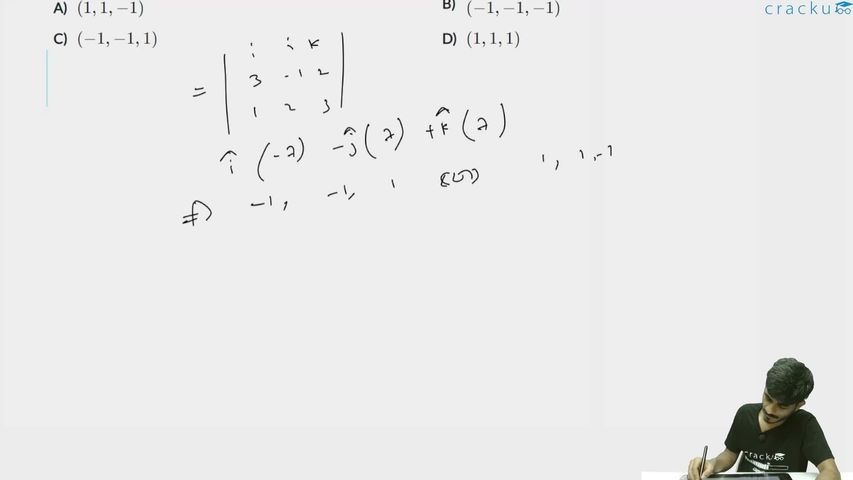
A plane that is parallel to both lines must contain both direction vectors, so its normal vector must be perpendicular to each of them. The normal vector can therefore be obtained via the cross product formula
$$\vec{n}=\vec{d_1}\times\vec{d_2}.$$
Using determinant expansion, we write
$$ \vec{n}= \begin{vmatrix} \mathbf{i} & \mathbf{j} & \mathbf{k}\\ 3 & -1 & 2\\ 1 & 2 & 3 \end{vmatrix} = \mathbf{i}\big((-1)(3)-2\!\cdot\!2\big) -\mathbf{j}\big(3\!\cdot\!3-2\!\cdot\!1\big) +\mathbf{k}\big(3\!\cdot\!2-(-1)\!\cdot\!1\big). $$
Computing each component, we have
$$ \mathbf{i}:\; (-1)(3)-2\!\cdot\!2=-3-4=-7,\\ \mathbf{j}:\; -(3\!\cdot\!3-2\!\cdot\!1)=-(9-2)=-7,\\ \mathbf{k}:\; 3\!\cdot\!2-(-1)\!\cdot\!1=6+1=7. $$
Thus
$$\vec{n}=(-7,\,-7,\,7).$$
Because any non-zero scalar multiple is also a valid normal, we divide by $$-7$$ to obtain the simpler normal
$$\vec{n}=(1,\,1,\,-1).$$
Using the point-normal form of a plane, stated as
$$\vec{n}\cdot\big((x,y,z)-(x_0,y_0,z_0)\big)=0,$$
and substituting $$(x_0,y_0,z_0)=(4,-1,2)$$ and $$\vec{n}=(1,1,-1)$$, we write
$$ (1,1,-1)\cdot\big((x,y,z)-(4,-1,2)\big)=0. $$
This dot product expands to
$$ 1\,(x-4)+1\,(y+1)-1\,(z-2)=0. $$
Simplifying term by term, we get
$$ x-4+y+1-z+2=0\;\;\Longrightarrow\;\;x+y-z-1=0. $$
Therefore the required plane has the Cartesian equation
$$x+y-z=1.$$
Now we test each option by substituting its coordinates into $$x+y-z$$ and checking whether the result equals $$1$$.
Option A: $$(1,1,-1)$$ ⇒ $$1+1-(-1)=3\neq1.$$
Option B: $$(-1,-1,-1)$$ ⇒ $$-1-1-(-1)=-1\neq1.$$
Option C: $$(-1,-1,1)$$ ⇒ $$-1-1-1=-3\neq1.$$
Option D: $$(1,1,1)$$ ⇒ $$1+1-1=1,$$ which satisfies the plane.
Hence, the correct answer is Option D.
Was this solution helpful?
Click on the Email ☝️ to Watch the Video Solution
Create a FREE account and get:
_1.webp)

Educational materials for JEE preparation

Ask our AI anything

AI can make mistakes. Please verify important information.
AI can make mistakes. Please verify important information.
