
Join Our JEE Preparation Group
Prep with like-minded aspirants; Get access to free daily tests and study material.
Sign in
Please select an account to continue using cracku.in
↓ →
Join Our JEE Preparation Group
Prep with like-minded aspirants; Get access to free daily tests and study material.
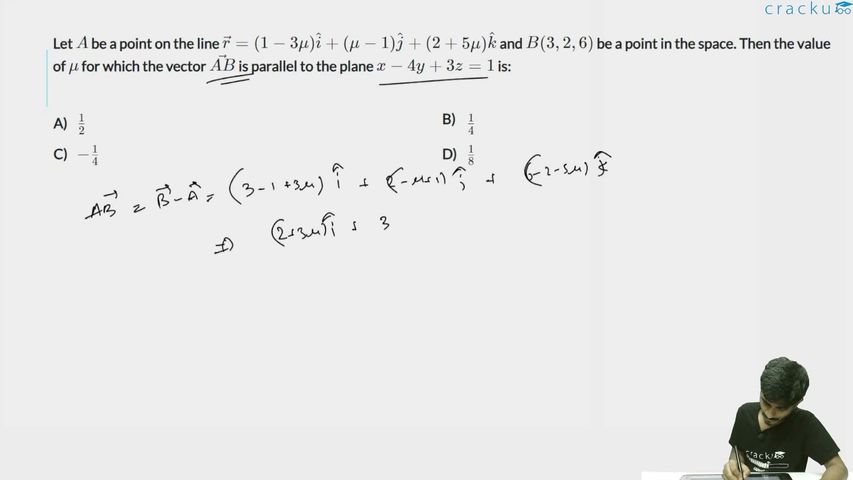
Let $$A$$ be a point on the line $$\vec{r} = (1-3\mu)\hat{i} + (\mu-1)\hat{j} + (2+5\mu)\hat{k}$$ and $$B(3, 2, 6)$$ be a point in the space. Then the value of $$\mu$$ for which the vector $$\vec{AB}$$ is parallel to the plane $$x - 4y + 3z = 1$$ is:
We are given the parametric line $$\vec r=(1-3\mu)\hat i+(\mu-1)\hat j+(2+5\mu)\hat k$$. For a particular value of $$\mu$$ this line produces a point $$A$$ whose coordinates can be read directly from the coefficients of $$\hat i,\,\hat j,\,\hat k$$. Hence we have
$$A\,(\,1-3\mu,\;\mu-1,\;2+5\mu\,).$$
The fixed point $$B$$ is already supplied as $$B\,(3,\,2,\,6).$$
Next we need the vector $$\vec{AB}$$. By definition,
$$\vec{AB}=\overrightarrow{OB}-\overrightarrow{OA},$$
where $$\overrightarrow{OA}$$ and $$\overrightarrow{OB}$$ are the position vectors of $$A$$ and $$B$$ with respect to the origin. Writing the coordinates component-wise we get
$$\vec{AB}=\Big(3-(1-3\mu),\;2-(\mu-1),\;6-(2+5\mu)\Big).$$
Now we simplify each coordinate separately:
$$ \begin{aligned} x\text{-component}&: 3-(1-3\mu)=3-1+3\mu=2+3\mu,\\[2pt] y\text{-component}&: 2-(\mu-1)=2-\mu+1=3-\mu,\\[2pt] z\text{-component}&: 6-(2+5\mu)=6-2-5\mu=4-5\mu. \end{aligned} $$
Thus
$$\vec{AB}=(\,2+3\mu,\;3-\mu,\;4-5\mu\,).$$
We want $$\vec{AB}$$ to be parallel to the plane $$x-4y+3z=1$$. A vector is parallel to a plane precisely when it is perpendicular to the plane’s normal vector. The normal vector of the plane $$x-4y+3z=1$$ is obtained directly from its coefficients:
$$\vec{n}=\hat i-4\hat j+3\hat k=(1,\,-4,\,3).$$
Therefore the condition for parallelism is
$$\vec{AB}\cdot\vec{n}=0.$$
We now compute this dot product step by step:
$$ \begin{aligned} \vec{AB}\cdot\vec{n}&=(2+3\mu)\cdot1+(3-\mu)\cdot(-4)+(4-5\mu)\cdot3\\[4pt] &=(2+3\mu)\;-\;4(3-\mu)\;+\;3(4-5\mu). \end{aligned} $$
Now we expand each product carefully:
$$ \begin{aligned} (2+3\mu)&=2+3\mu,\\ -4(3-\mu)&=-12+4\mu,\\ 3(4-5\mu)&=12-15\mu. \end{aligned} $$
Adding these three expressions gives
$$ 2+3\mu\;+\;(-12+4\mu)\;+\;(12-15\mu)=0. $$
Combine the constant terms first:
$$2-12+12=2.$$
Now combine the $$\mu$$ terms:
$$3\mu+4\mu-15\mu=(3+4-15)\mu=-8\mu.$$
So the full simplification yields
$$2-8\mu=0.$$
We isolate $$\mu$$ by moving the constant term to the right and then dividing:
$$ \begin{aligned} 2-8\mu&=0\\[2pt] -8\mu&=-2\\[2pt] \mu&=\dfrac{-2}{-8}=\dfrac14. \end{aligned} $$
Hence, the correct answer is Option B.
Click on the Email ☝️ to Watch the Video Solution
Create a FREE account and get:
_1.webp)

Educational materials for JEE preparation

Ask our AI anything

AI can make mistakes. Please verify important information.
AI can make mistakes. Please verify important information.


