
Join Our JEE Preparation Group
Prep with like-minded aspirants; Get access to free daily tests and study material.
Sign in
Please select an account to continue using cracku.in
↓ →
Join Our JEE Preparation Group
Prep with like-minded aspirants; Get access to free daily tests and study material.
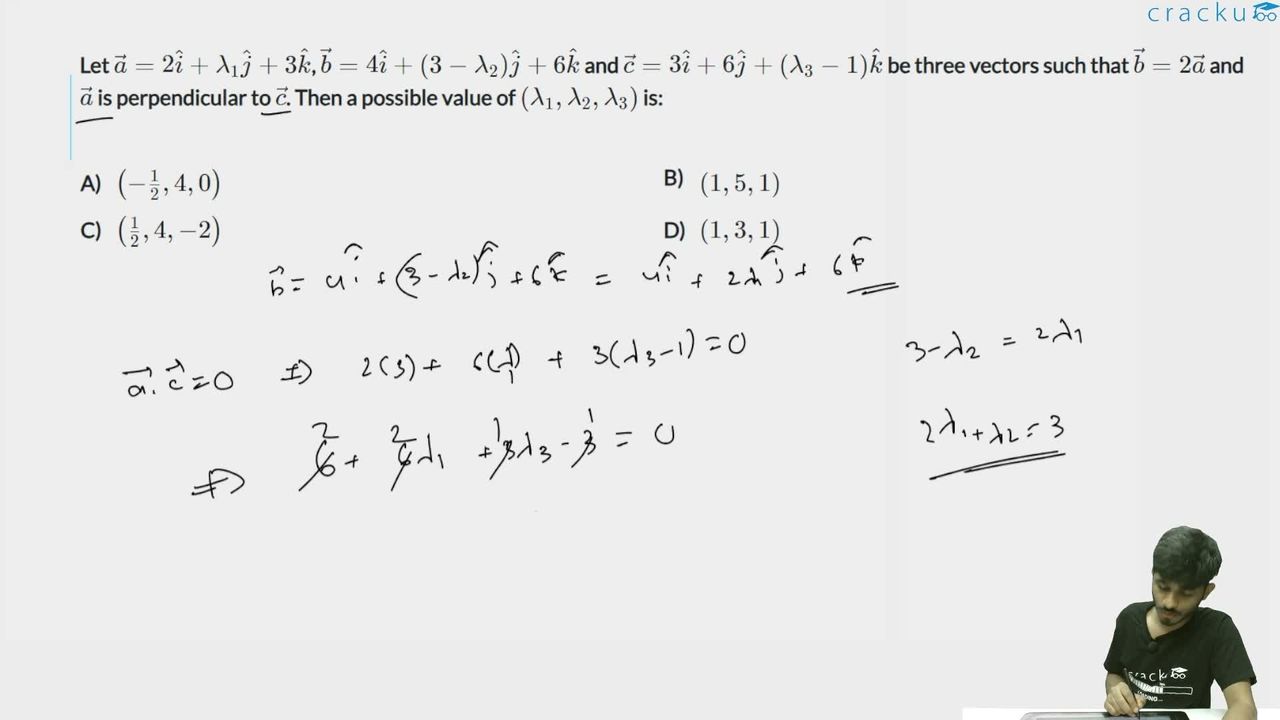
Let $$\vec{a} = 2\hat{i} + \lambda_1\hat{j} + 3\hat{k}$$, $$\vec{b} = 4\hat{i} + (3-\lambda_2)\hat{j} + 6\hat{k}$$ and $$\vec{c} = 3\hat{i} + 6\hat{j} + (\lambda_3 - 1)\hat{k}$$ be three vectors such that $$\vec{b} = 2\vec{a}$$ and $$\vec{a}$$ is perpendicular to $$\vec{c}$$. Then a possible value of $$(\lambda_1, \lambda_2, \lambda_3)$$ is:
We have three vectors given by
$$\vec a = 2\hat i + \lambda_1 \hat j + 3\hat k,$$
$$\vec b = 4\hat i + (3-\lambda_2)\hat j + 6\hat k,$$
$$\vec c = 3\hat i + 6\hat j + (\lambda_3 - 1)\hat k.$$
The first condition in the question is $$\vec b = 2\vec a.$$ We therefore equate each corresponding component of the two vectors.
First write the doubled vector $$2\vec a.$$ Multiplying every component of $$\vec a$$ by 2 gives
$$2\vec a = 2\left(2\hat i + \lambda_1 \hat j + 3\hat k\right) = 4\hat i + 2\lambda_1\hat j + 6\hat k.$$
Now set $$\vec b$$ equal to this result:
$$4\hat i + (3-\lambda_2)\hat j + 6\hat k \;=\; 4\hat i + 2\lambda_1\hat j + 6\hat k.$$
By comparing the $$\hat i$$ components we observe $$4 = 4,$$ which is automatically satisfied.
Comparing the $$\hat j$$ components gives the equation
$$3 - \lambda_2 = 2\lambda_1.$$
Solving this equation for $$\lambda_2$$ we get
$$\lambda_2 = 3 - 2\lambda_1.$$
The $$\hat k$$ components give $$6 = 6,$$ which again is always true, so no further information is obtained from that component.
The second condition is that $$\vec a$$ is perpendicular to $$\vec c.$$ Two vectors are perpendicular if and only if their dot product is zero. Using the dot-product formula $$\vec p\!\cdot\!\vec q = p_x q_x + p_y q_y + p_z q_z,$$ we compute
$$\vec a \cdot \vec c \;=\; 2\cdot3 \;+\; \lambda_1\cdot6 \;+\; 3\cdot(\lambda_3 - 1).$$
Carrying out the multiplications gives
$$6 + 6\lambda_1 + 3(\lambda_3 - 1) = 0.$$
Now expand the last term:
$$6 + 6\lambda_1 + 3\lambda_3 - 3 = 0.$$
Combine the constant terms $$6 - 3 = 3$$ to obtain
$$6\lambda_1 + 3 + 3\lambda_3 = 0.$$
Divide every term by 3 to simplify:
$$2\lambda_1 + 1 + \lambda_3 = 0.$$
Isolating $$\lambda_3$$ gives
$$\lambda_3 = -1 - 2\lambda_1.$$
We now have two relations connecting the three unknowns:
$$\lambda_2 = 3 - 2\lambda_1,$$
$$\lambda_3 = -1 - 2\lambda_1.$$
Any triple $$(\lambda_1,\lambda_2,\lambda_3)$$ that satisfies both relations will meet the required conditions. We check the answer options one by one.
Option A proposes $$\left(-\dfrac12,\;4,\;0\right).$$ Substituting $$\lambda_1 = -\dfrac12$$ into the first relation gives
$$\lambda_2 = 3 - 2\left(-\dfrac12\right) = 3 + 1 = 4,$$
which matches the listed $$\lambda_2 = 4.$$ Substituting the same $$\lambda_1$$ into the second relation gives
$$\lambda_3 = -1 - 2\left(-\dfrac12\right) = -1 + 1 = 0,$$
which also matches the listed $$\lambda_3 = 0.$$ Therefore Option A satisfies both equations.
Option B lists $$(1,\,5,\,1).$$ With $$\lambda_1 = 1,$$ the first relation requires $$\lambda_2 = 3 - 2(1) = 1,$$ but the option gives $$\lambda_2 = 5,$$ so it fails.
Option C lists $$\left(\dfrac12,\,4,\,-2\right).$$ For $$\lambda_1 = \dfrac12,$$ the first relation yields $$\lambda_2 = 3 - 2\left(\dfrac12\right) = 2,$$ whereas the option has $$\lambda_2 = 4,$$ so this also fails.
Option D lists $$(1,\,3,\,1).$$ Again setting $$\lambda_1 = 1$$ forces $$\lambda_2 = 1,$$ but the option gives $$\lambda_2 = 3,$$ so it is incorrect.
Only Option A meets both derived conditions.
Hence, the correct answer is Option A.
Was this solution helpful?
Click on the Email ☝️ to Watch the Video Solution
Create a FREE account and get:
_1.webp)

Educational materials for JEE preparation

Ask our AI anything

AI can make mistakes. Please verify important information.
AI can make mistakes. Please verify important information.
