
Join Our JEE Preparation Group
Prep with like-minded aspirants; Get access to free daily tests and study material.
Sign in
Please select an account to continue using cracku.in
↓ →
Join Our JEE Preparation Group
Prep with like-minded aspirants; Get access to free daily tests and study material.
An unbiased coin is tossed. If the outcome is a head then a pair of unbiased dice is rolled and the sum of the numbers obtained on them is noted. If the toss of the coin results in tail then a card from a well-shuffled pack of nine cards numbered 1, 2, 3, ..., 9 is randomly picked and the number on the card is noted. The probability that the noted number is either 7 or 8 is:
Let us begin with the very first random event. An unbiased coin is tossed. For any unbiased coin we have the fundamental fact $$P(\text{Head})=\frac12 \quad\text{and}\quad P(\text{Tail})=\frac12.$$
Now, we split the entire experiment into two separate branches because what happens after the coin depends on whether we see a head or a tail.
Branch 1 (Head): A pair of unbiased dice is rolled. Each die has six faces, so the ordered pair of results has $$6\times 6 = 36$$ equally likely possibilities. We are asked to find the probability that the sum of the two dice is either $$7$$ or $$8$$.
First we list all ordered pairs giving these sums.
Sum $$7$$: $$(1,6),(2,5),(3,4),(4,3),(5,2),(6,1)\,$$ ⇒ $$6$$ ways.
Sum $$8$$: $$(2,6),(3,5),(4,4),(5,3),(6,2)\,$$ ⇒ $$5$$ ways.
So the count of favourable outcomes on the dice is $$6+5=11.$$ Therefore, using $$P=\dfrac{\text{favourable outcomes}}{\text{total outcomes}},$$ we get
$$P(\text{sum is }7\text{ or }8\;|\;\text{Head})=\frac{11}{36}.$$
Multiplying with the earlier coin probability, the overall contribution from this branch is
$$P(\text{noted number is }7\text{ or }8\;\&\;\text{Head}) \;=\; P(\text{Head})\times P(\text{sum }7\text{ or }8|\text{Head}) \;=\; \frac12 \times \frac{11}{36} \;=\; \frac{11}{72}.$$
Branch 2 (Tail): A single card is drawn at random from nine cards numbered $$1,2,3,\dots,9.$$ Because the deck is well-shuffled, every card is equally likely, so
$$P(\text{any specified card})=\frac19.$$
There are exactly two favourable cards—those showing $$7$$ or $$8$$—so by adding the probabilities (or simply counting favourable numbers) we have
$$P(\text{card is }7\text{ or }8\;|\;\text{Tail})=\frac{2}{9}.$$
Multiplying by the coin probability for a tail, the total contribution from this branch equals
$$P(\text{noted number is }7\text{ or }8\;\&\;\text{Tail}) \;=\; P(\text{Tail})\times P(\text{card }7\text{ or }8|\text{Tail}) \;=\; \frac12 \times \frac{2}{9} \;=\; \frac19.$$
For a common denominator, rewrite $$\frac19=\frac{8}{72}.$$
Finally, because the two branches are mutually exclusive and cover all possibilities, we add their probabilities:
$$\begin{aligned} P(\text{noted number is }7\text{ or }8) &= \frac{11}{72} + \frac{8}{72} \\ &= \frac{19}{72}. \end{aligned}$$
Hence, the correct answer is Option 2.
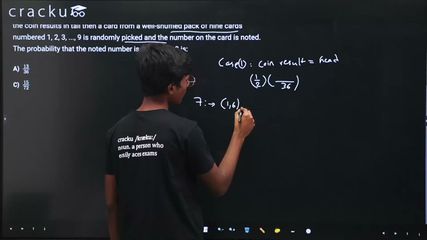
Click on the Email ☝️ to Watch the Video Solution
Create a FREE account and get:
_1.webp)

Educational materials for JEE preparation

Ask our AI anything

AI can make mistakes. Please verify important information.
AI can make mistakes. Please verify important information.


