Join Our JEE Preparation Group
Prep with like-minded aspirants; Get access to free daily tests and study material.
Sign in
Please select an account to continue using cracku.in
↓ →
Join Our JEE Preparation Group
Prep with like-minded aspirants; Get access to free daily tests and study material.
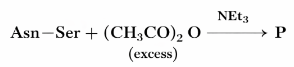
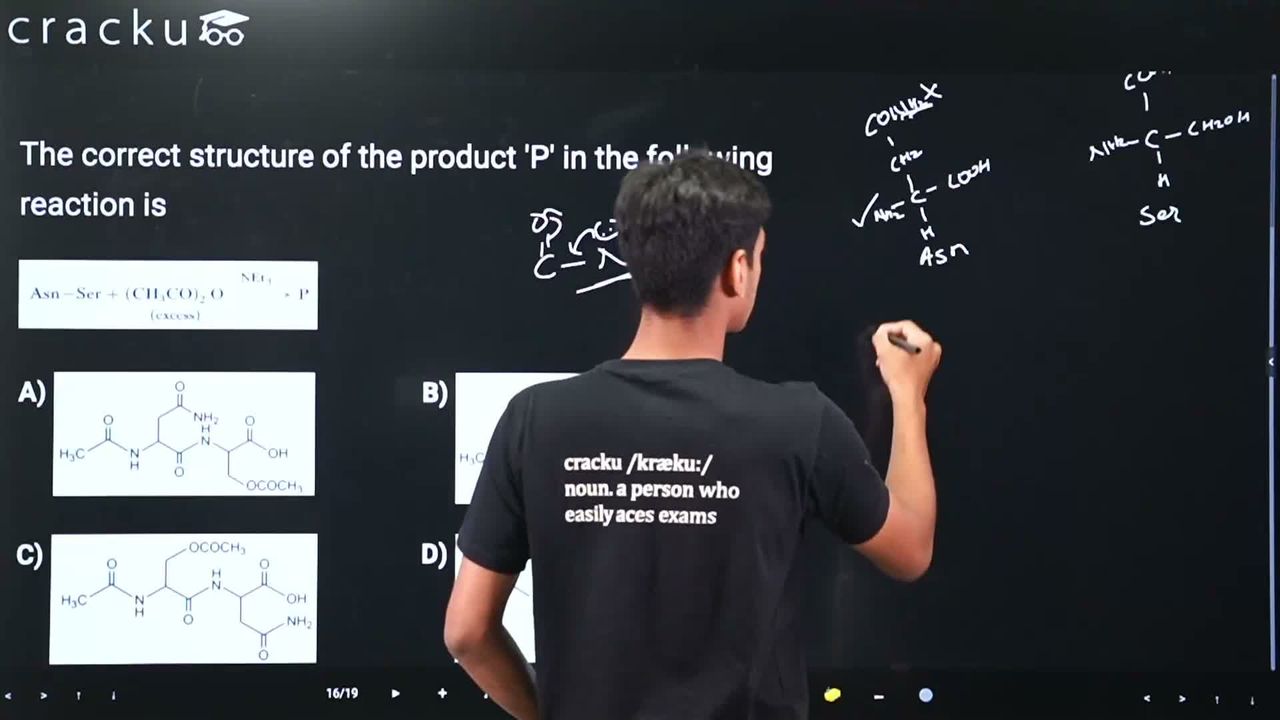
The starting material is a dipeptide composed of two amino acids: Asparagine (Asn) at the N-terminus and Serine (Ser) at the C-terminus. Combined, they contain several nucleophilic functional groups capable of reacting:
The reagents are acetic anhydride (CH3CO)2O in excess and triethylamine (NEt3) as a base.
This is an acetylation reaction. Acetic anhydride introduces acetyl groups (CH3CO-) to nucleophilic atoms like nitrogen and oxygen. Because it is explicitly added in excess, every nucleophilic group that is strong enough to react will become fully acetylated.
Not all nitrogen and oxygen atoms in a peptide react equally with acetic anhydride. Here is how they behave:
Click on the Email ☝️ to Watch the Video Solution
Create a FREE account and get:
_1.webp)

Educational materials for JEE preparation

Ask our AI anything

AI can make mistakes. Please verify important information.
AI can make mistakes. Please verify important information.